Vecura
PricingSolutions
Resources
Vecura

Product

  • Solutions
  • Pricing
  • Referral Program

Company

  • Contact us
  • Academic Research Program

Resources

  • Updates
  • News
  • Insights
  • Use Cases
  • AI4Life Bootcamp
  • Community

Legal

  • Privacy Policy
  • Terms of Service
  • Citation Guidelines
  • Trust Center

© 2026 NYB AI. All rights reserved.

All systems operational
Vecura
PricingSolutions
Resources

Use Cases

How teams use Vecura.

Real workflows and results from discovery teams using Vecura across drug discovery and life science research.

Looking for a replay rather than a guide?

Watch the Vecura agent run real jobs end to end, then try them with your own inputs.

Open the gallery

Browse by what you work on

14 guides in 4 groups

Proteins4Small molecules and drugs6Antibodies and TCRs1Peptides and binders2More use cases1
  • Proteins4
    • Docking and interactions3
    • Design and engineering1
  • Small molecules and drugs6
    • Design and optimization3
    • Screening and targets2
    • Properties and safety1
  • Antibodies and TCRs1
    • Generation and optimization1
  • Peptides and binders2
    • Binder design2
  • More use cases1

Run it, don't just read it

Every guide here has agent replays in the Vecura app.

Open the gallery

Proteins

4 guides

Docking and interactions

3 guides

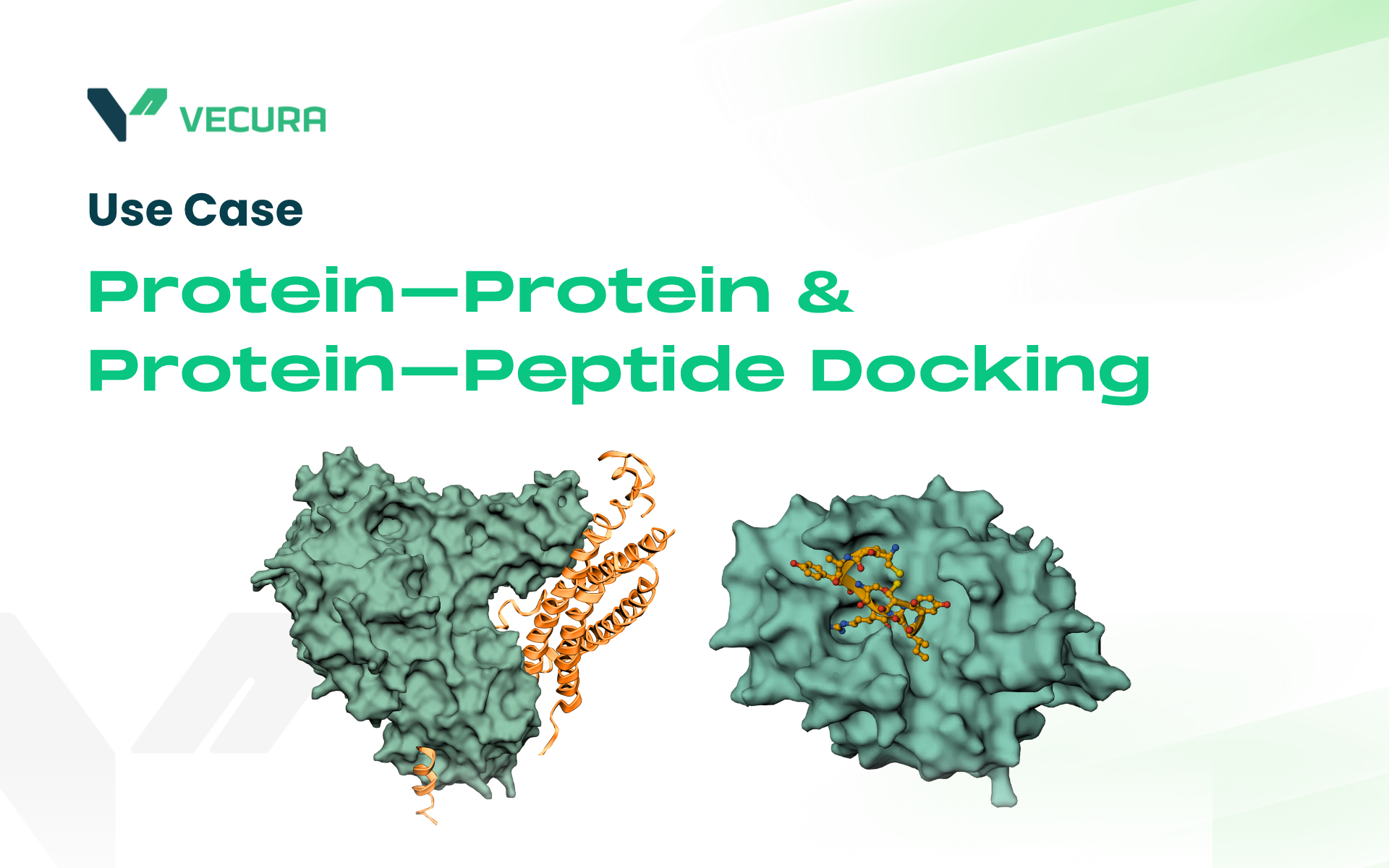
Protein–protein & protein–peptide docking on Vecura

Vecura offers four operations for modelling how a protein binds another protein or a peptide, from fast geometric pose prediction to physics-guided integrative docking, ΔΔG mutation scanning, and restraint-file generation. The four operations are: protein-protein docking, protein-peptide docking, protein-protein binding change prediction, and docking restraint sampling. Choosing the right operation before selecting a model prevents fitting the wrong tool to the question. The sections below describe what each operation produces and which models serve it.
Oct 21, 2026

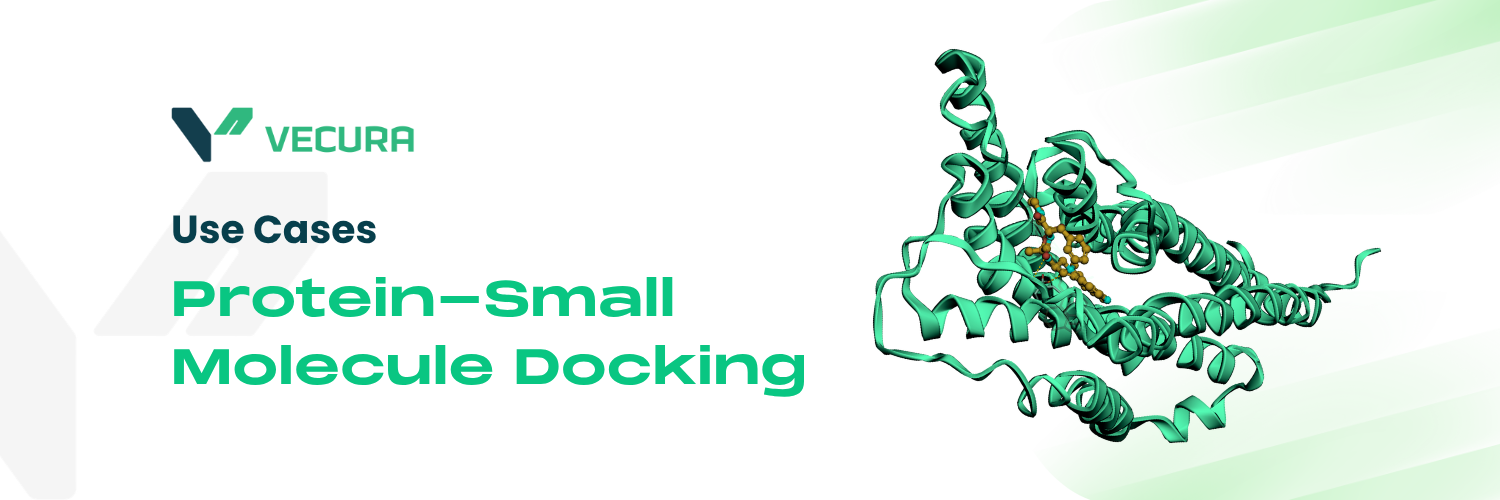
Protein–small molecule docking on Vecura

Getting a small molecule into the right pocket is one problem. Knowing whether the pose you got is any good is another. Vecura splits small-molecule docking into four separate operations so you're not forced through steps you don't need: predicting a binding pose, scoring the resulting interaction, refining a pose and estimating binding free energy.

Oct 14, 2026

Molecular Docking on Vecura: Models, Methods & Use Cases

Every drug begins as a question: does this molecule fit? Molecular docking answers that question computationally by predicting how a small molecule, peptide, or protein settles into a binding site and estimating how tightly it holds. What once required weeks of crystallography or biochemical assay can now be explored in minutes, at scale, before a single compound is synthesized.

Jun 19, 2026

Design and engineering

1 guide

Protein Structure Prediction on Vecura: Models, Methods & Use Cases

From AlphaFold2’s breakthrough accuracy to Boltz‑2’s binding affinity predictions, protein structure prediction has leapt from theory into everyday research. On Vecura, scientists can now fold single chains in seconds, model complex assemblies, design antibodies, and even tackle cyclic peptides — all with AI‑powered precision. This guide breaks down the models, their strengths, and how to choose the right one for your experiment.

Jun 17, 2026

Small molecules and drugs

6 guides

Design and optimization

3 guides

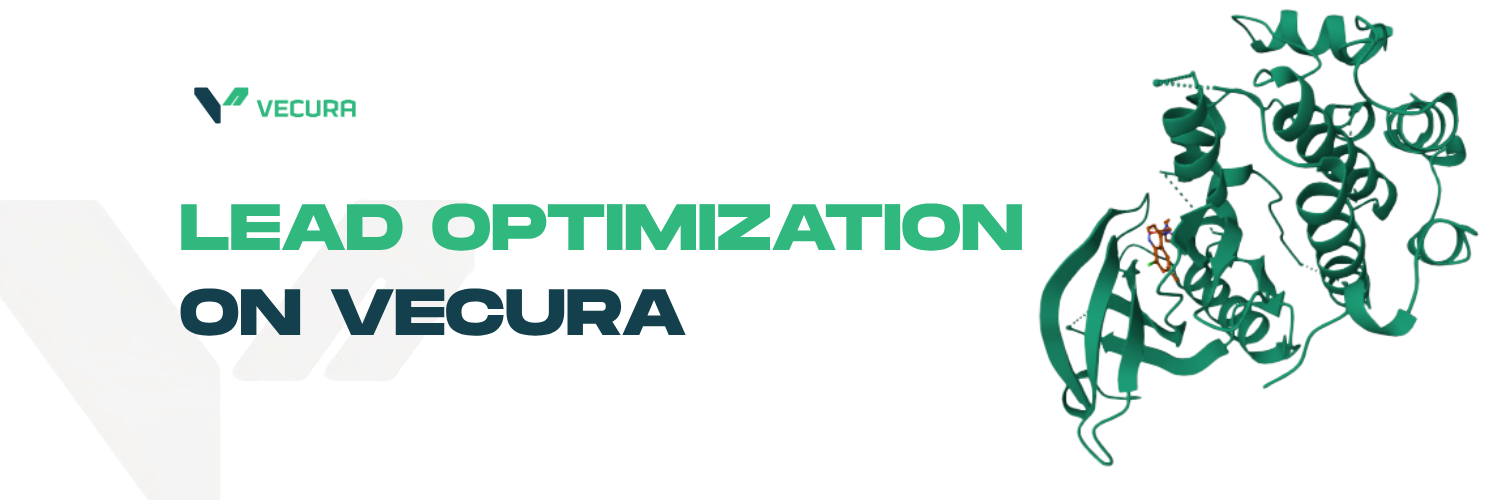
Lead Optimization on Vecura: Models, Methods & Use Cases

Jul 11, 2026

Small Molecule Design on Vecura: Models, Methods & Use Cases

Every approved pill began as an idea about a molecule — a specific arrangement of atoms that could bind a target, survive the body, and be made at scale. Getting from that idea to a viable compound is the hardest, slowest, most expensive part of drug discovery. Small molecule design is the discipline of engineering those compounds computationally, before a single reaction is run at the bench.

Jul 7, 2026

NVIDIA BioNemo Model Use case: Using GenMol in a Molecule Optimization Workflow

This workflow on Vecura uses GenMol – a model belonging to the BioNeMo collection, to turn a single flagged compound into a batch of drug-like alternatives in seconds, then validates every one of them so a chemist can act on the results with confidence.

Jul 3, 2026

Screening and targets

2 guides

Drug Repurposing / Target Interaction on Vecura: Models, Methods & Use Cases

The fastest path to a new medicine is often through an old one. Identifying which approved or investigational molecules bind a new target — and how tightly — is the central computational challenge of drug repurposing. On Vecura, scientists get one-click access to a full, integrated stack of drug-target interaction and repurposing tools — from ultrafast genome-scale DTI screening to physics-grade binding free energy calculations — without leaving the browser.

Jul 15, 2026

Virtual Screening on Vecura: Models, Methods & Use Cases

Virtual screening has transformed drug discovery, turning a slow, billion‑dollar process into a fast, computational workflow. On Vecura, researchers can access over 300 AI‑powered models covering every stage of the pipeline: from structure prediction and docking to binding affinity, ADMET prediction, and generative chemistry. This guide shows how to choose the right tools to accelerate your path from target to therapeutic.

Jun 22, 2026

Properties and safety

1 guide

Pharmacokinetic-Pharmacodynamic Toxicity Prediction on Vecura: Models, Methods & Use Cases

Jun 26, 2026

Antibodies and TCRs

1 guide

Generation and optimization

1 guide

Antibody Design on Vecura: Models, Methods & Use Cases

Jul 21, 2026

Peptides and binders

2 guides

Binder design

2 guides

Protein / Peptide Binder Design on Vecura: Models, Methods & Use Cases

Protein, binder, and peptide design have long been bottlenecked by combinatorial complexity, structural uncertainty, and empirical validation overhead. Vecura dismantles these barriers with an integrated suite of state-of-the-art generative and predictive AI models—accessible via intuitive web interfaces, Python SDKs, and automated pipelines. Critically, Vecura bridges the “design–test–learn” cycle: generated sequences are automatically routed to partner wet-lab providers for expression, binding assays (SPR/BLI), and functional readouts—with results feeding back into iterative model refinement.

Jul 17, 2026

NVIDIA BioNeMo Model Use Case: Using Proteina-Complexa to Generate a Binder Against NEK2 at the ATP-Binding Site

How the Vecura platform uses Proteina-Complexa to generate a complete binder-target complex in under three minutes, producing a dense, analyzable interface near the NEK2 ATP pocket for downstream scoring.

Jul 3, 2026

More use cases

Guides that aren't filed under a group yet.

1 guide

Explore NVIDIA BioNeMo Models on Vecura

This update focuses on BioNeMo’s open‑source models, which are now available on Vecura with no‑code access. By making these models openly available, BioNeMo empowers scientists to design novel molecules, predict structures, and accelerate drug discovery workflows, all while lowering the barrier to entry for advanced AI in life sciences.

Jul 1, 2026
Vecura

Product

  • Solutions
  • Pricing
  • Referral Program

Company

  • Contact us
  • Academic Research Program

Resources

  • Updates
  • News
  • Insights
  • Use Cases
  • AI4Life Bootcamp
  • Community

Legal

  • Privacy Policy
  • Terms of Service
  • Citation Guidelines
  • Trust Center

© 2026 NYB AI. All rights reserved.

All systems operational