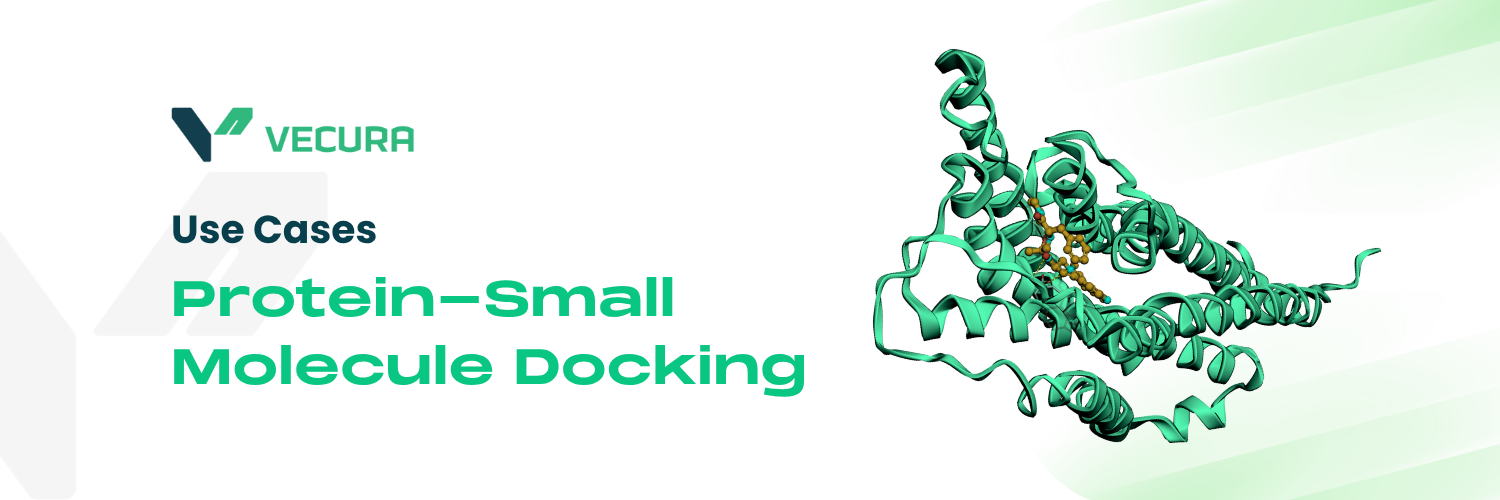
Protein–small molecule docking on Vecura
Getting a small molecule into the right pocket is one problem. Knowing whether the pose you got is any good is another. Vecura splits small-molecule docking into four separate operations so you're not forced through steps you don't need: predicting a binding pose, scoring the resulting interaction, refining a pose and estimating binding free energy.
Which one to start from depends on what you already have in hand and how rigorous the answer needs to be, the table below sorts that out.
Choosing an operation
| What you have | What you want | Use | Typical runtime |
| Protein structure + ligand SMILES | 3D binding pose(s) ranked by predicted binding affinity | Protein-small molecule docking | 1–30 minutes (depends on method and ligand count) |
| Docked protein–ligand complex (receptor + pre-positioned ligand) | Per-residue interaction fingerprint | Protein-ligand interaction scoring | Seconds to minutes |
| Receptor PDB + pre-positioned 3D ligand pose | Energy-minimized pose with CNN refinement | Docking pose optimization | 1–5 minutes |
| Protein–ligand complex (receptor + docked ligand) | Binding free energy (ΔG) | Binding energy parameter optimization | 5 minutes (energy minimization) to 1+ hour (full MD) |
The single biggest practical tradeoff here is depth versus runtime. Classical Vina-style methods (AutoDock-Vina, smina, gnina) are fast, interpretable, and grounded in decades of benchmarking, but need a user-defined search box and treat the receptor as rigid by default. Deep-learning diffusion and flow-matching models (DiffDock, DynamicBind, FlowDock, SurfDock, SigmaDock, PocketXMol) dock blind, handle flexibility implicitly, and generalise to novel sites, at the cost of compute time and scoring transparency. MM/GB(PB)SA (Uni-GBSA) is the most physics-grounded and the most accurate for rank-ordering a small focused set, but it is the slowest and needs a pre-docked pose as input.
The operations
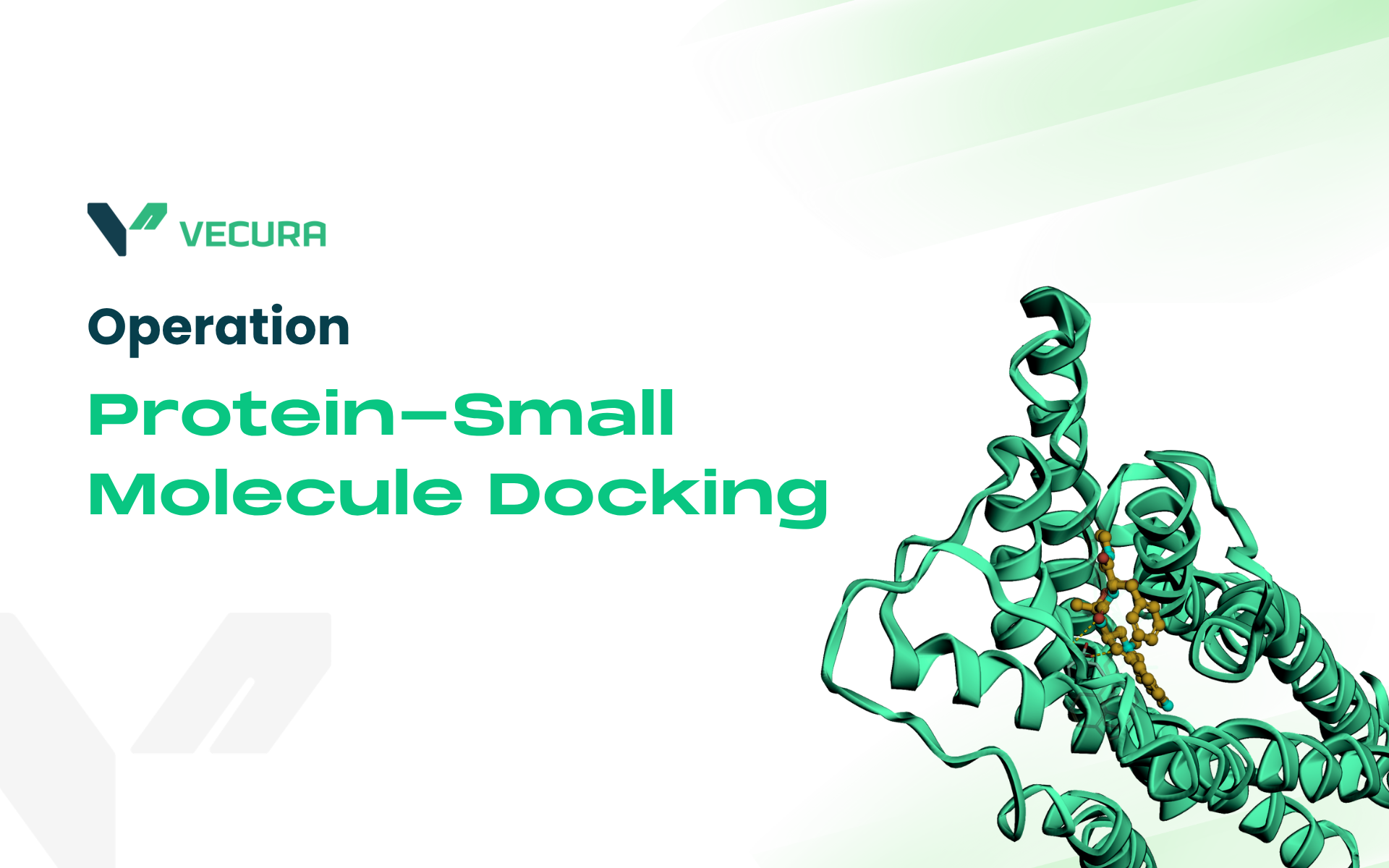
Protein-small molecule docking
 Use case replayProtein-Small Molecule DockingSee this use case
Protein-small molecule docking predicts the three-dimensional binding pose of a ligand within a protein receptor, returning scored conformations ranked by estimated binding affinity.
Use this operation at the start of any structure-based campaign, whether you are screening a library or placing a single lead compound. It precedes pose optimization (which refines an existing pose rather than generating new ones) and interaction scoring (which annotates a pose already in hand).
Input
Receptor PDB; ligand as SMILES, SDF, or MOL2; optional search box coordinates
Output
Ranked 3D pose ensemble (SDF/PDB); predicted binding scores
Which model.
AutoDock-Vina, smina and gnina are one lineage, and choosing between them is really choosing how far up it you need to go.
-
AutoDock-Vina is the canonical open-source engine, scoring poses with a hybrid empirical/knowledge-based function over a user-defined grid box — the reproducible, well-cited baseline and the fastest of the three.
-
smina is a maintained fork that adds alternative scoring functions (vina, vinardo, AD4) and true minimization to convergence; take it over Vina when you want to compare scoring functions on the same poses, or need rigorous local minimization before Uni-GBSA.
-
gnina extends smina with a CNN rescoring layer trained on PDB complexes, applicable at three stages — rescore only, refinement, or full CNN-driven docking — and it supports covalent docking, making it the classical-tier choice for reactive compounds.
Beyond that lineage, eight deep-learning models solve different variants of the same problem:
| Model | Approach | Reach for it when |
| DiffDock | Diffusion over ligand translation, rotation and torsions; no search box | The binding site is unknown, or cryptic pockets should be explored |
| DynamicBind | Equivariant diffusion with an explicit receptor flexibility model | You only have an apo or AlphaFold structure and expect induced fit |
| EquiBind | SE(3)-equivariant, single forward pass, no iterative sampling | Runtime dominates — large screens where the top pose is refined later |
| FlowDock | Geometric flow-matching; also predicts a binding affinity score | You want geometry and affinity from one model |
| SigmaDock | Fragment-based SE(3) diffusion — decomposes the ligand, then reassembles it in the site | Ligands are large or flexible and whole-ligand diffusion struggles |
| SurfDock | SE(3) diffusion over molecular surface representations | Binding sites are shallow or featureless and grid methods underperform |
| PocketXMol Docking | Pocket-conditioned generation | You want tighter control of the search space than blind diffusion gives |
| PandaDock | Vina-style pose generation plus GNN rescoring; accepts MOL2 | You want a physics-based search paired with learned scoring, or GNN rescoring of poses from another method (PandaDock also serves interaction scoring, below) |
Not a pose model: BoltzMol-1 is a small-molecule hit-discovery pipeline built around an optimised version of Boltz-2, adding medicinal-chemistry filters and ADMET property models to rank compounds from commercial catalogs. It prioritises molecules rather than predicting poses, don’t use it as a consensus pose source alongside the models above.
Protein-ligand interaction scoring
 Use case replayProtein-Ligand Interaction ScoringSee this use case
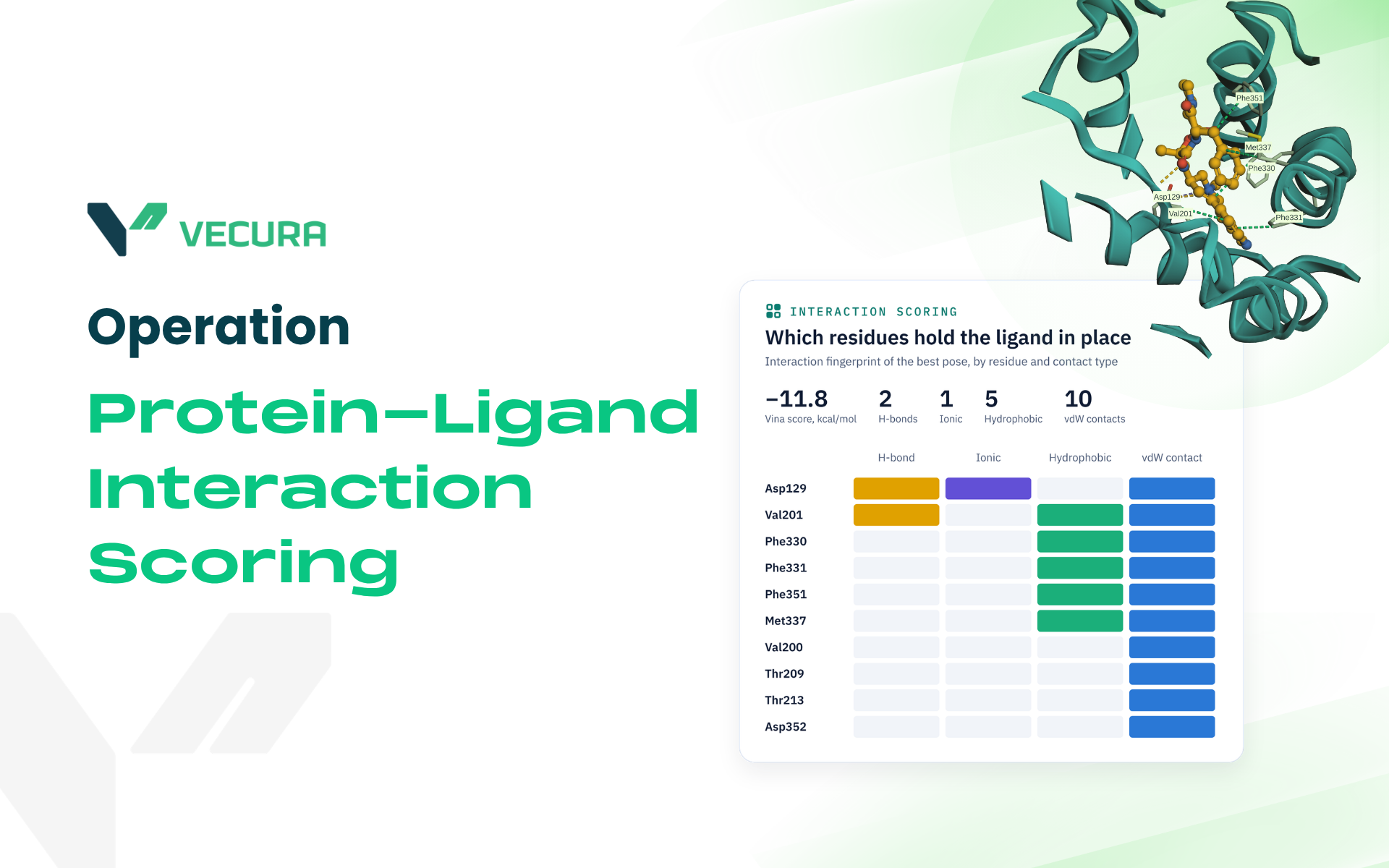
Protein-ligand interaction scoring analyses a bound complex and catalogues every non-covalent contact between the ligand and the receptor at residue or atom resolution.
Use this operation after docking to understand why a pose scores well, for example, to confirm that a pharmacophoric hydrogen bond donor is engaging its target residue, or to identify a buried hydrophobic contact that will guide R-group optimisation. It complements pose optimization (which alters geometry) and binding energy parameter optimization (which quantifies thermodynamic stabilisation), but unlike those operations it does not modify coordinates or produce free energies.
Input
Receptor PDB + ligand pose (SDF, MOL2, or co-crystallised HETATM)
Output
Interaction fingerprint table (H-bond, hydrophobic, π-stacking, salt bridge, halogen bond, metal, VdW, water bridge per residue); optionally GNN-derived pK or pKd estimate
Which model. Five models take a pose already in hand and either characterise it or score it:
| Model | What it produces | Reach for it when |
| ProLIF | Rule-based interaction fingerprint per residue: H-bonds, hydrophobic, π-stacking, salt bridges, halogen bonds, metal coordination, VdW, water bridges | You need a human-readable answer to “which residues are engaged?” — it gives no affinity estimate |
| PandaDock | Vina-style rescoring plus GNN score, accepts MOL2 | You already used it for docking and want the matching scorer |
| AEV-PLIG | pK prediction from ANI-2x Atomic Environment Vectors with a GATv2 ensemble | Subtle local electrostatics matter — it captures QM-level local geometry without QM cost |
| GEMS | Affinity from a molecular-graph GNN plus transfer learning from a protein language model | Targets have thin structural coverage but rich sequence data |
| DSMBind | Unsupervised SE(3) denoising score matching; needs no labelled affinity data | The target is understudied, with few or no known binders |
| BALM | pKd from fine-tuned ESM-2 (protein) and ChemBERTa (ligand) embeddings — sequence and SMILES only | No 3D structure is available, or you want a language-model prior alongside structure-based scores |
Docking pose optimization
Docking pose optimization
 Use case replayDocking Pose OptimizationSee this use case
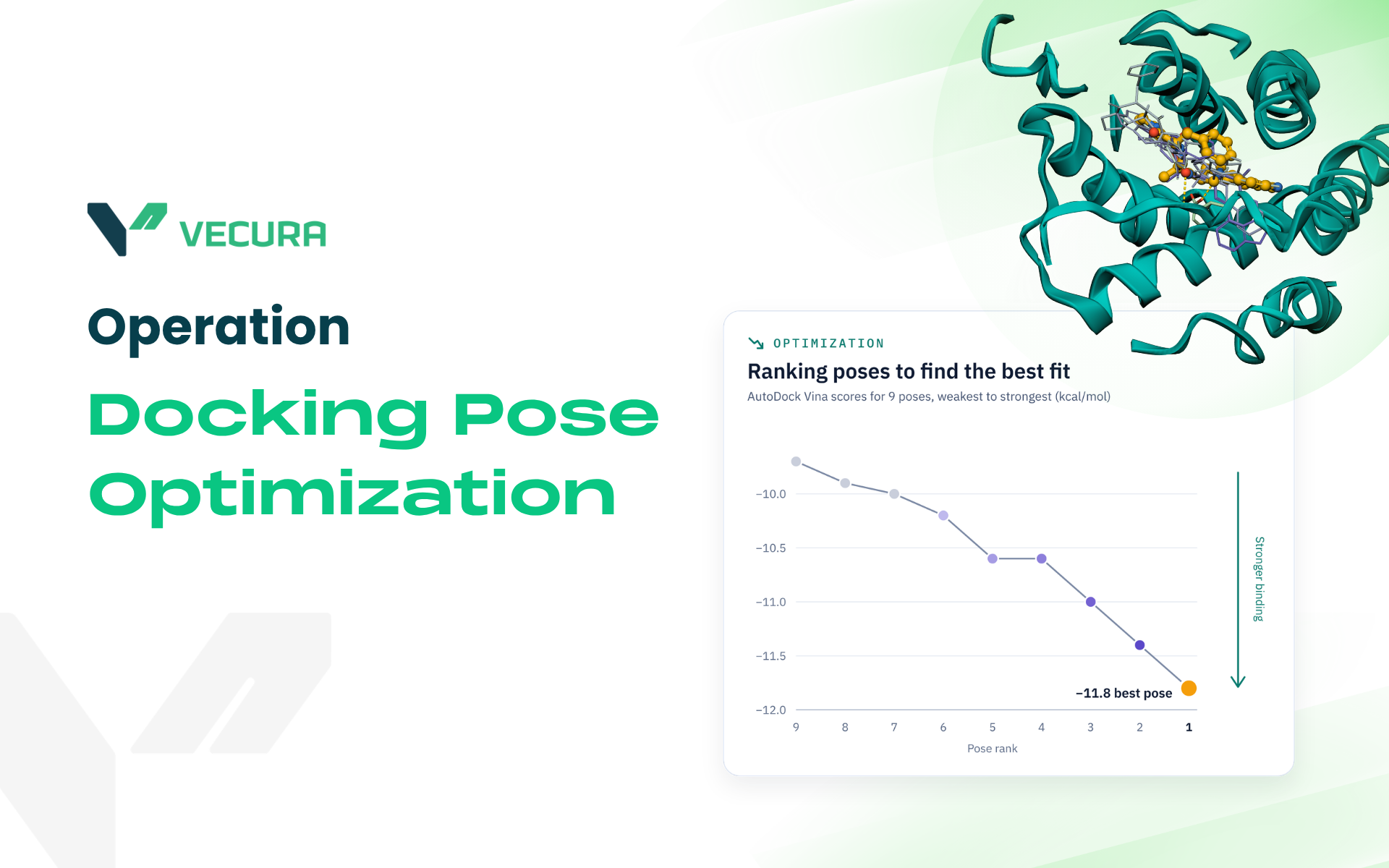
Docking pose optimization takes a pre-positioned 3D ligand already placed inside the receptor and energy-minimizes it in place, improving steric complementarity and bond geometry without re-running a full docking search.
Use it after any docking step when you want to clean up clashes introduced by rigid-body placement, or when you have imported an experimental pose and need to adapt it to a new ligand. It should precede MM/GB(PB)SA calculations, since those free-energy estimates are sensitive to local geometry errors.
Input
Receptor PDB; pre-positioned 3D ligand pose (SDF/PDB)
Output
Energy-minimized pose; rescored binding estimate; optionally per-model CNN rescore
Which model.
Both come from the classical lineage above, in their pose-optimization modes: gnina (CNN rescoring modes: rescore / refinement / all) and smina (Vina-based minimization to convergence; scoring functions: default / vina / vinardo / AD4).
Binding energy parameter optimization
 Use case replayBinding Energy Parameter OptimizationSee this use case
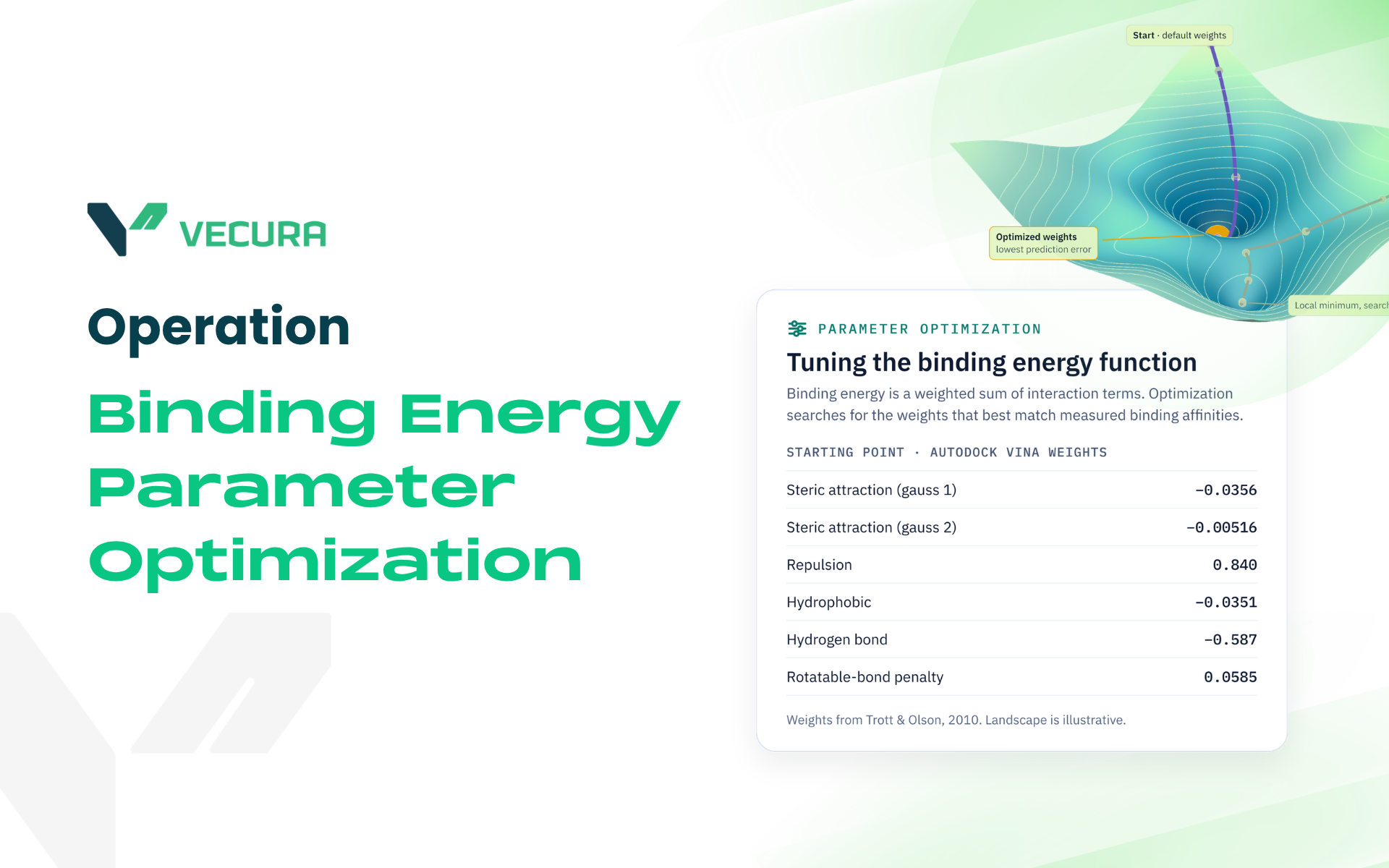
Binding energy parameter optimization runs an MM/GB(PB)SA thermodynamic cycle on a receptor–ligand complex to produce an estimated absolute or relative binding free energy with per-residue decomposition.
Use this operation on a curated short-list of poses (typically ≤ 20 compounds) after docking and pose optimization, because it is the most physically rigorous — and most compute-intensive — step in the pipeline. It is not a replacement for explicit-solvent FEP for high-accuracy rank ordering, but it substantially outperforms empirical scoring functions for distinguishing binders from non-binders within a matched chemical series.
Input
Receptor PDB + energy-minimized ligand pose; forcefield choice; solvent model parameters
Output
ΔG_bind estimate (kcal/mol); per-residue energy decomposition; optionally PB solvation correction
Which model.
Uni-GBSA is the only model here, and the most physically rigorous binding-energy model on this page: a complete MM/GB(PB)SA workflow with configurable pre-simulation (energy minimization or short MD), GAFF/GAFF2 ligand parameterisation, amber03 protein forcefield, adjustable interior/exterior dielectric constants, and both GB and PB solvation models. Per-residue energy decomposition makes it directly actionable for medicinal chemistry: residues contributing large unfavourable terms are immediate optimisation targets. It requires a well-minimized starting complex, run pose optimization first.
Next step
Once you have ranked docked poses, annotated interaction fingerprints, and estimated binding free energies for your prioritised compounds, the natural next group is Small Molecule Discovery / Optimization. Its property and toxicity prediction operations remove liabilities, metabolic instability, hERG activity, poor solubility, before you commit to synthesis, and its small molecule generation and optimization operations propose R-group substitutions and scaffold modifications directly informed by the interaction fingerprints and per-residue energy decompositions produced here.