Virtual Screening on Vecura: Models, Methods & Use Cases
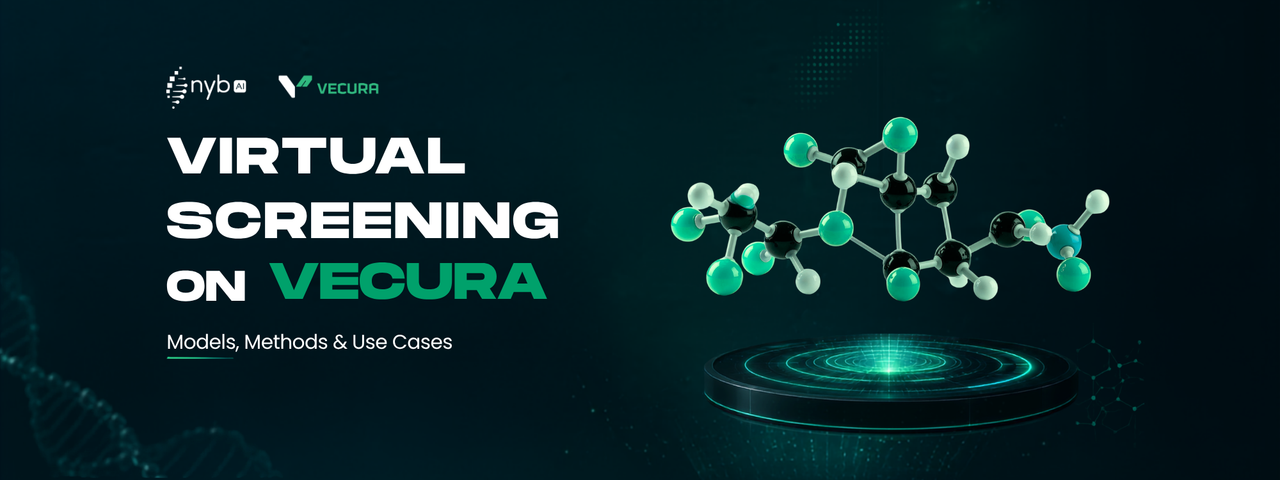
Virtual screening has transformed drug discovery, turning a slow, billion‑dollar process into a fast, computational workflow. On Vecura, researchers can access over 300 AI‑powered models covering every stage of the pipeline: from structure prediction and docking to binding affinity, ADMET prediction, and generative chemistry. This guide shows how to choose the right tools to accelerate your path from target to therapeutic.
Virtual Screening on Vecura: Models, Methods & Use Cases
Introduction
Virtual screening has revolutionized drug discovery, transforming what was once a laborious, expensive process into a computationally tractable endeavor. By rapidly evaluating millions of compounds against biological targets in silico, researchers can identify promising drug candidates before ever stepping into the wet lab.
On Vecura, scientists have access to a comprehensive suite of over 300 AI-powered models spanning the entire virtual screening pipeline, from structure prediction and molecular docking to binding affinity estimation, ADMET profiling, and generative chemistry. This article provides a complete guide to the virtual screening tools available on Vecura, organized by use case to help you select the right model for your research.
Background
What is Virtual Screening?
Virtual screening, or compound screening is a computational technique used in drug discovery to search large libraries of small molecules and identify those most likely to bind to a target of interest, typically a protein receptor or enzyme [1]. Rather than physically testing each compound, virtual screening uses algorithms to predict binding interactions, toxicity screening and pharmacokinetic profiles, and annotate drug-like properties, dramatically reducing the time and cost of hit identification.
There are two primary approaches:
-
Structure-based compound screening (SBVS): Uses the 3D structure of the target protein to dock and score candidate molecules
-
Ligand-based compound screening (LBVS): Relies on known active compounds to find structurally similar molecules
Why is Virtual Screening Important?
The traditional drug discovery pipeline takes 10–15 years and costs over $2 billion, with a failure rate exceeding 90% [2]. Virtual screening addresses these challenges by:
-
Accelerating hit identification: Screening millions of compounds in days rather than months
-
Reducing costs: Eliminating the need to synthesize and test inactive compounds
-
Enabling exploration of ultra-large chemical spaces: Modern make-on-demand libraries contain billions of synthesizable compounds—far too many for experimental screening [3]
-
Supporting rational drug design: Providing structural insights into binding modes that guide lead optimization
Recent advances in deep learning have further enhanced virtual screening capabilities. AI-augmented docking and scoring functions now achieve higher accuracy while reducing computational time by orders of magnitude [4].
The integration of structure prediction tools like AlphaFold has also expanded the universe of druggable targets, enabling structure-based approaches for proteins without experimental structures [5].
Virtual Screening Models on Vecura
Vecura provides a comprehensive ecosystem of models covering every stage of the virtual screening workflow. The table below organizes all available tools by use case, with recommended models and rationale for selection.
| Use Case | Models | Why |
|---|---|---|
| Structure Prediction | ||
| High-accuracy monomer prediction | Boltz-2, AlphaFold3, Protenix | Boltz-2 co-predicts structure and binding affinity with near-FEP accuracy; AlphaFold3 and Protenix extend to complexes with ligands, nucleic acids, and ions |
| Fast single-sequence prediction | ESMFold, ESMFold2 | No MSA required—ideal for metagenomic or orphan sequences; ESMFold2 adds diffusion-based refinement |
| Rapid screening & complexes | ColabFold | Combines MMseqs2 MSA generation with AlphaFold2 for 40–60× speedup; supports multimer prediction |
| Multi-modal biomolecular complexes | Chai-1, IntelliFold | Foundation models handling proteins, ligands, DNA, RNA in a unified framework |
| Molecular Docking | ||
| High-throughput screening | AutoDock-Vina | Industry standard; Vina is fast and reliable; GPU version accelerates large campaigns |
| AI-powered docking | DiffDock, FlowDock, SigmaDock | Diffusion-based methods with improved pose accuracy and confidence estimation |
| CNN-enhanced scoring | gnina | Fork of Vina with integrated CNN scoring for improved pose ranking |
| Blind docking (no pocket definition) | EquiBind | SE(3)-equivariant model predicting binding site and pose in a single forward pass |
| Flexible receptor docking | DynamicBind | Predicts holo conformations from apo structures—ideal for induced-fit targets |
| Rapid pose refinement | PLACER | Atom-level GNN from Baker Lab for fast sidechain and ligand ensemble prediction |
| Binding Affinity Prediction & Rescoring | ||
| GNN-based rescoring | PandaDock, AEV-PLIG | SE(3)-equivariant GNN scoring (R=0.88 on PDBbind); AEV-PLIG uses ANI-2x atomic vectors |
| Bioactivity prediction from complexes | DTIGN | Predicts pKi/pKd/pIC50 directly from docked poses |
| Universal binding energy prediction | DSMBind | Unsupervised SE(3) denoising for protein-ligand, protein-protein, and antibody-antigen |
| Relative binding free energy | RBFENN | Twin GCN predicting RBFE perturbations for lead optimization |
| MM/PBSA & MM/GBSA workflows | Uni-GBSA, g_mmpbsa, gmx_MMPBSA | Physics-based free energy calculations for rigorous rescoring |
| Protein-protein affinity | PRODIGY, PPAP | Contact-based and ESM2-integrated predictors for PPI complexes |
| Target identification | LigTMap, SPRINT | LigTMap identifies targets across 6,000+ proteins; SPRINT provides ultrafast DTI prediction |
| Protein-Protein Docking | ||
| Rigid-body PPI docking | EquiDock | SE(3)-equivariant end-to-end docking for protein complexes |
| Flexible PPI docking | LightDock | GSO-based framework supporting restraints and custom scoring |
| AF2-integrated docking | ColabDock | Incorporates experimental restraints into AlphaFold2-Multimer |
| Diffusion-based PPI docking | DFMDock | Unified sampling and ranking with denoising force matching |
| ADMET Screening & Property Prediction | ||
| Comprehensive ADMET profiling | Admetica, ADMET-AI | Admetica: 22 pre-trained Chemprop models; ADMET-AI: broad pharmacokinetic predictions |
| Toxicity estimation | eToxPred | Predicts toxicity scores and synthetic accessibility |
| hERG liability | hERGAI | Structure-based prediction of hERG channel inhibition |
| PPI compound screening | QEPPI | Quantitative estimate index for PPI-targeted compounds |
| Ligand-Based Virtual Screening | ||
| Shape-based screening | ROSHAMBO | GPU-accelerated Gaussian molecular shape comparison |
| Ultra-large library search | Thompson Sampling | Active learning for combinatorial libraries—finds top hits without full enumeration |
Notes
-
Start with structure: If your target lacks an experimental structure, use AlphaFold3 or ColabFold to generate a high-confidence model before docking.
-
Cascade your screening: For ultra-large libraries (>1M compounds), use fast methods (Vina, Thompson Sampling) for initial filtering, then rescore top hits with GNN-based models (PandaDock, DTIGN) or physics-based methods (MM/GBSA).
-
Validate poses experimentally: AI docking models provide predictions—always cross-reference with known actives or mutagenesis data when available.
-
ADMET early and often: Integrate ADMET prediction (like Admetica) alongside binding scores to avoid advancing compounds with poor pharmacokinetic profiles.
-
Leverage generative models: When hits are scarce, use REINVENT 4 to explore novel chemical space around known pharmacophores.
Conclusion
Virtual screening on Vecura spans the complete drug discovery pipeline, from target structure prediction through hit identification, binding affinity estimation, and lead optimization. With over 300 models accessible through a unified platform, researchers can design custom screening workflows that balance speed, accuracy, and computational cost. Whether you're screening a focused library of 10,000 compounds or exploring billion-member combinatorial spaces, Vecura provides the tools to accelerate your path from target to therapeutic.
References
[1] Docking-based virtual screening: past, present, and future. Biophysical Journal (2026).
https://doi.org/10.1016/j.bpj.2026.04.011
[2] From Virtual Molecules to Clinical Trials: How AI Is Reshaping Preclinical Drug Discovery. JMIR (2024). https://doi.org/10.2196/101366
[3] Docking of millions: accelerating a million-scale virtual screening using deep learning. Briefings in Bioinformatics (2023). https://doi.org/10.1093/bib/bbag128
[4] Open-Source Molecular Docking and AI-Augmented Structure-Based Drug Design: Current Workflows, Challenges, and Opportunities. Int J Mol Sci (2024). https://doi.org/10.3390/ijms27073302
[5] Using Computational Intelligence to Connect Data and Drug Design in Medicinal Chemistry: A Review. Current Computer-Aided Drug Design (2024). https://doi.org/10.2174/0115701638439592260516051944
Try Vecura now.
Bring your own inputs and start exploring what Vecura can do.