Lead Optimization on Vecura: Models, Methods & Use Cases
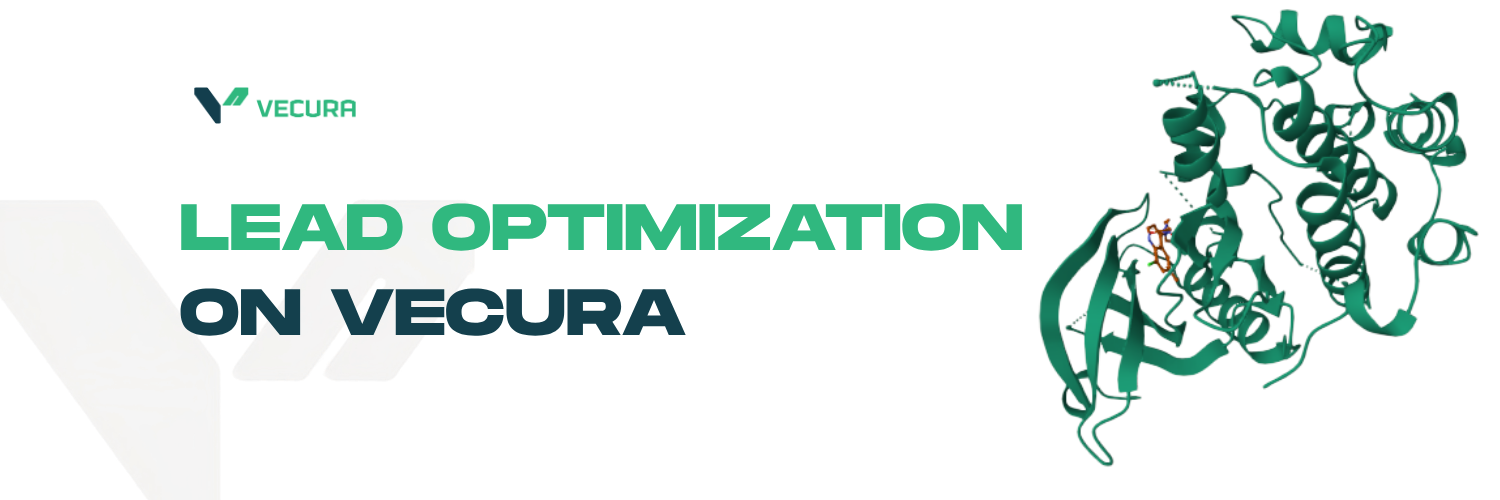
Lead Optimization on Vecura: Models, Methods & Use Cases
Introduction
A hit tells you a molecule can bind; lead optimization tells you whether it should become a drug. This is the stage where potency, selectivity, ADME, developability, and manufacturability all have to move forward together — not sequentially, and not by luck. Vecura consolidates the entire lead-optimization toolchain — docking and rescoring, generative fragment growing, ADMET profiling, antibody engineering, and codon design — into one workspace, with one-click access to the underlying models.
Background
What it is
Lead optimization is arguably the highest-attrition, highest-cost phase of small-molecule and biologic discovery because it demands simultaneous, multi-parameter optimization — potency, selectivity, ADME, and developability — under tight time and cost pressure, with prioritization decisions often needing to account for multi-target binding profiles rather than a single affinity number [8]. Structure-based design has become central to de-risking this stage, and the maturation of structural biology within pharma organizations, alongside AI-driven structure prediction methods, has materially reshaped how teams generate and interpret the 3D hypotheses that guide analog design [3][1][2]. Roadmaps for translating a screening hit into a high-quality clinical candidate now explicitly build in iterative structure- and property-guided cycles rather than treating optimization as a single linear step.
Why it matters
Mechanistically, lead optimization is the iterative modification of a validated hit's chemical structure, guided by structural data and predicted properties, to improve its overall profile before candidate nomination. The field has shifted markedly from classical physics-based or empirical scoring functions toward machine-learned scoring and rescoring models that better correlate with experimental affinity, and toward generative design methods that propose new chemical matter directly rather than merely ranking pre-enumerated libraries [4][6]. Virtual screening pipelines themselves have evolved into reproducible, hierarchical, multi-stage workflows that combine docking, rescoring, and filtering in a documented sequence [7][5].
Lead Optimization Models on Vecura
Vecura organizes lead-optimization models into functional sections spanning affinity prediction, fragment-based design, de novo generation, ADMET, biologics engineering, structure refinement, and codon optimization for expression.
| Use Case | Models | Why |
| Binding Affinity Prediction & Rescoring | ||
| Pose generation + GNN rescoring | PandaDock, SigmaDock, DiffDock, EquiBind | SE(3)/diffusion docking; PandaDock adds GNN rescoring (Pearson R≈0.88 on PDBbind) to sharpen pose ranking |
| Structure-free affinity (pKd) | GEMS, BALM, DTIGN | GNN + protein/ligand language-model embeddings predict pKd fast without a bound pose — good for ranking analog series |
| Co-folded complex + affinity | Boltz-2, FlowDock | Jointly predict the 3D complex and ligand affinity, useful when no crystal pose exists |
| Protein–protein / mutation ΔΔG | StaB-ddG, DDG Predictor, PPAP, PRODIGY | Score how a mutation changes binding free energy — core for biologic affinity maturation |
| Fragment-Based Lead Optimization | ||
| Fragment addition to a bound ligand | DeepFrag2 | 3D-CNN suggests the next fragment in the actual pocket context |
| Pocket-conditioned growing / linking | PMDM, DiffSBDD | Diffusion models grow or link fragments conditioned on the 3D pocket (E(3)-equivariant) |
| Linker / SAFE-based elaboration | GenMol | Masked diffusion over SAFE representations for linker design and lead elaboration |
| De Novo & Scaffold Generation/Optimization | ||
| Valence-constrained graph generation | CoCoGraph | Constrained discrete graph diffusion enforces valid valence throughout |
| Property-guided molecular optimization | MoFlow | Invertible flow gives exact-likelihood latent space for optimizing molecular properties |
| Multi-Parameter (ADMET) Optimization | ||
| Broad ADMET profiling | ADMET-AI, Admetica | 22–30+ Chemprop MPNN endpoints (absorption, metabolism, tox) from SMILES for MPO filtering |
| Solubility | ESOL, FastSolv | Fast logS estimates to keep analogs developable |
| Toxicity + synthetic accessibility | eToxPred | Tox-score plus SAscore to flag risky / hard-to-make analogs |
| Antibody & Biologics Engineering | ||
| CDR sequence–structure co-design | DiffAb | Diffusion co-design of CDR sequence and 3D loop conditioned on antigen |
| Nanobody optimization | EvoNB | ESM2 fine-tuned on ~7.7M nanobody sequences for mutation suggestion |
| Humanization | Humatch | CNN-based joint VH/VL humanization with germline-likeness scoring |
| De novo binder design | BindCraft | AF2 + ProteinMPNN + PyRosetta binder design pipeline |
| Structure Refinement & Dynamics | ||
| Energy minimization / MD refinement | OpenMM | GPU-accelerated MD to relax designed poses/complexes and check stability |
| DNA / Codon Optimization (Expression) | ||
| Codon optimization | CodonTransformer | Context-aware BigBird transformer for organism-specific codon-optimized DNA |
| Gene-synthesis oligo design | DNAWorks | Monte-Carlo oligo design for PCR-based gene synthesis |
Notes
• Treat these as a multi-objective pipeline, not a single-metric race: chain docking → rescoring → ADMET so potency gains are never optimized in isolation from selectivity, ADME, and developability.
• Machine-learned scores are excellent for relative ranking of an analog series but still require experimental confirmation (SPR, ITC, functional assay) before absolute numbers are trusted for go/no-go decisions.
• Generative fragment- and pocket-based models are only as good as the input structure — use a high-quality, validated holo pocket rather than a low-resolution or apo model.
• All citations in this report were independently retrieved and validated this turn; no prompt-supplied reference was reused.
Conclusion
Vecura turns lead optimization into a connected, model-driven loop — from pose generation and rescoring, through fragment and scaffold elaboration, ADMET triage, and biologics engineering, to producible, codon-optimized sequence — so every optimization cycle moves the whole candidate profile forward, not just one number.
References
-
The transformative impact of AI-enabled AlphaFold 3 https://doi.org/10.3389/frai.2026.1739303
-
Protein structure prediction powered by artificial intelligence: from biochemical foundations to practical applications https://doi.org/10.3389/fmolb.2026.1767821
-
The evolving role of structural biology in pharma https://doi.org/10.1107/s2059798326004390
-
Open-Source Molecular Docking and AI-Augmented Structure-Based Drug Design https://doi.org/10.3390/ijms27073302
-
Integrative Computational Chemistry Approaches in Modern Drug Discovery https://doi.org/10.3390/pharmaceutics18050565
-
BA-Pred and RMSD-Pred: GNN Models for Protein-Ligand Binding Affinity and Pose Prediction https://doi.org/10.1021/acs.jcim.5c02591
-
A Reproducible Hierarchical Virtual Screening Framework (IDO1) https://doi.org/10.1021/acs.jcim.6c00967
-
A simple compound prioritization method considering multi-target binding https://doi.org/10.1039/d5dd00464k