Peptides and binders
NVIDIA BioNeMo Model Use Case: Using Proteina-Complexa to Generate a Binder Against NEK2 at the ATP-Binding Site
How the Vecura platform uses Proteina-Complexa to generate a complete binder-target complex in under three minutes, producing a dense, analyzable interface near the NEK2 ATP pocket for downstream scoring.
- Published
NVIDIA BioNeMo Model Use Case: Using Proteina-Complexa to Generate a Binder Against NEK2 at the ATP-Binding Site
How the Vecura platform uses Proteina-Complexa to generate a complete binder-target complex in under three minutes, producing a dense, analyzable interface near the NEK2 ATP pocket for downstream scoring.
Designing a protein binder against a specific pocket is a two-part problem. You have to propose a binder, and you have to place it correctly against the target, as a complex, so the interface can actually be evaluated. Doing those steps separately is slow and error-prone. Generating the binder and the bound complex together in one shot changes the economics of the task. On the Vecura platform, Proteina-Complexa (a model in the NVIDIA BioNeMo model collection) does exactly that, producing a full binder-target complex fast enough to make interface design an iterative step rather than an overnight job.
This case study walks through one run on Vecura. The target is NEK2, a mitotic kinase whose overexpression is linked to tumor progression and drug resistance, which makes disrupting its activity an attractive anticancer strategy. Using the NEK2 structure as the design target, Proteina-Complexa generated a binder in complex with the kinase, and the resulting interface was scored with PRODIGY. The focus here is what Proteina-Complexa contributes: a complete, structured complex, generated quickly, ready for analysis.
| 2 min 20 s to generate a full complex | -12.09 kcal/mol predicted affinity | ~1.4 nM predicted dissociation constant |
What Proteina-Complexa generated
Proteina-Complexa was run on Vecura against the NEK2 structure (PDB 2XKF), with the binder length allowed to range from 50 to 100 residues. The job completed in 2 minutes 20 seconds and returned not just a binder sequence but a full three-dimensional binder-target complex, with the designed protein already positioned against the kinase.
Generating the complex, not just the binder, is the point. Most design tools hand back a binder and leave the docking to a separate step, which adds time and introduces a second source of error. By producing the bound complex directly, Proteina-Complexa gives an interface that can be scored and inspected immediately, with no intermediate docking stage. That is what makes the downstream analysis in this case study possible in a single pass.
Where the binder sits on NEK2
In the generated complex, the binder forms a dense hydrogen-bonded interface with NEK2, with the individual contact residues and their bonding distances labeled in Figure 1. These contacts fall in and around the glycine-rich loop and hinge region that frame the ATP-binding pocket, which places the designed binder against the ATP-site surface of the kinase, the region of interest for an ATP-competitive strategy.
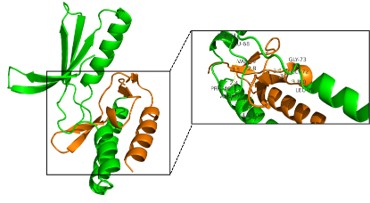
Figure 1. Predicted Proteina-Complexa binder in complex with NEK2, with interface contacts and hydrogen-bond distances (Å) shown in the zoom panel.
A precise word on what this shows. The binder makes contacts with residues that line and neighbor the ATP pocket, which is the necessary starting condition for competing with ATP. It is not, on its own, proof of ATP competition. A 50 to 100 residue binder covers a broad surface, so contacting ATP-site residues and functionally blocking ATP are related but distinct claims, and only a biochemical assay can establish the latter. The honest read is that Proteina-Complexa placed the binder on the right part of NEK2, which is exactly where a competitive design needs to start.
Scoring the interface
The generated complex fed straight into PRODIGY, which analyzes a protein-protein interface and estimates binding properties from its contacts. The interface Proteina-Complexa produced is substantial and well-structured (Table 1).
Table 1. PRODIGY analysis of the Proteina-Complexa binder-NEK2 interface.
| PRODIGY metric | Value | Read |
| Predicted binding affinity | -12.09 kcal/mol | Strong |
| Predicted dissociation constant | ~1.4 nM | Low-nanomolar |
| Intermolecular contacts | 136 | Dense interface |
| Apolar non-interacting surface | 40.4 % | Hydrophobic-rich |
| Charged non-interacting surface | 31.5 % | Charged contribution |
The interface is the real story here. PRODIGY counted 136 intermolecular contacts, a dense binding surface, dominated by apolar-apolar interactions (63) with a strong charged-apolar contribution (34). The non-interacting surface is 40.4% apolar and 31.5% charged. Taken together, this describes a large, hydrophobic-rich interface with meaningful electrostatic character, which is the kind of interface geometry that underlies specific, high-quality protein-protein binding. That structured interface, generated in one pass, is what Proteina-Complexa delivered.
On top of that interface, PRODIGY returned a predicted binding affinity of -12.09 kcal/mol, corresponding to a dissociation constant in the low-nanomolar range (about 1.4 nM). That places the Proteina-Complexa design squarely in the affinity range of a strong, specific binder, generated and scored in a single pass on Vecura in under three minutes.
Why run Proteina-Complexa on Vecura
Protein-Complexa is just one of many BioNeMo models now available on Vecura. Researchers can also run CodonFM and RNAPro for RNA understanding and structure prediction, La‑Proteina and ProtComposer for protein generation and binder design, and optimization models like ReaSyn, and DualBind for property prediction, synthesizability, and binding affinity.
On Vecura, Proteina-Complexa produced the binder and its bound pose together on Vecura, removing a separate docking stage and the errors that come with it. The interface was ready to score the moment generation finished. Because the output is a complete complex, it flows directly into interface scoring with PRODIGY, giving contact counts, composition, and a triage signal without any handoff between tools.
A full binder-target complex in 2 minutes 20 seconds means design and scoring can iterate in a single working session, so a designer can explore many targets and constraints rather than waiting on each one.
Note on scope: Contacting ATP-site residues is a promising start toward an ATP-competitive binder, and the next step is experimental confirmation of both binding and competition. What the run shows is the operational result this piece is about: on Vecura, Proteina-Complexa generated a complete, well-structured NEK2 binder complex in under three minutes, positioned at the ATP-site surface, with a strong predicted interface affinity to carry into validation.
Bring your target to Vecura and generate binder-target complexes with NVIDIA BioNeMo models like Proteina-Complexa, scored at the interface in the same loop. Design, dock, and triage in minutes.