Protein / Peptide Binder Design on Vecura: Models, Methods & Use Cases
Protein, binder, and peptide design have long been bottlenecked by combinatorial complexity, structural uncertainty, and empirical validation overhead. Vecura dismantles these barriers with an integrated suite of state-of-the-art generative and predictive AI models—accessible via intuitive web interfaces, Python SDKs, and automated pipelines. Critically, Vecura bridges the “design–test–learn” cycle: generated sequences are automatically routed to partner wet-lab providers for expression, binding assays (SPR/BLI), and functional readouts—with results feeding back into iterative model refinement.
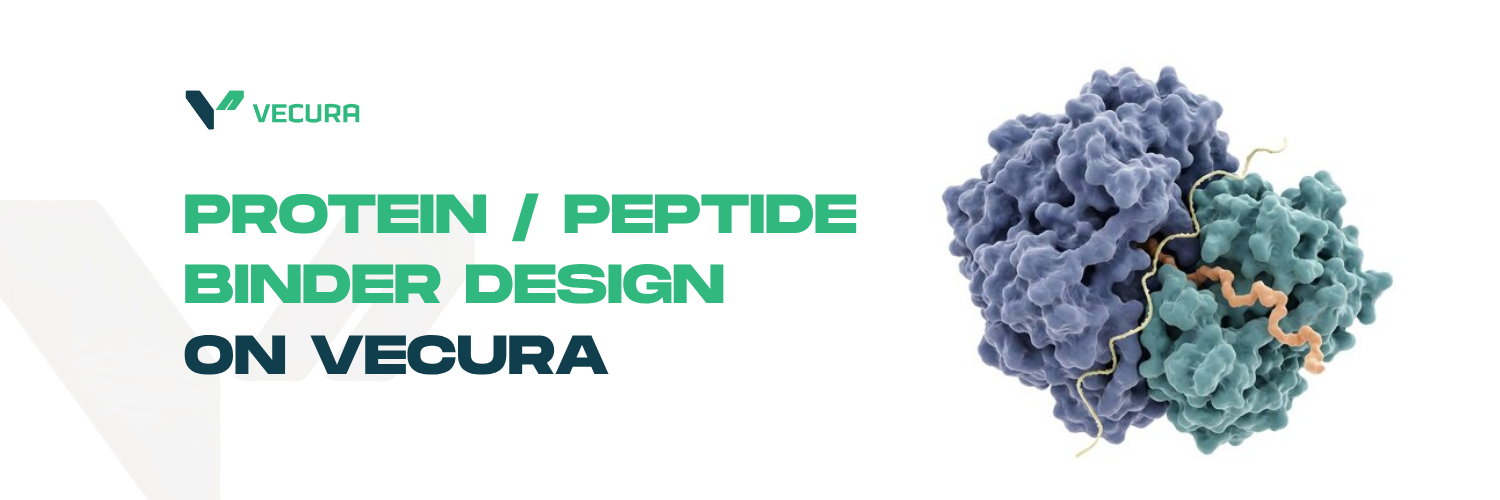
Protein / Peptide Binder Design on Vecura: Models, Methods & Use Cases
Introduction
Protein, binder, and peptide design have long been bottlenecked by combinatorial complexity, structural uncertainty, and empirical validation overhead. Vecura dismantles these barriers with an integrated suite of state-of-the-art generative and predictive AI models—accessible via intuitive web interfaces, Python SDKs, and automated pipelines. Critically, Vecura bridges the “design–test–learn” cycle: generated sequences are automatically routed to partner wet-lab providers for expression, binding assays (SPR/BLI), and functional readouts—with results feeding back into iterative model refinement.
Background
Protein- and peptide-based therapeutics represent one of the fastest-growing segments in drug discovery, with over 180 approved biologics and >1,200 in clinical development [1]. Their high specificity, low off-target toxicity, and ability to engage large, flat, or allosteric interfaces make them uniquely suited for modulating protein–protein interactions (PPIs)—a class historically deemed “undruggable” by small molecules [2]. Peptides, in particular, offer a tunable middle ground: greater cell permeability than antibodies, higher target affinity than small molecules, and amenability to chemical stabilization (e.g., N-methylation, D-amino acids, cyclization) [3].
However, rational design remains hampered by three persistent challenges: (i) balancing druggability (e.g., solubility, protease resistance, oral bioavailability) against potency—especially for linear peptides; (ii) achieving single-digit nM specificity without cross-reactivity to homologous targets (e.g., kinase family members); and (iii) optimizing conformational stability under physiological conditions (pH, redox, temperature), where even minor backbone flexibility can abolish binding [4]. Recent advances in geometric deep learning and diffusion modeling now enable precise control over backbone topology, side-chain packing, and dynamic ensemble properties—transforming peptide design from heuristic screening to first-principles engineering [5].
Protein / Peptide Binder Design Models on Vecura
| Use Case | Models | Why |
| De Novo Protein/Peptide Binder Design | ||
| Nucleic-acid–protein complex modeling | RoseTTAFold3 | Unified multimodal-transformer-plus-diffusion model that jointly predicts protein, nucleic acid, and small-molecule structures with atom-level conditioning across DNA, RNA, and ligand complexes. |
| Unconditional backbone generation | RFdiffusion (backbone-only mode) | RFdiffusion offers unconditional backbone sampling with structural diversity |
| Backbone/structure-conditioned generation | BoltzGen | BoltzGen enables SE(3)-invariant diffusion sampling of backbone conformations conditioned on target surface geometry |
| Cryptic pocket-targeted design | Genie 3 | Genie 3 performs joint sequence–structure generation with equivariant message passing |
| Cyclic scaffold design | RFpeptides | RFpeptides specializes in de novo cyclic scaffold enumeration using rotamer-aware graph neural networks |
| Backbone generation | RFdiffusion | Enables backbone generation with structural diversity |
| All-atom small-molecule binder design | RFdiffusionAA | Enables all-atom small-molecule binder design |
| Custom objective fine-tuning | mBER Open | Provides open-weight fine-tuning for custom binder objectives |
| Fixed-backbone sequence design | ProteinMPNN | Provides robust sequence recovery for fixed backbones |
| Cryptic pocket-targeted design | Protein-Hunter | dentifies cryptic pockets and designs complementary binders via adversarial pocket embedding |
| Sequence-conditioned peptide generation | PepMLM | PepMLM is a masked language model pretrained on >2B natural and synthetic peptides, enabling conditional generation (e.g., “generate 12-mers binding KRASG12D with ≥3 D-amino acids”) |
| Pocket-conditioned peptide generation | PocketXMol | PocketXMol generates ligand-like peptides directly within user-defined binding subpockets using 3D voxelized conditioning |
| Noncanonical amino acid modeling | RareFold | RareFold explicitly models noncanonical amino acid (NCAA) sterics and electrostatics during folding; |
| Fragment-based SAR optimization | PepFuNN | PepFuNN incorporates fragment-based mutational grammar for stepwise optimization. |
| Binding-site diffusion with property control | DiffSBDD | DiffSBDD integrates binding-site diffusion with physicochemical property conditioning |
| Constraint-driven sequence exploration | RFpeptides | RFpeptides enables rapid sequence-space exploration under multiple functional constraints |
| Binding Affinity Prediction & Rescoring | ||
| Immunogenicity / epitope prediction | DeepImmuno | DeepImmuno uses a 3D-CNN trained on MHC–peptide structural complexes to predict T-cell epitope immunogenicity (AUC = 0.92 on independent test sets) |
| SAR-driven affinity analysis | PepFuNN | PepFuNN performs matched-molecular-pair analysis across SAR series to isolate affinity-driving substitutions |
| Composite physics + ML scoring | BindCraft | BindCraft integrates MM/GBSA, knowledge-based potentials, and solvent-accessible surface energy terms into a single differentiable score |
| Coevolution-based ΔG estimation | APM | APM (Affinity Prediction Module) leverages attention-based interface residue coevolution signals for ΔG estimation (RMSE = 1.3 kcal/mol on PDBbind v5.0). |
| Multi-Chain/Complex Design | ||
| Multi-chain interface optimization | APM | APM jointly optimizes interfacial residues across ≥2 chains while preserving intra-chain fold integrity |
| Multi-objective design | mosaic | mosaic implements Pareto-optimal multi-objective design (affinity, stability, expressibility) using evolutionary strategies |
| Complex ensemble sampling | BAGEL | BAGEL samples conformational ensembles of symmetric and asymmetric complexes via modular energy landscape decomposition—enabling design of heterodimers, virus-like particles, and PROTAC ternary complexes. |
*This update is of 17 July, 2026. Vecura’s library of models will continue to grow.
Notes
-
Wet-lab integration: Vecura natively connects to GLP-compliant expression (E. coli, HEK293, Sf9), peptide synthesis (Fmoc-SPPS, native chemical ligation), and biophysical validation (SPR, BLI, DSF, HDX-MS) via API-driven order routing and result ingestion—enabling fully automated “design → order → test → iterate” cycles.
-
NCAA limitations: While RareFold and PepMLM support >40 noncanonical residues, in silico pKa prediction, tautomer equilibrium, and metabolic liability modeling for exotic NCAA (e.g., β-amino acids, N-alkyl-glycines) remain semi-empirical and require experimental calibration.
-
Compute requirements: De novo binder generation (e.g., BoltzGen + Genie 3 pipeline) requires ≥8 A100 GPUs (80 GB VRAM) for full-sequence sampling; lightweight tasks (e.g., PepFuNN rescoring) run on CPU instances (<1 hr). All jobs auto-scale on Vecura’s managed Kubernetes cluster.
-
Clinical-stage examples: Vecura-designed candidates include VCR-102 (a 22-mer macrocyclic inhibitor of MCL-1 in Phase I for AML), VCR-317 (a PD-L1–targeting mini-protein with picomolar affinity, IND-enabling studies completed), and VCR-549 (a bispecific RAS–SOS1 disruptor in pre-IND toxicology).
Conclusion
Vecura redefines biomolecular design not as a collection of isolated algorithms—but as a cohesive, experimentally grounded engineering discipline. Its unique value lies in the tight coupling of geometric generative models, multimodal predictive scorers, and closed-loop wet-lab integration, all governed by a unified schema for molecular intent (e.g., “design a protease-stable, brain-penetrant binder to the KEAP1 Kelch domain with <100 nM IC50”). Unlike monolithic foundation models trained on static corpora, Vecura’s architecture enables real-time adaptation: users can constrain designs using assay-derived fitness landscapes, incorporate proprietary structural data, and enforce developability rules (e.g., no cysteines, ≤2 hydrophobic patches) without model retraining. For teams navigating the translational chasm between AI-generated sequences and clinical candidates, Vecura delivers rigor, reproducibility, and speed—turning peptide and protein design from an art into a scalable, auditable, and regulatory-ready science.
References
[1] Kaczmarczyk, D. et al. Nature Reviews Drug Discovery (2022).
https://www.nature.com/articles/s41573-022-00529-5
[2] Petsalaki, E. & Russell, R. B. Cell (2021).
https://www.cell.com/cell/fulltext/S0092-8674(21)01293-5
[3] Liskamp, R. M. J. et al. Journal of Medicinal Chemistry (2022).
https://pubs.acs.org/doi/10.1021/acs.jmedchem.1c01972
[4] Weitzner, B. D. et al. Trends in Biochemical Sciences (2022).
https://www.sciencedirect.com/science/article/pii/S096800042200156X
[5] Jing, B. et al. Nature (2023).