BioNeMo · NVIDIA
Explore NVIDIA BioNeMo Models on Vecura
This update focuses on BioNeMo’s open‑source models, which are now available on Vecura with no‑code access. By making these models openly available, BioNeMo empowers scientists to design novel molecules, predict structures, and accelerate drug discovery workflows, all while lowering the barrier to entry for advanced AI in life sciences.
- Published
Explore NVIDIA BioNeMo Models on Vecura
This update focuses on BioNeMo’s open‑source models, which are now available on Vecura with no‑code access. By making these models openly available, BioNeMo empowers scientists to design novel molecules, predict structures, and accelerate drug discovery workflows, all while lowering the barrier to entry for advanced AI in life sciences.
What is BioNeMo?
BioNeMo is NVIDIA’s open developer platform for AI‑driven life science research. It provides GPU‑accelerated models, tools, and datasets across the entire AI lifecycle — enabling scientists to transform physical lab results into digital insights that drive the next experiment.
The platform is built on five pillars:
-
Data – curated, large‑scale biological datasets
-
Models – open‑source AI models for proteins, RNA, and small molecules
-
Libraries & Tools – GPU‑optimized libraries for training and inference
-
Training & Customization – frameworks for pretraining and fine‑tuning
-
Optimized Inference & Deployment – enterprise‑ready microservices (NIMs)
The BioNeMo models collection spans proteins, RNA, and small molecules - offering generative and predictive models that cover structure prediction, molecular design, property optimization, and binding affinity.
NVIDIA BioNeMo Models Available on Vecura
NVIDIA BioNeMo delivers high‑quality, fully open‑source models - completed with the full training codebase, pre‑trained weights, and research papers, all freely available to the community.
For Understanding
| Use Case | Model | Description |
| Disease Understanding (RNA) | CodonFM | Codon-level RNA foundation model trained on 130M protein-coding sequences from 22K+ species. Captures synonymous codon variation for mRNA design, stability modeling, and variant interpretation. |
| Structure Prediction (RNA) | RNAPro | State-of-the-art RNA 3D structure prediction model. Combines Protenix-based co-folding architectures with RNA foundation models, MSA, and template-based modeling. |
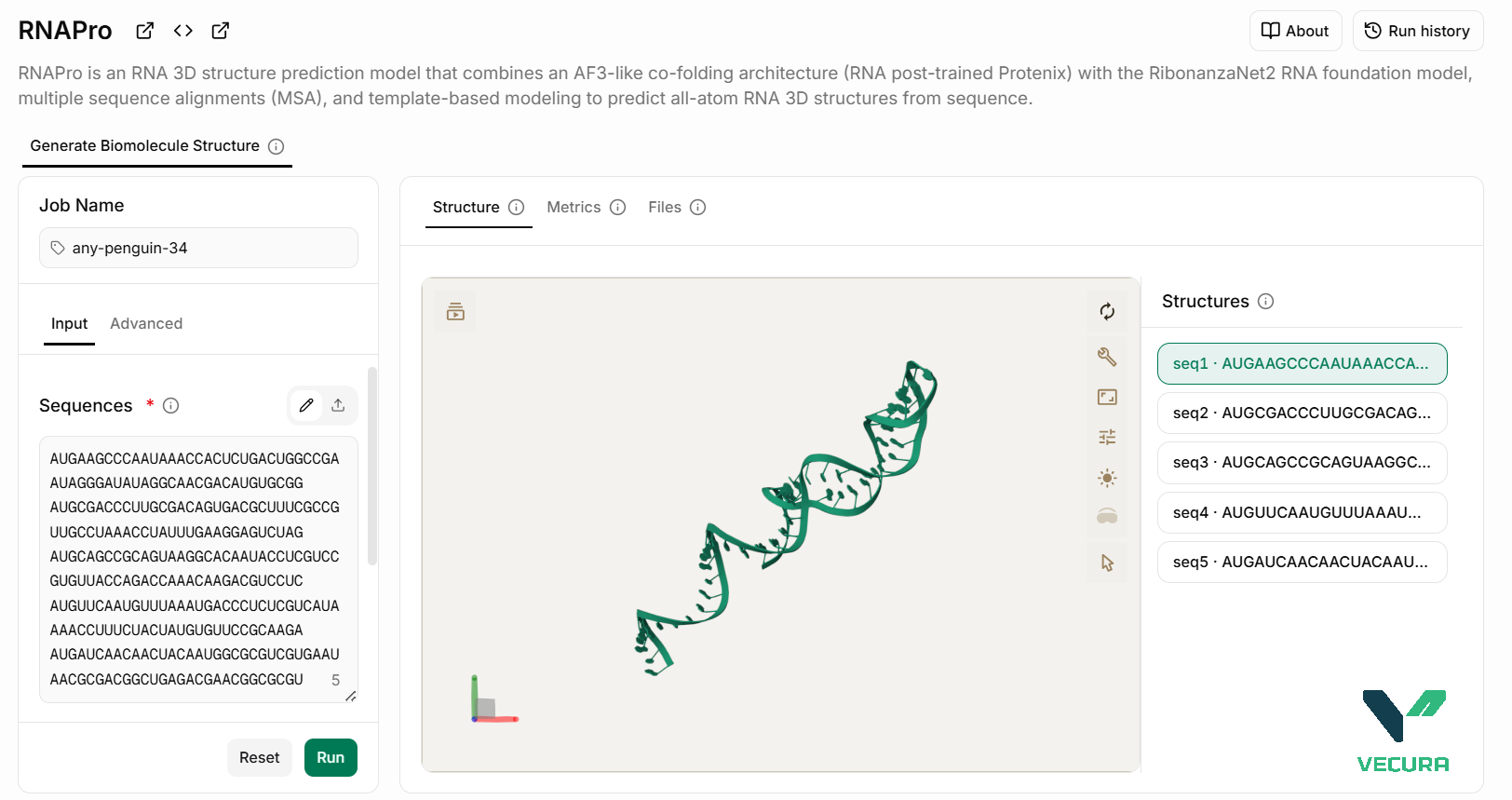
RNAPro by NVIDIA BioNeMo, available on Vecura
For Design
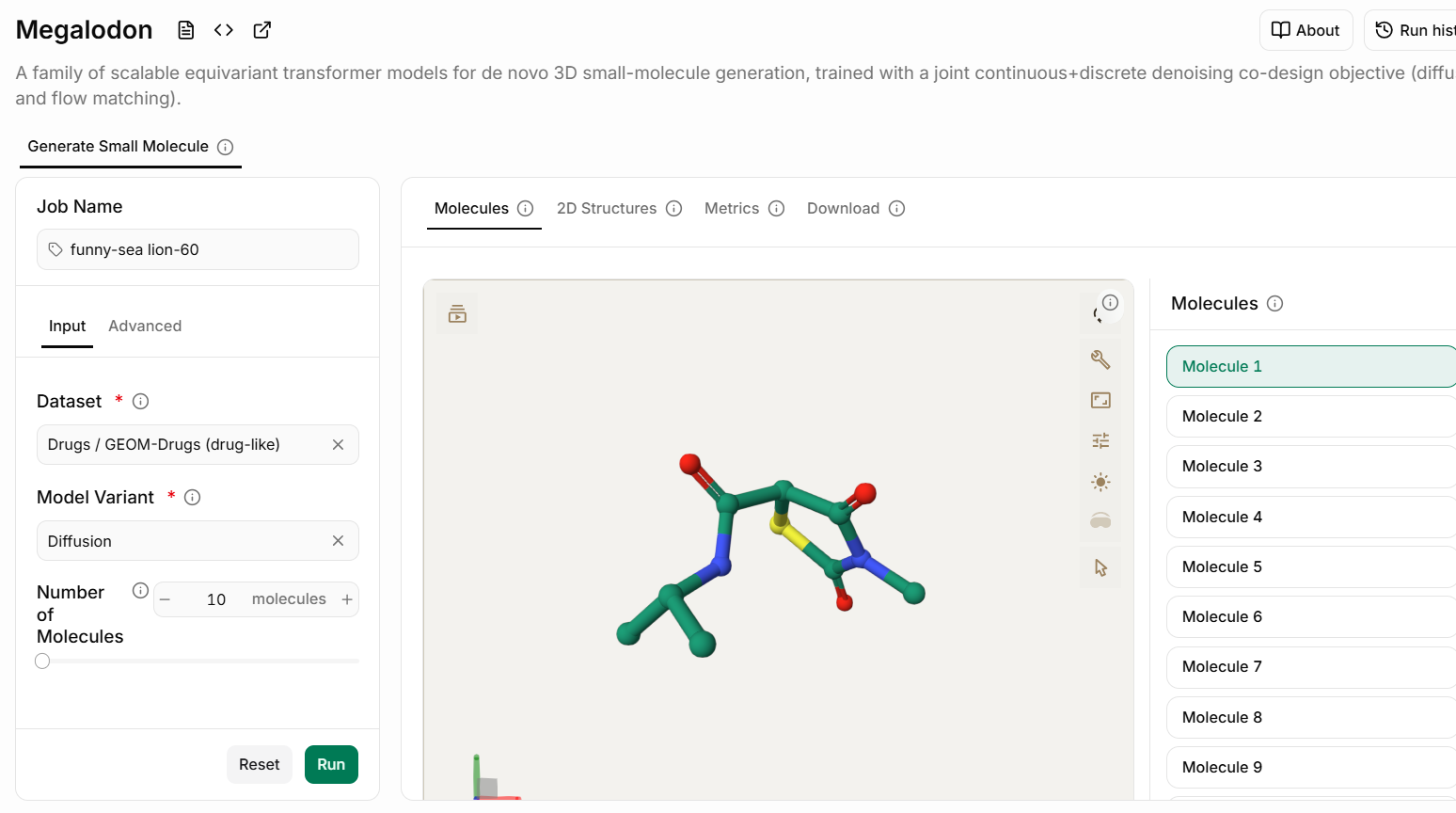
Megalodon by NVIDIA BioNeMo on Vecura
| Use Case | Model | Description |
| Proteins | Proteina-Complexa | Protein binder design for protein and small molecule targets. Combines a pretrained flow-based generative model (built on La-Proteina) with inference-time optimization for high-quality binder generation. |
| La-Proteina | All-atom protein generation using partially latent flow matching. Jointly generates amino acid sequence and full atomistic structure (backbone + side chains) for up to 800 residues. Enables atomistic motif scaffolding for enzyme design. | |
| Proteina | Large-scale flow-based generative model for protein backbone structures with hierarchical fold-class conditioning and a scalable transformer architecture. | |
| ProtComposer | Spatial-layout-conditioned protein structure generation using 3D ellipsoids to control shape and substructure arrangements. | |
| Small Molecules | GenMol | Fragment-based molecule generation using masked discrete diffusion over SAFE representations. Supports de novo design, scaffold decoration, linker design, motif extension, and lead optimization. |
| Megalodon | Transformer-based 3D molecule generative model using equivariant graph transformer architecture. Generates both 2D topology and 3D structure with physically realistic, low-energy conformations. | |
| AvgFlow | Efficient molecular 3D conformer generation using SO(3)-averaged flow-matching and reflow. Architecture-agnostic framework applicable to equivariant and non-equivariant models. |
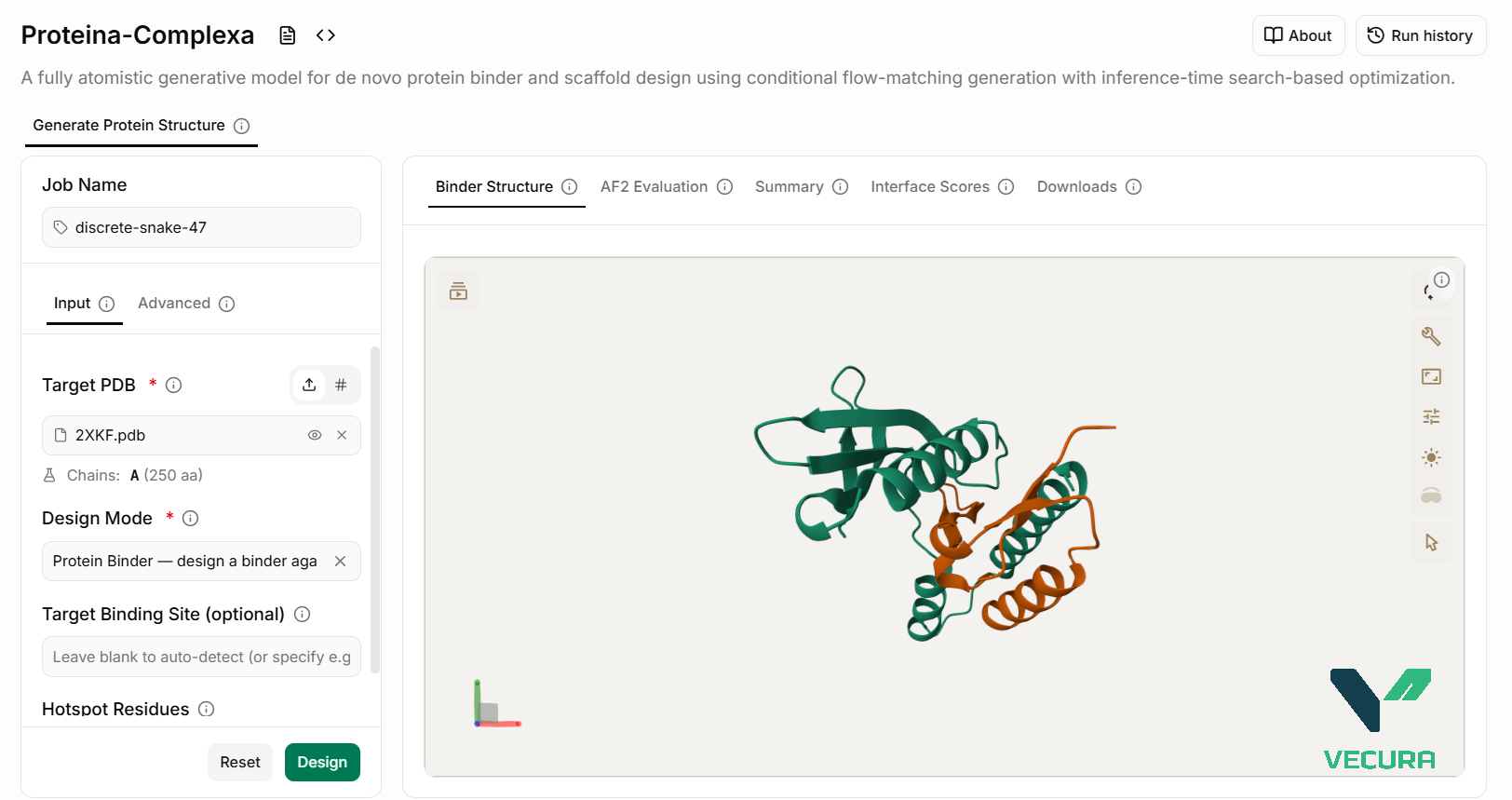
Protein-Complexa by NVIDIA BioNeMo, available on Vecura
For Optimization
| Use Case | Model | Description |
| Property Prediction | KERMT | Pretrained graph neural network for molecular property prediction (ADMET). Multi-task extension of GROVER with accelerated data loading via cuik-molmaker. SOTA on real-world ADMET data. |
| Synthesizability | ReaSyn | Synthesis pathway prediction using an encoder-decoder Transformer with Chain-of-Reaction notation. Predicts reaction steps from building blocks to final products, or finds synthesizable analogs for unsynthesizable targets. |
| Binding Energy | DualBind | 3D structure-based deep learning model for protein-ligand binding affinity prediction using a dual-loss framework (supervised MSE + unsupervised denoising). Orders of magnitude faster than physics-based FEP methods. |
Models are continuously onboarded on Vecura. Sign up*** ***to try BioNeMo out!
Why It Matters
By bringing BioNeMo models into Vecura, we’re lowering the barrier to entry for advanced AI in life sciences. Researchers can now:
-
Run GPU‑accelerated workflows without coding expertise
-
Apply generative AI to drug discovery, protein engineering, and genomics
-
Scale experiments faster and more efficiently
-
Collaborate with the broader BioNeMo community
BioNeMo on Vecura is available today. Explore the models, test workflows, and see how AI can accelerate your research.
Try BioNeMo models now on Vecura.
References & Further Reading
-
GitHub (NVIDIA BioNeMo organization): https://github.com/NVIDIA-BioNeMo
-
Find out more about BioNeMo: