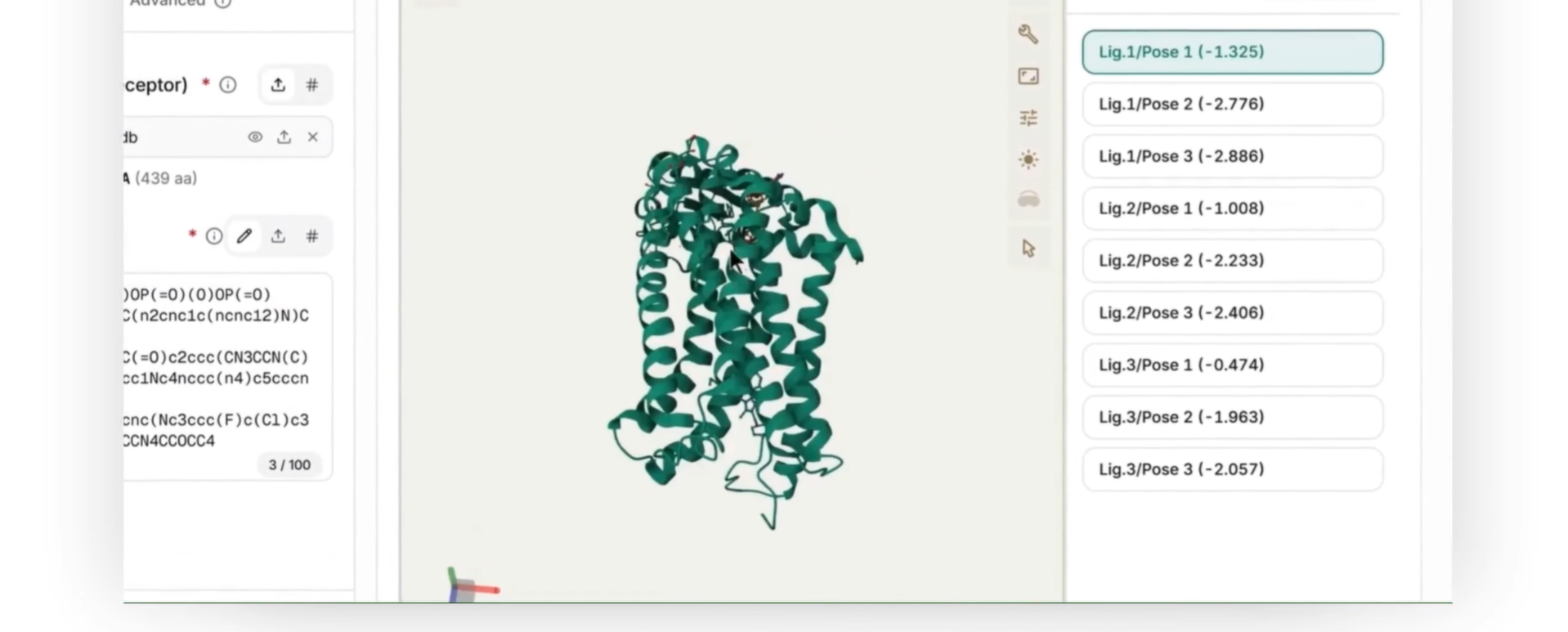
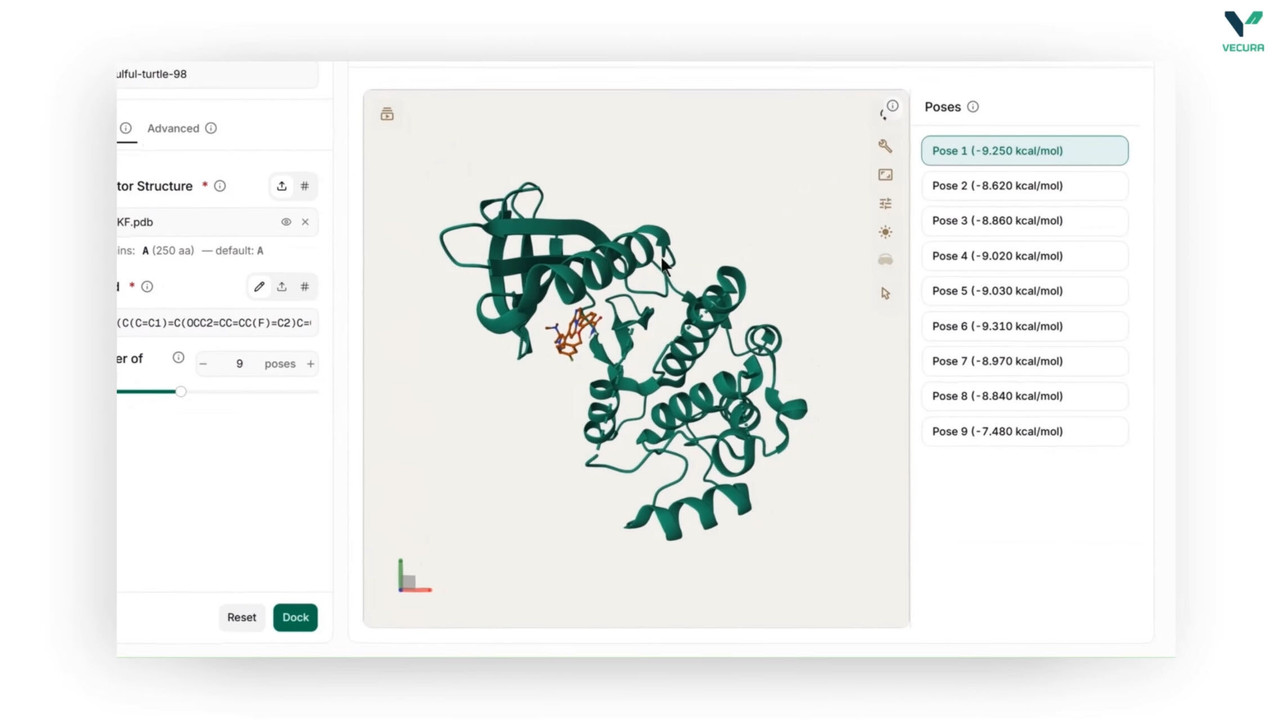
Advanced Protein-Ligand Docking with smina: Now Available on Vecura
This update allows medicinal chemists and researchers to perform high-accuracy protein-ligand docking and pose refinement directly within the Vecura platform, eliminating the need for complex software installation or infrastructure management.
What is smina?
smina is a powerful fork of the industry-standard AutoDock Vina, specifically engineered to enhance scoring accuracy and energy minimization in protein-ligand docking. It simplifies complex computational drug-discovery tasks by providing robust support for diverse ligand formats and offering advanced energy minimization that runs to convergence. It is especially useful for medicinal chemists and structural biologists who need to rapidly refine ligand poses or perform high-accuracy global docking to predict binding affinities.
What can users do with smina on Vecura?
With smina on Vecura, users can:
-
Perform global docking to predict how small molecules bind to a rigid receptor.
-
Optimize and refine existing ligand poses through gradient-based energy minimization.
-
Automatically generate binding boxes around reference ligands, streamlining the setup process.
-
Choose between built-in scoring functions—Vina or Vinardo—to tailor predictions to specific system requirements.
What the output means
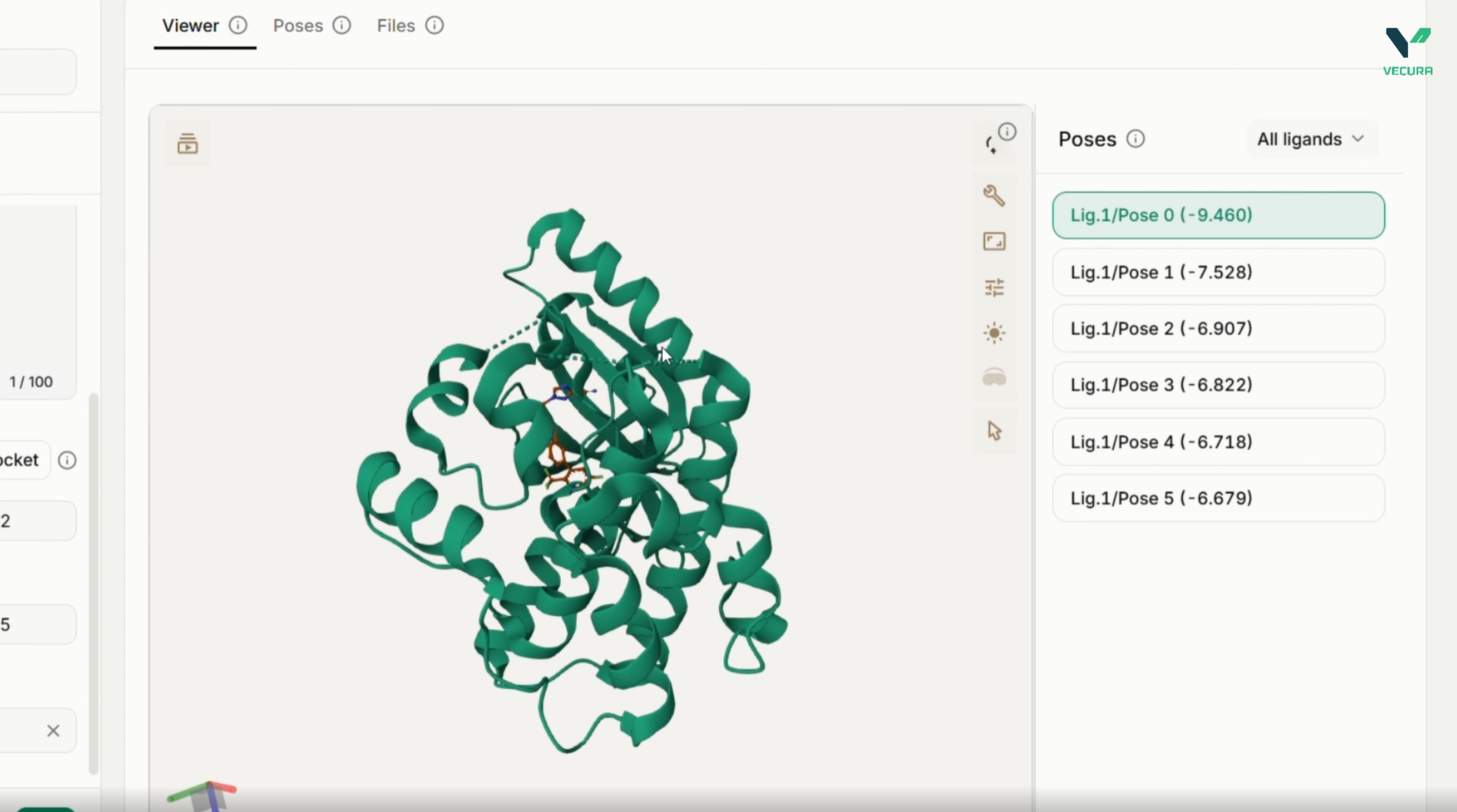
The output provides ranked docked poses in SDF format, detailed binding affinity scores (kcal/mol), and energy-minimized ligand structures.
This output should be used to support scientific decision making. It does not replace experimental validation.
Why this matters
In drug discovery, the ability to accurately predict the binding mode and affinity of a small molecule to a protein target is critical for prioritizing leads. By improving upon the original AutoDock Vina framework with refined scoring and more robust minimization, smina helps researchers narrow down vast chemical spaces more efficiently, saving time and resources in the early stages of drug development.
-
Developed by: Matthew Wojcikowski, David Polizzi, and Ryan McDowell
-
Source: Official GitHub repository
Vecura で smina を試す。
モデルワークスペースを開き、ご自身の入力で評価を始めましょう。