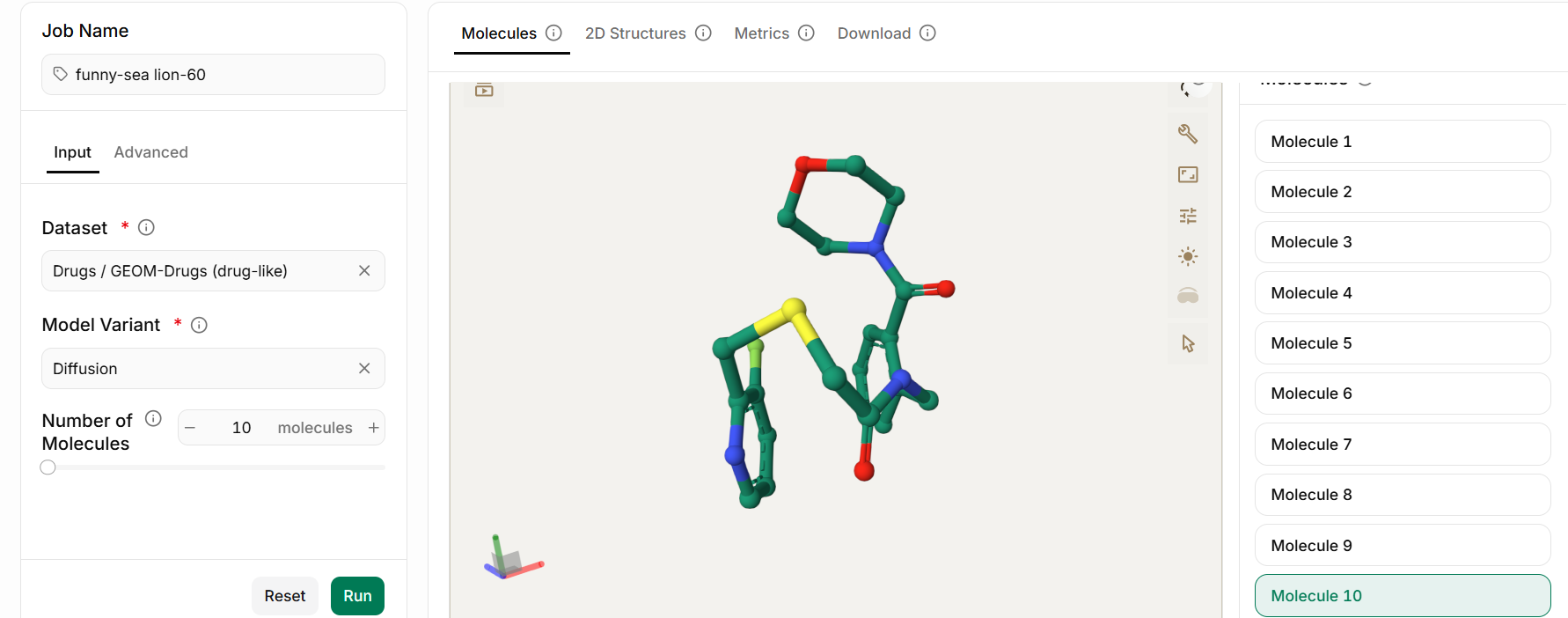
ReaSyn by NVIDIA Is Now Available on Vecura
This update enables medicinal chemists and drug-discovery researchers to project molecules onto synthesizable chemical space and generate concrete synthesis routes through a guided workflow inside Vecura, without setting up complex technical infrastructure.
What is ReaSyn?
ReaSyn v2 is an encoder-decoder Transformer system developed by NVIDIA that explores synthesizable chemical space through iterative pathway refinement. It uses a two-model architecture: a 166M-parameter autoregressive Transformer generates synthetic pathways via combined bottom-up/top-down synthetic-tree traversal, and a 174M-parameter Edit Flow model refines those pathways with insertion, deletion, and substitution edits. Given a target molecule as a SMILES string, ReaSyn projects it onto the space of molecules that can actually be built from purchasable building blocks, returning structurally similar synthesizable analogs together with concrete synthesis routes based on 115 SynFormer reaction templates.
It helps users bridge the gap between computational molecular design and real-world synthesis by ensuring that every candidate molecule comes with a buildable route. It is especially useful for retrosynthetic analysis of computationally designed hits, synthesizable hit expansion for SAR campaigns, and goal-directed molecular optimization constrained to synthesizable space.
What can users do with ReaSyn on Vecura?
With ReaSyn on Vecura, users can:
-
Reconstruct synthesizable analogs: Find the closest synthesizable match to a target molecule and retrieve its full synthesis route from purchasable building blocks.
-
Expand around validated hits: Generate diverse families of buildable analogs around a validated hit compound to support structure-activity relationship (SAR) exploration.
-
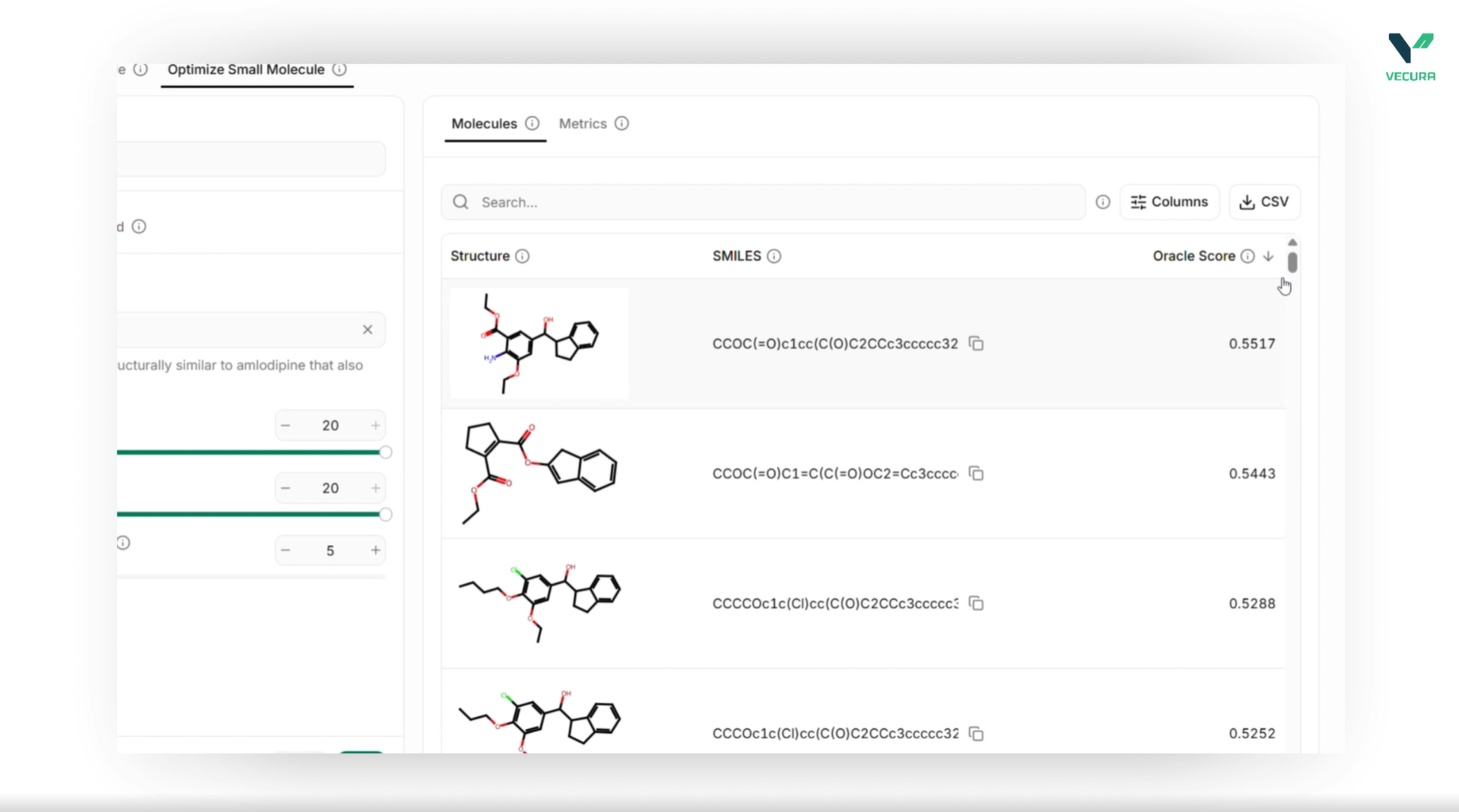
Optimize molecules toward drug-discovery objectives: Run genetic-algorithm-driven optimization against TDC property oracles (e.g., DRD2, JNK3, GSK3B, multi-property objectives) while keeping every candidate anchored in synthesizable space.
-
Filter out undesirable chemotypes: Exclude molecules structurally similar to known toxic or problematic compounds using configurable similarity thresholds.
What the output means
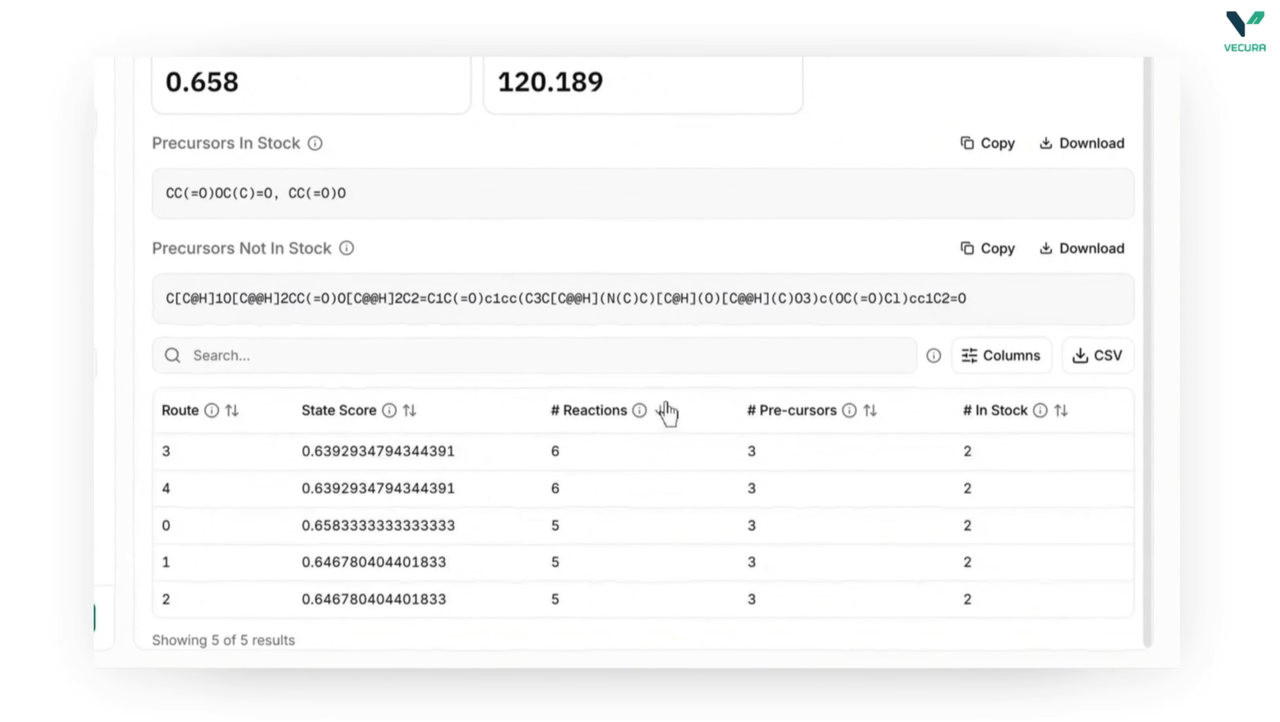
The output provides ranked synthetic pathways including the product molecule SMILES, a Tanimoto similarity score to the target (where 1.0 indicates an exact synthesizable reconstruction), the full synthesis route (building-block SMILES and reaction-template IDs), the number of reaction steps, and additional similarity metrics (scaffold, pharmacophore, and RDKit fingerprint similarity) for top-ranked results. For goal-directed optimization runs, the output also includes optimized molecule SMILES ranked by oracle score, along with top-1, top-10, and top-100 average scores and an internal diversity metric.
This output should be used to support scientific decision making. It does not replace experimental validation.
Why this matters
A persistent challenge in computational drug discovery is that generative models and virtual screening campaigns routinely produce molecules that score well in silico but cannot be synthesized in practice. This "synthesizability gap" means promising computational hits often stall when handed to medicinal chemists, wasting time and resources. ReaSyn addresses this by projecting any target molecule directly onto synthesizable chemical space, guaranteeing that every output is buildable from commercially available building blocks with a known reaction sequence.
By combining autoregressive pathway generation with holistic Edit Flow refinement, ReaSyn v2 corrects the local decoding errors common in purely sequential models, producing higher-quality routes. When coupled with a genetic-algorithm optimization loop over TDC oracles, it enables truly synthesizable goal-directed molecular design — a capability that moves the field closer to closing the loop between AI-driven molecule generation and real-world synthesis and testing.
-
Developed by: NVIDIA BioNeMo
-
Source: Official GitHub repo · Model card
-
Reference: Exploring Synthesizable Chemical Space with Iterative Pathway Refinements (arXiv:2509.16084)
Vecura で ReaSyn を試す。
モデルワークスペースを開き、ご自身の入力で評価を始めましょう。