Megalodon: Scalable 3D Molecule Generation Now on Vecura
This update enables medicinal chemists, drug-discovery researchers, and computational scientists to generate novel, chemically valid 3D small molecules from scratch through a guided workflow inside Vecura, without setting up complex GPU infrastructure or managing pretrained model weights.
What is Megalodon?
Megalodon is a family of scalable, equivariant transformer models designed for de novo three-dimensional small-molecule generation. Developed by NVIDIA and Carnegie Mellon University, it jointly denoises both continuous atomic coordinates and discrete atom/bond identities within a single unified architecture, using a co-design of diffusion and flow-matching objectives. Rather than relying on fragment libraries, pharmacophore templates, or pre-existing scaffolds, Megalodon learns a direct noise-to-molecule mapping, producing complete molecular graphs — including 3D coordinates, atom types, formal charges, and bond orders — entirely from scratch.
It helps users rapidly generate diverse libraries of chemically valid 3D molecules for downstream tasks such as virtual screening, docking, or property-guided optimization. It is especially useful for hit-finding campaigns where researchers need large, diverse seed libraries of novel chemical structures that are immediately compatible with standard cheminformatics tools like RDKit and OpenBabel.
What can users do with Megalodon on Vecura?
With Megalodon on Vecura, users can:
-
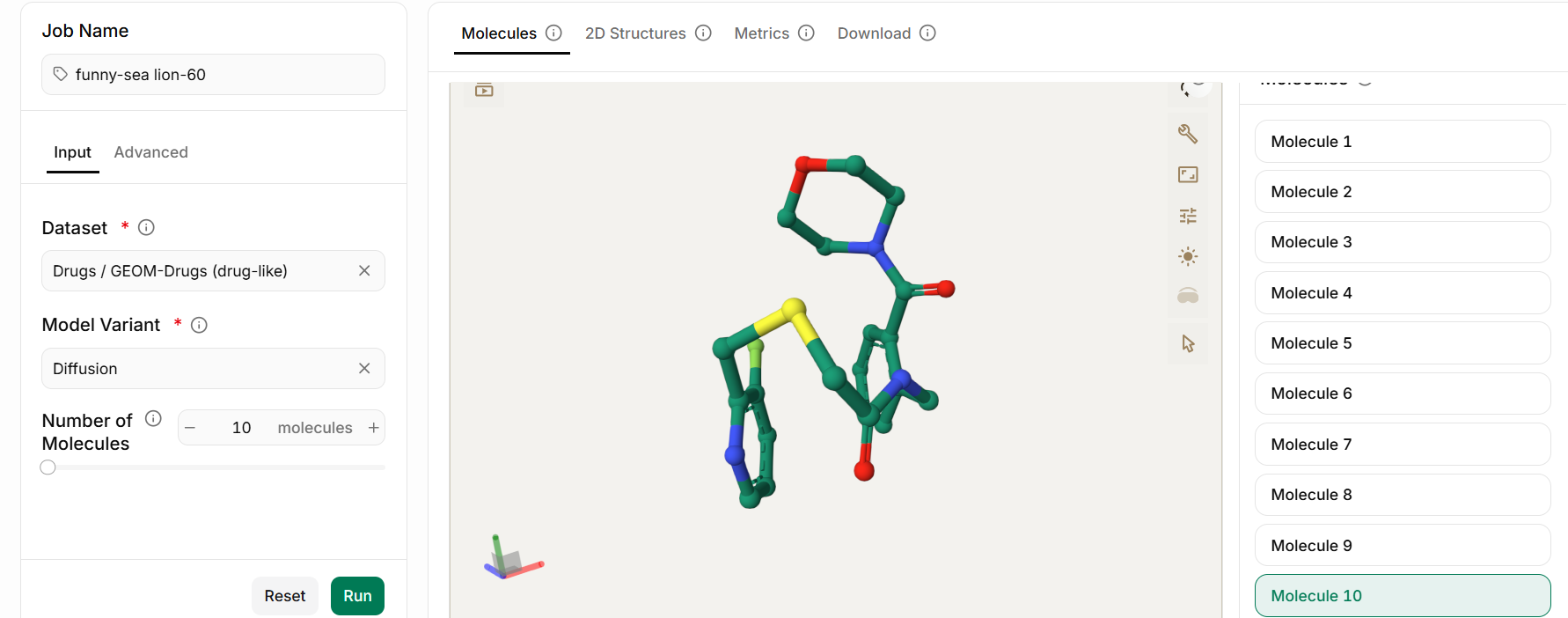
Generate small-fragment molecules (≤9 heavy atoms) trained on the QM9 dataset, ideal for fragment-based drug discovery and building-block exploration.
-
Generate drug-like molecules (up to ~125 atoms) trained on the GEOM-Drugs dataset, producing full-scale candidates suitable for docking and ADMET screening.
-
Choose between generation strategies — full diffusion, flow-matching (for faster inference with fewer timesteps), or a lightweight quick-diffusion variant — depending on the balance of quality and speed required.
-
Obtain automatic quality metrics for every generated batch, including molecular stability, RDKit validity, QED drug-likeness, synthetic accessibility, LogP, Lipinski compliance, uniqueness, and diversity scores.
What the output means
The output provides a multi-record SDF file containing all generated 3D molecules, with per-atom coordinates, atom types, formal charges, and bond orders — ready for immediate use in molecular modelling, docking, or filtering pipelines. Alongside the structures, a metrics report summarizes stability, validity, drug-likeness, and diversity of the generated batch.
This output should be used to support scientific decision making. It does not replace experimental validation. Generated geometries may still contain physically unreasonable bond lengths or angles, and downstream energy minimisation or structure optimisation is recommended before use in docking or simulation workflows.
Why this matters
De novo 3D molecule generation has long been a bottleneck in early-stage drug discovery. Traditional approaches either rely on curated fragment libraries — limiting chemical novelty — or use sequential pipelines that first generate a 2D graph and then attempt to embed it in 3D space, often producing geometrically implausible structures. Megalodon's joint continuous-and-discrete denoising framework eliminates this two-stage bottleneck by learning a unified mapping from noise to complete 3D molecular graphs, enabling researchers to explore genuinely novel regions of chemical space with geometrically coherent structures from the outset.
The availability of Megalodon on Vecura democratises access to this state-of-the-art generative capability. Previously, running these models required managing NVIDIA NGC credentials, downloading gated pretrained checkpoints, provisioning GPU infrastructure, and orchestrating complex sampling scripts. By wrapping Megalodon in a guided, no-setup workflow, Vecura allows researchers to focus on the chemistry — generating, filtering, and evaluating novel 3D molecules — rather than the engineering overhead. This is particularly impactful for smaller research groups, academic labs, and biotech startups that lack dedicated ML-ops resources but need access to cutting-edge generative models to accelerate their discovery pipelines.
-
Developed by: Daniel Reidenbach and Filipp Nikitin, NVIDIA BioNeMo & Carnegie Mellon University (2025)
-
Source: Official GitHub repository (NVIDIA-BioNeMo/megalodon)
-
Reference: arXiv:2505.18392 | Pretrained weights on NVIDIA NGC
Vecura で Megalodon を試す。
モデルワークスペースを開き、ご自身の入力で評価を始めましょう。