Vecura Biotech Insiders #07: Beta-Lactam Design Against Amoxicillin: The Highest-Scoring Edit Was the One That Breaks the Drug
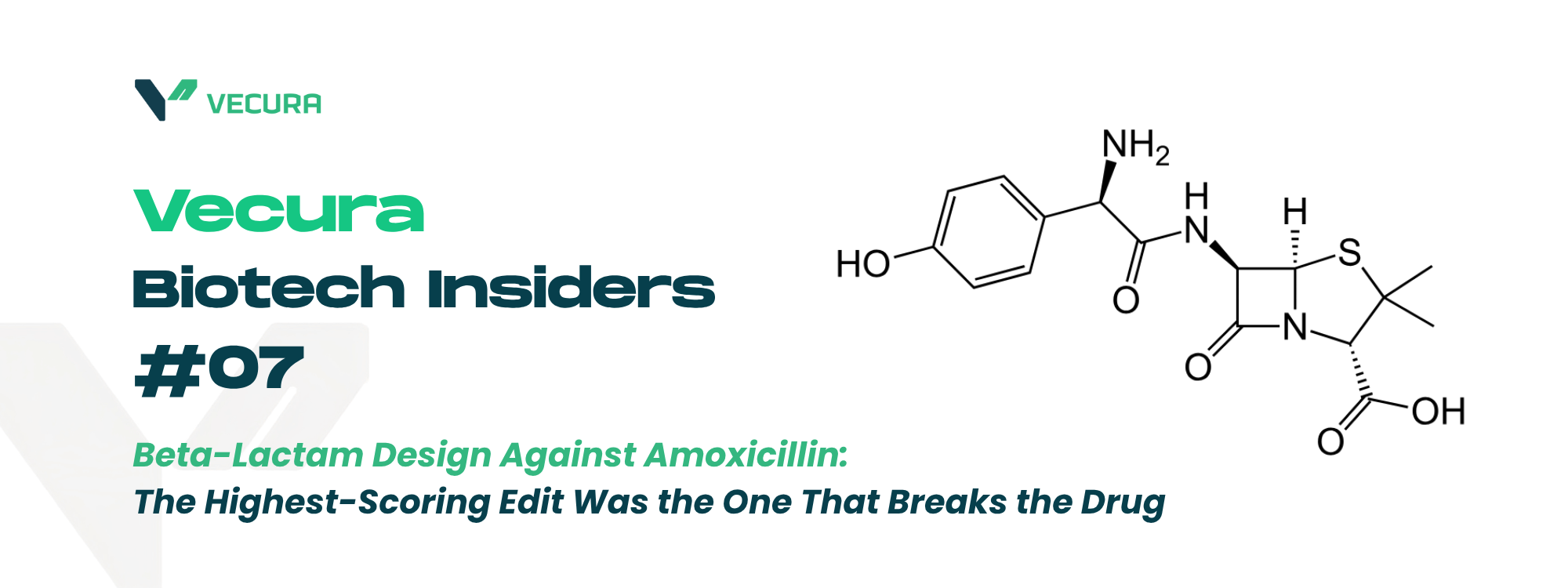
In this seventh edition of Vecura Biotech Insiders, we highlight a workflow shared with the Vecura team by Azlan Firdaus Iskandar: a constrained generative design campaign against amoxicillin's beta-lactam core, and what it took to stop the highest-scoring edit from being the one that breaks the drug.
A User-Shared Workflow From The Vecura Community
A beta-lactam design campaign run against amoxicillin, twice over. Twice the scoring tried to optimize away the part that makes the molecule work, and twice it had to be caught before it got through.
A molecule can top every generative and ADMET score in the room and still lose the exact feature that makes it a drug, because none of those scores know what a beta-lactam ring is for.
Amoxicillin's four-membered beta-lactam ring is what lets its carbonyl acylate the catalytic serine of a penicillin-binding protein and shut it down; its free alpha-amino group is what gives it Gram-negative coverage beyond penicillin G. Neither is measured by similarity, drug-likeness, toxicity or docking affinity. All four scores can improve while both quietly disappear. Azlan Firdaus Iskandar ran the campaign in two arms to see how far that goes.
Arm one, generation with nothing held fixed
MolMIM was given amoxicillin as the template and no structural constraint. It returned nine molecules with strong generative scores, structurally adventurous, carrying thiazolidine cores, bicyclic scaffolds, sulfone variants and fluorinated aromatics.
Docked against penicillin-binding protein 1a (PBP1a) and scored across affinity, toxicity and drug-likeness, the set looked healthy. Drug-likeness ran between 0.74 and 0.89. Several compounds carried predicted liver injury an order of magnitude below anything the constrained arm would later produce, one as low as 0.008. The leader, referred to here as compound 5, combined the best affinity in the set at −9.32 kcal/mol with an acceptable liver signal of 0.595.
Checked directly against the ring, though, every MolMIM output had lost the four-membered lactam. Compound 5 turned out to be a five-membered hydroxy-imide with a chlorophenyl group, no beta-lactam, no free alpha-amino group. The generative score, the ADMET panel and the docking score were all satisfied, and between them they had retained neither feature the molecule needs.
The optimization round that followed is worth reporting because it failed instructively. The goal was to lower compound 5's liver signal while holding affinity. Six analogs were designed against the hypothesis that the alpha-hydroxy amide was the metabolic soft spot. The hypothesis was wrong. The two edits removing the hydroxyl came back at 0.575 and 0.604 against a parent of 0.595, essentially neutral. The chlorine was the driver, and removing it dropped the liver score by about thirty percent while costing between 0.37 and 0.74 kcal/mol of binding, because the same halogen was making a productive contact in the pocket.
Under equal weighting, the analog that ranked first was the one that made the liver signal worse, at 0.687 against the parent's 0.595. It won on raw affinity. Not one of the six cleared the project gate of affinity at or below −9.0 with liver injury under 0.60.
Both of the top-ranked edits also deleted the free alpha-amino group, the feature responsible for the Gram-negative coverage that distinguishes ampicillin and amoxicillin from penicillin G. The highest-scoring edits available were the two most likely to abolish the activity the molecule exists to have.
The scores agreed. The structure disagreed.
None of the nine MolMIM outputs retained the beta-lactam. The generative model, the docking score and the ADMET panel were all satisfied at once, and all three were wrong about the thing that actually mattered, because none of them was ever asked to look at the ring.
What we changed
Two things, both direct consequences of the first arm.
The core was specified. ChemBounce was given the beta-lactam ring as a substructure to preserve and the phenol marked as the fragment to vary, so the warhead could not be spent.
The weighting was changed. Equal weighting across affinity, toxicity and drug-likeness had rewarded binding at the expense of the exact liability the project existed to fix. The second arm was scored at 0.2 for docking, 0.4 for toxicity and 0.4 for drug-likeness, weights that reflect what the campaign actually wanted.
Arm two, generation with the core held fixed
ChemBounce returned 22 analogs, every one carrying the fused beta-lactam and thiazolidine system intact. Variation landed where it was directed, on the aromatic residue at the alpha-amino position, giving biaryls, naphthalenes, hydroxypyridines, hydroxymethyl and carboxylic acid substitutions and thiophenol analogs.
The reweighted ranking reorders the set in a way the equal-weight version did not.
| Rank | Compound | Docking | DILI | LogP |
| 1 | alpha-hydroxybenzyl | −9.74 | 0.50 | −0.32 |
| 2 | benzyl alcohol, ortho | −9.64 | 0.49 | −0.19 |
| 3 | hydroxymethyl, meta | −9.59 | 0.52 | −0.19 |
| 4 | biphenyl, ortho | −10.48 | 0.86 | 1.99 |
| 5 | biphenyl, para | −10.52 | 0.88 | 1.99 |
Table 1. ChemBounce analogs under safety-weighted ranking. The strongest binders no longer lead.
The biphenyls dock hardest, by roughly 0.8 kcal/mol, and they carry predicted liver injury between 0.86 and 0.88. The lipophilicity that buys the binding is the same property driving the flag. Under equal weighting they led the table. Under the safety weighting they sit fourth and fifth, and three compounds with liver scores around 0.50 come to the top while still docking respectably.
The second trap, and it is subtler
The rank-one compound was then taken into optimization. Its weakness was drug-likeness, with a QED of 0.515 held down by four hydrogen-bond donors, a polar surface area of 133 Ų and a logP of −0.32. The molecule is over-functionalized with polar groups, and every route to a higher score points the same way, which is to remove a donor and add lipophilicity.
Ten modifications were generated and scored. The two best lifted QED from 0.515 to about 0.79, a gain of 0.28.
This is the same failure as the first arm, arriving through a different door. QED is a composite of eight desirability functions and none of them knows that a particular amine is a pharmacophore. It sees a hydrogen-bond donor, it sees polar surface area, and it recommends removal. The C-3 carboxylate is in the same position, essential for binding penicillin-binding proteins and penalized by the metric.
Worth noting alongside this, all of these compounds carry four Lipinski violations that come from the beta-lactam core itself. That is an inherent property of penicillins rather than something side-chain tuning will fix, and it is a fair illustration of why a general-purpose drug-likeness score is a poor primary objective for this scaffold.
The compound we would advance
Setting aside the edits that strip the pharmacophore leaves the benzylic position, where two modifications give a smaller and safer gain. Removing the hydroxyl entirely, called M3 here, and replacing it with fluorine, called M4. Both lift QED to about 0.645.
Docking and ADMET separate them cleanly, and along a single axis.
| Metric | M3 — hydroxyl removed | M4 — hydroxyl to fluorine |
| Docking affinity (kcal/mol) | −9.65 | −8.85 |
| CNN pose score | 0.765 | 0.657 |
| DILI | 0.47 | 0.61 |
| AMES | 0.044 | 0.112 |
| hERG | 0.008 | 0.031 |
| Carcinogenicity | 0.18 | 0.32 |
| Bioavailability | 0.77 | 0.84 |
| Stereocentres | 4 | 5 |
Table 2. M3 against M4. The fluorine buys absorption and costs everything else.
M3 binds about 0.8 kcal/mol tighter with better pose confidence, and it is cleaner on every toxicity endpoint measured, in several cases by a factor of two to four. It also avoids introducing a new chiral centre, since the carbon–fluorine benzylic position in M4 is stereogenic and both epimers would need separate handling.
M4's advantage is absorption, driven by the higher logP. That is the same lipophilicity that lifts its liver, mutagenicity and cardiac signals, which is the pattern this whole campaign keeps returning to.
M3 clears both project gates, at −9.65 kcal/mol against a threshold of −9.0 and a liver-injury score of 0.47 against a threshold of 0.60. It retains the beta-lactam ring and the free alpha-amino group. Nothing in the unconstrained arm cleared either gate, and nothing in it retained either feature.
What we would take from this
Where the mechanism depends on a specific substructure, that substructure belongs in the constraints. ChemBounce kept the beta-lactam because it was told to, and MolMIM lost it because nothing in the objective protected it. The difference between the two arms was one line of configuration.
Composite metrics need a mechanism-aware veto. QED, drug-likeness and equal-weight rankings are useful for sorting a list and unsafe as objectives, because they will trade away whatever they cannot see. In this campaign the correct answer was the third-ranked edit rather than the first, twice.
Weight the score toward the liability you are actually trying to fix. Moving from equal weighting to 0.2 docking and 0.4 each on toxicity and drug-likeness changed which compounds reached optimization, and the compound that eventually cleared the gates came from that reordering.
Why Vecura helps
Vecura ran both arms of this campaign side by side, same starting molecule, same docking target, same ADMET panel, so the only variable between them was whether the pharmacophore was written into the constraints. That comparability is what turned “the constrained arm did better” from an impression into a measurement: nothing in the unconstrained arm cleared either project gate, and nothing in it retained either feature the molecule needs.
It is also what let the second trap surface before synthesis. Re-ranking the same 22 analogs under a safety-first weighting, then pushing the new leader through another round of optimization, happened inside the same workflow, so the QED-driven attempt to strip the C-3 carboxylate was visible immediately, not after the compound had already been ordered.
Azlan Firdaus Iskandar's use of both arms, one unconstrained, one with the warhead and the weighting fixed, is what makes this a controlled comparison rather than a single generative run taken on faith.
A fair word on scope
This campaign was computational from end to end. No compound was synthesised and no antibacterial activity was measured, so nothing here demonstrates antibiotic action. Docking scores describe reversible binding and do not represent the covalent acylation by which beta-lactams inhibit penicillin-binding proteins, so they should be read as positioning rather than mechanism. Toxicity and drug-likeness values are model predictions. The claim that M3 retains the pharmacophore is a structural observation, not evidence of activity, and confirming it requires synthesis and susceptibility testing.
Thank you, Azlan Firdaus Iskandar, for running this campaign and sharing the full workflow with the Vecura team.
今すぐVecuraを試す
自分の入力を持って、Vecuraができることを探求しましょう