Vecura Biotech Insiders #09: It cleared every filter. Then the most confident synthesis step turned out to be impossible.
For Vecura Biotech Insiders Spotlight #09, Kerem brought us a campaign that passed four straight stages of computational scrutiny and stalled on the fifth, the one that decides whether anyone could ever hold the molecule in their hand.
A workflow shared with the Vecura team by Kerem Demir
One hundred de novo molecules against CDK6, filtered on ADMET, redocked, and held in the ATP site through molecular dynamics. Kerem Demir’s retrosynthesis search then explored 912 routes and solved none of them.
For Vecura Biotech Insiders Spotlight #09, Kerem brought us a campaign that passed four straight stages of computational scrutiny and stalled on the fifth, the one that decides whether anyone could ever hold the molecule in their hand.
Why CDK6
CDK6 is a validated oncology target. Palbociclib, ribociclib and abemaciclib are approved CDK4/6 inhibitors in hormone receptor positive breast cancer, so the pocket is well characterised and the chemistry around it is well precedented.
That is precisely why Kerem picked it. A well-trodden pocket is a fair place to run a full design pipeline end to end and see where it actually holds, not the exotic target where everything is expected to be hard, but the ordinary one where a failure is informative.
Kerem ran five stages on Vecura against PDB 2EUF: de novo generation, ADMET triage, redocking, molecular dynamics on the lead, and retrosynthetic planning. The first four went well. The fifth is the one worth reading.
Stage 1: De novo generation
Kerem generated 100 molecules against the CDK6 pocket with PocketXMol. Confidence scores, which reflect how well each molecule fits the pocket geometry, clustered tightly around 1.44. Seventy-one percent fell between 1.4 and 1.5, thirteen percent scored at or above 1.5, and only two fell below 1.3, with the lowest at 1.2608.
A narrow distribution like this indicates the model found a consistent solution to the pocket rather than scattering. It says nothing yet about whether those molecules are drug-like, selective or makeable.
Stage 2: ADMET triage
ADMET-AI scored the full set, and the ranking combined design confidence at fifty percent with drug-likeness at thirty and predicted safety at twenty.
| Rank | Mol | Composite | MW | QED | hERG | Bioavail. |
| 1 | 92 | 1.152 | 379 | 0.714 | 0.923 | 0.790 |
| 2 | 8 | 1.132 | 407 | 0.460 | 0.872 | 0.916 |
| 3 | 65 | 1.127 | 339 | 0.583 | 0.909 | 0.907 |
| 4 | 72 | 1.124 | 343 | 0.776 | 0.918 | 0.928 |
| 9 | 93 | 1.116 | 368 | 0.885 | 0.791 | 0.891 |
Table 1. Top-ranked molecules after combined design and ADMET scoring.
The composite spread across the top ten is narrow, from 1.152 down to 1.115, which means the ranking is not strongly discriminating and any of these could reasonably be advanced. Molecule 92 led on the combined score. Molecule 72 had the best drug-likeness at QED 0.776 with good predicted bioavailability. Molecule 93 had the highest QED in the set at 0.885 and the lowest predicted hERG liability.
Stage 3: Redocking
Kerem redocked the top ten against 2EUF with AutoDock Vina. Nine succeeded, with a mean affinity of -10.3 kcal per mole across a range of -11.6 to -6.2.
Two results are worth separating from the headline. Molecule 22 could not be docked, its SMILES carried a piperidine salt counterion, written as a disconnected component, and the docking step failed on it. This is a preparation issue rather than a property of the molecule, and worth catching upstream rather than losing a compound at this stage.
Molecule 8 docked far weaker than its scores implied. It carried the highest design confidence in the set and good predicted ADMET, and it returned -6.2 kcal per mole, roughly four to five kcal per mole behind its neighbours. Design confidence describes fit to the pocket at generation time and does not guarantee that an independent docking engine will reproduce it.
The two strongest binders were molecule 92 at -11.6 kcal per mole, which had also led the ADMET ranking, and molecule 72 at -11.4. Kerem carried molecule 72 forward on the combination of affinity and the best drug-likeness in the set.
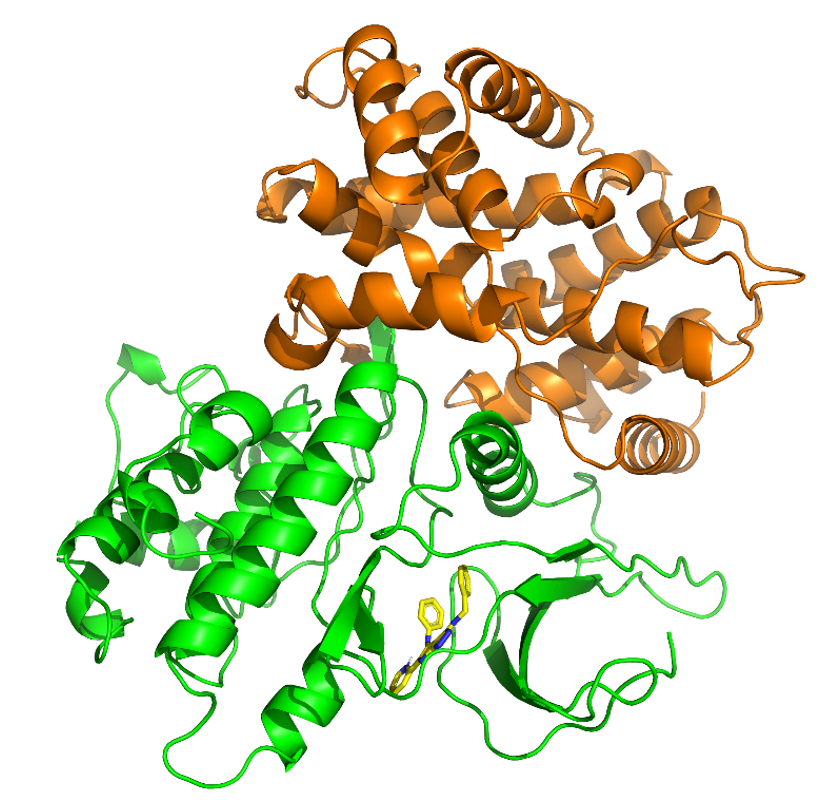
FIGURE 1: Molecule 92 docked to CDK6, -11.6 kcal per mole.
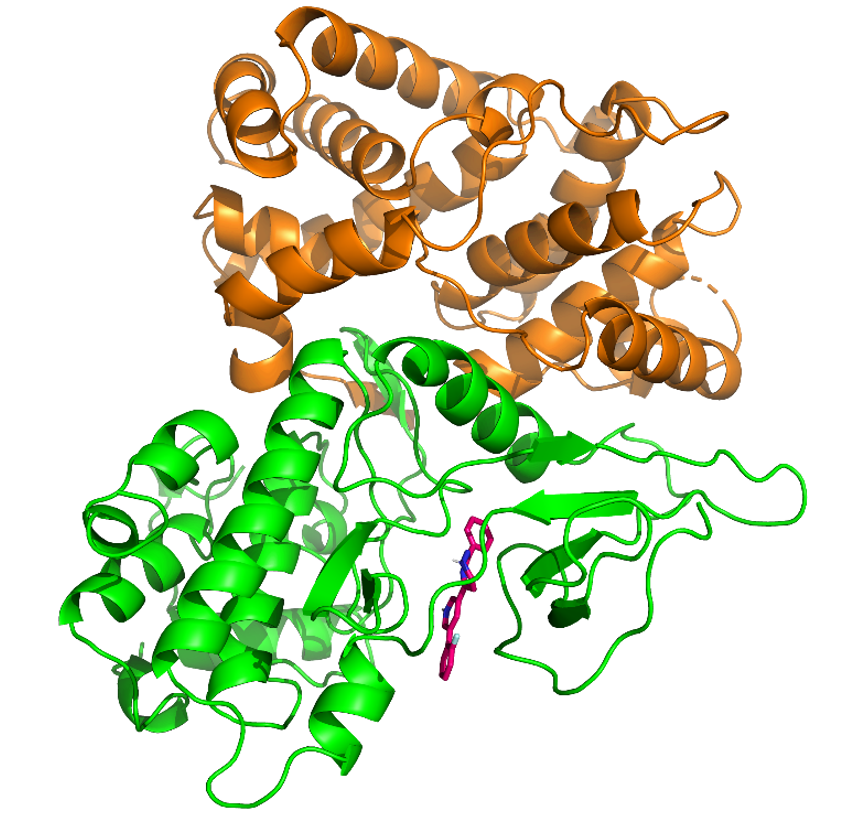
FIGURE 2: Molecule 72 docked to CDK6, -11.4 kcal per mole. This compound was taken forward.
Stage 4: Molecular dynamics
Molecule 72 was parameterised and simulated in complex with CDK6 in GROMACS over 2 ns, sampled across 201 frames.
The ligand stayed put. Ligand RMSD averaged 0.086 nm with a standard deviation of 0.024, and the second half of the trajectory sat at 0.097 plus or minus 0.024, so there is no drift and no jump. Contact with the protein was maintained in every one of the 201 frames, with a minimum heavy-atom distance of 2.92 plus or minus 0.14 angstrom. Thermodynamics were clean throughout, temperature at 300.02 K, pressure 0.30 bar, potential energy stable at -927,670 plus or minus 1,209 kJ per mole.
| Kinase element | Residues contacted |
| Glycine-rich loop region | Ile19, Gly20, Val27 |
| VAIK catalytic lysine | Lys43 |
| alpha-C helix glutamate | Glu61 |
| Hinge | Phe98 to Asp104, including Val101 |
| HRD catalytic loop | Gln149 |
| DFG motif | Asp163 |
Table 2. Contact shell at the first frame, mapped onto the kinase motifs by sequence.
That is a conventional ATP-site footprint. The ligand sits between the glycine-rich loop and the hinge while contacting the catalytic lysine, the alpha-C glutamate and the DFG aspartate, and it held that position throughout. Two nanoseconds is long enough to show the docked pose does not immediately collapse. It is not long enough to establish binding stability.
.gif)
Figure 3: Molecule 72 in the CDK6 ATP site across 2 ns of simulation. The ligand maintains contact in all 201 frames with a mean RMSD of 0.086 nm.
A pose that survives 2 ns can still unbind at 100. Read this stage as a sanity check on the docked pose rather than as evidence of residence time.
Stage 5: Retrosynthesis, and where the pipeline stops
Kerem ran AiZynthFinder on molecule 72. It completed without error, explored 912 routes over 396 iterations in 120 seconds, and returned is_solved = false.
Not one route reached purchasable starting material. The eleven routes it returns are the closest approaches rather than solutions, and every one of them terminates on a compound that cannot be bought.
The blocker is a single ring
Molecule 72 is C21H15FN4 at 342.38 daltons. Its ring census is three aromatic six-membered rings plus one seven-membered ring containing three nitrogens, two of them directly bonded. That N-N bond is the defining feature of the scaffold.
Nine of the eleven routes score identically at 0.7375. That is not eleven ideas, it is one strategic family with cosmetic permutations of halogenation order and coupling partner. The search converged early and then circled. The state score rewards proximity to purchasable material, so 0.766 for the best route sounds respectable and means little while is_solved is false. It is the score of a route that ends in mid-air.
What the best route actually does
Route 1 runs to seven steps. Three of them delete atoms rather than build the molecule. Steps two through four form an OMe to OH to Cl to H sequence whose entire net effect is removing a methoxy group, a legitimate deoxygenation tactic in isolation, but here it consumes half the route undoing a substituent the target never had.
Step seven is more revealing. It strips a chlorine from the fluorophenyl ring, a chlorine that was never wanted. It arrived because the stock set contains 2-chloro-6-fluorophenylboronic acid but apparently not plain 2-fluorophenylboronic acid, so the search took the chlorinated analogue and then spent a step at policy probability 0.0015, ranked 25th among available templates, to remove the halogen it had just introduced. That is the algorithm papering over a gap in the stock library with its least confident option.
Three of the seven steps are genuinely productive. The Suzuki coupling that joins the two halves, the key bond-forming step in the whole route, scores 0.008.
And the most confident step in the run is wrong
Route 2 is the shortest at four steps and contains the highest-probability single prediction anywhere in the run, at 0.8156. The step converts 1-bromo-2-fluorobenzene with trimethyl borate into what the tool writes as an aryl borate ester, boron attached to the ring through an oxygen, not a direct boron-to-carbon bond as a true arylboronic acid would need. A C-O-B linkage will not transmetalate, so as written the route’s key bond-forming step cannot proceed.
The single most confident prediction in the run is chemically impossible. That is a sharp argument against reading policy probability as a correctness score, because the two measure different things entirely.
The confidence picture across the whole run
All fifty reaction steps across the eleven routes were classified as unrecognised by the USPTO reaction classifier. Not one matched a named reaction type, meaning the model was operating outside the chemistry it was trained to recognise for the entire search. Twenty of the fifty steps carry policy probability below 0.01. Several routes stall on fragments bearing an extra fluorine absent from the target, the same install-then-delete artefact seen in Route 1, arising independently.
What this run actually tells you
The failure is specific and diagnosable rather than a timeout or a malformed input. The search handled peripheral chemistry competently, finding bromination, borylation, POCl3 activation and Suzuki coupling onto real in-stock material. It failed at exactly one thing: opening or closing the nitrogen-containing seven-membered ring.
That is a known limitation class rather than a statement about the molecule. Single-step retro templates mined from reaction databases are built to cut bonds between fragments, and a cyclocondensation that assembles a seven-membered ring from an acyclic precursor is poorly represented in that data. Chemically, the adjacent N-N bond points toward a hydrazine-derived cyclocondensation as the obvious forward disconnection, a reading of the connectivity rather than something this run produced. Unsolved here means outside this tool’s template space. It does not mean unsynthesisable.
The practical consequence for the pipeline, as Kerem frames it: synthetic accessibility belongs earlier. Molecule 72 passed generation, ADMET triage, redocking and dynamics before anyone asked how it would be made. Scoring the generated set on synthetic accessibility at stage 1, or running retrosynthesis across the top ten rather than the single lead, would have surfaced the scaffold problem while there were still alternatives on the table.
Scope
-
This campaign was computational from end to end. No compound was synthesised and no activity was measured, so nothing here demonstrates CDK6 inhibition.
-
Docking scores and ADMET values are predictions. The molecular dynamics run covers 2 ns, which tests pose stability and not binding residence time.
-
The retrosynthesis assessment describes the behaviour of one tool against one stock library, a different tool or an expanded library may reach a different result.
Run de novo design on your own target, with synthetic accessibility scored from the start.
*Every model in this campaign (PocketXMol, ADMET-AI, AutoDock Vina, GROMACS and AiZynthFinder) is available in the Vecura model catalog. Explore more models and tools on Vecura: ***vecura.com
今すぐVecuraを試す
自分の入力を持って、Vecuraができることを探求しましょう


