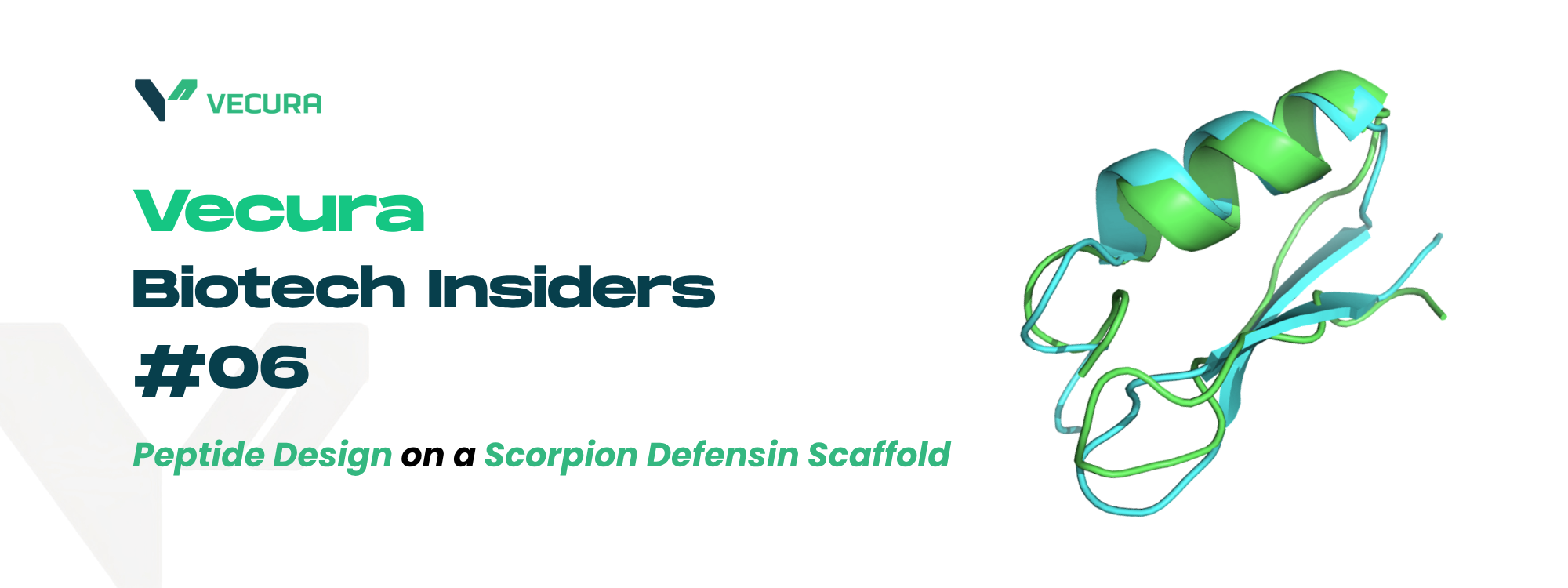
Vecura Biotech Insiders #06: Peptide Design on a Scorpion Defensin Scaffold
In this sixth edition of Vecura Biotech Insiders, we highlight a workflow shared with the Vecura team by Xiao Jing Chen: a scaffold-based peptide design campaign against a scorpion defensin, and what happened when the folded structures and the sequences behind them were finally read side by side.
A User-Shared Perspective From The Vecura Community
A ranking table can quietly become the only thing a design campaign trusts, but a high score on fold fit, charge and solubility doesn't mean a peptide still carries the mechanism it was designed for. Those are separate questions, and only one of them was being asked here.
In this sixth edition of Vecura Biotech Insiders, we highlight a workflow shared with the Vecura team by Xiao Jing Chen: a scaffold-based peptide design campaign against a scorpion defensin, and what happened when the folded structures and the sequences behind them were finally read side by side.
Scorpion venom peptides that block voltage-gated potassium channels do it through a small, specific arrangement of two residues: a lysine whose side chain inserts into the channel pore and occludes it, and an aromatic residue roughly six to seven ångström away that anchors against a hydrophobic patch on the channel surface. This pairing is known as the functional dyad, and it recurs across structurally unrelated toxins from scorpions, sea anemones, snakes and cone snails, a strong hint that it is doing real work.
Designing a new blocker on an existing scaffold therefore means preserving two things at once. The fold, because the dyad is a three-dimensional arrangement and a collapsed peptide cannot present it. And the residues themselves, because a perfect fold with nothing to insert into the pore blocks nothing.
Those are different requirements, and a design campaign can satisfy one while quietly failing the other. This one did.
The run
Xiao Jing Chen set up the campaign on BmKDfsin3, a 38-residue defensin-like peptide from scorpion venom, held in shape by three disulfide bonds.
CyclicMPNN generated one hundred novel sequences onto that backbone, each scored for how well it fits the scaffold. The full set was re-scored with five samples per sequence to give a mean rather than a single-shot number, which matters when the score is used to rank.
Sequences were then ranked on net charge at physiological pH, basic residue count, predicted solubility from NetSolP, and thermostability from TemStaPro, together with the scaffold-fit score. The top three went to structure prediction with HighFold, run with disulfide constraints, to test whether the cage still closes.
Only one design closed the cage
| Candidate | Mean pLDDT | Disulfides | Connectivity |
| #86 | 78.8 | 3 of 3 | 4–25, 11–33, 15–35 |
| #27 | 74.3 | 2 of 3 | 4–25 open at 3.5 Å |
| #83 | 66.2 | 2 of 3 | 4–25 open at 6.7 Å |
Table 1. Structure prediction outcome for the top three ranked designs.
Candidate 86 closed all three disulfides in the native pairing pattern, with the braced core at per-residue confidence between 83 and 88 and only the flexible termini falling below.
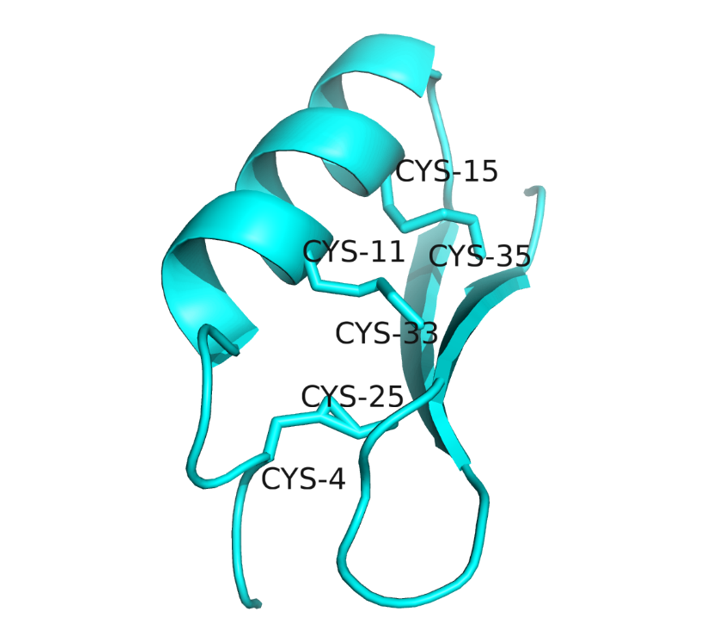
Figure 1. Predicted structure of candidate 86 with all six cysteines labelled. The three pairs close across the cysteine-stabilised helix and sheet, giving native defensin connectivity.
Candidate 83 returned the lowest confidence and left the first cysteine pair 6.7 ångström apart, far outside bonding distance. Candidate 27 came close, at 3.5 ångström, near enough that experimental oxidation might complete it.
On the fold question the answer was clean. Candidate 86 wins.
Aligned against the parent with US-align, candidate 86 gives a backbone deviation of 2.43 ångström across 34 of 38 residues, with all three bonds preserved in the correct pairing, at 29.4 percent sequence identity. The fold is held while the sequence has moved a long way, which is what a scaffold design campaign is supposed to achieve.
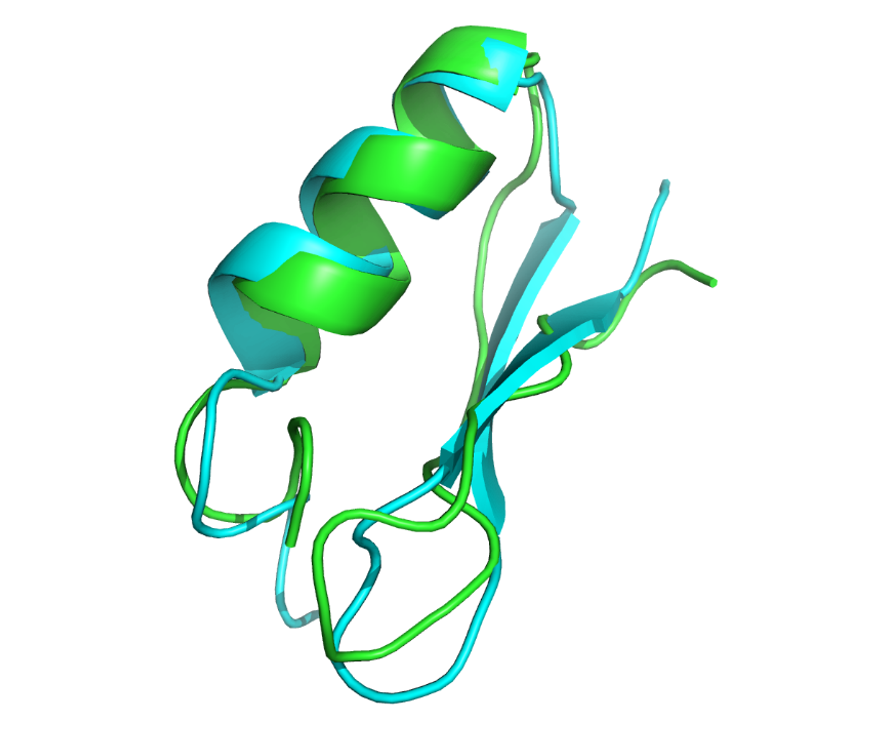
Figure 2. Candidate 86 (cyan) superposed on the parent BmKDfsin3 (green). The helix and sheet trace the same path despite 29.4 percent sequence identity, with the four unaligned residues at the flexible termini.
Then we counted the aromatics
The dyad needs a lysine and an aromatic partner. Xiao Jing Chen counted those residues across the parent and the three designs, and the picture got uncomfortable.
| Peptide | Aromatic residues | Lysines | Fold outcome |
| Parent BmKDfsin3 | 5 — F2, F6, Y24, F28, Y36 | 3 | native |
| #86 | 1 — Y6 | 4 | 3 of 3 closed |
| #83 | 8 | 2 | 2 of 3 |
| #27 | 1 — F38, flexible terminus | 2 | 2 of 3 |
Table 2. Residues available to form a functional dyad, by sequence.
This does not prove the dyad is absent. Dyad geometry is a three-dimensional measurement between specific side chains, not a residue count, and blockers lacking the canonical dyad do exist. But a peptide with one aromatic has very few ways to build the pairing, and the design that retained the parent's aromatic character, candidate 83, is the one whose cage would not close. The structural winner, candidate 86, lost four of the parent's five aromatics, keeping only Y6 near the N-terminus. Candidate 27 fares worse still, retaining only a C-terminal phenylalanine sitting in the segment the fold prediction marks as low-confidence and flexible.
The ranking never asked this question, which is why nobody noticed until the sequences were read back.
What the scoring was actually selecting for
Looking back at the weighting explains the outcome. Net charge and basic residue count carried most of the weight, with fold fit and solubility behind them. Those terms are defensible for a channel blocker, since positive charge steers a peptide toward the negatively charged outer vestibule and the fold has to be right for any surface to present correctly.
What the ranking contained no term for was the dyad. The single feature most associated with this mechanism carried no weight at all, so the optimiser had no reason to protect it and every reason to spend aromatic positions on residues that improved the terms being scored.
Two further terms in the weighting, amphipathicity and overall hydrophobicity, measure how readily a peptide partitions into a lipid bilayer. That is the right question for a membrane-disrupting antimicrobial peptide and the wrong one for a pore blocker, which has to stay soluble and available to bind a protein surface.
The next round is straightforward to specify: score dyad geometry directly, which means folding many more than three candidates so the measurement can be made; weight fold retention higher; keep charge as a secondary term; and drop the membrane-partitioning features entirely.
The developability read
Property profiling with PepFuNN gives the practical picture, and it is mostly encouraging, with one number that needs interpreting rather than acting on.
At 3,963 Da, the peptide sits within the normal range for a therapeutic peptide. It is strongly hydrophilic, which for this objective is the right direction, a pore blocker has to remain in solution and available to engage a protein surface, so the hydrophilicity that would count against a membrane-disrupting peptide counts in favour here.
The instability index came back at 89, well above the conventional threshold of 40. That number should be treated with care rather than designed around: it is calculated from dipeptide composition along a linear sequence and carries no information about disulfide bonds, so for a peptide braced by three of them it is an upper bound rather than a measurement. The more concrete liability is the single methionine at position 16, which is oxidation-sensitive and a reasonable candidate for substitution in a later round.
Both synthesis rules failed, which for a 38-mer requiring three regioselective disulfide bonds is expected rather than alarming. It is nonetheless a real cost and timeline consideration, and argues for confirming the disulfide connectivity experimentally early, before any activity work is commissioned.
Why Vecura helps
Vecura ran this as one connected workflow rather than a string of disconnected tools, generate with CyclicMPNN, rank, fold the top candidates under disulfide constraints with HighFold, and align the winner back against the parent with US-align, all in the same session. That continuity is what let both signals in this campaign surface together instead of one at a time.
The fold result (candidate 86 closing the cage at 29.4 percent identity to its parent, confirmed against the parent structure) is a genuine result, and it is the hard part of scaffold design. The dyad gap, the same candidate keeping only one of the parent's five aromatics, is a specific, testable reason the current selection function is incomplete. That is more useful than a ranking nobody interrogated.
Reading the fold output and the sequences back to back, in the same afternoon, is what surfaced both facts before either had a chance to become a wet-lab surprise.
A fair word on scope
This campaign was computational from end to end. No binding assay, no docking against a potassium channel and no experimental oxidation has been performed, so nothing here demonstrates channel-blocking activity. Predicted structures are hypotheses, and the disulfide connectivity requires experimental confirmation. Dyad presence was assessed here by residue availability rather than by measured three-dimensional distance, and a structural measurement is needed before any conclusion about the pharmacophore. Property predictions carry their own limits, and sequence-based stability metrics in particular are not parameterised for disulfide-constrained peptides. None of the designs reached the parent peptide's net charge of +8.9.
今すぐVecuraを試す
自分の入力を持って、Vecuraができることを探求しましょう