AF2Dock Is Now Available on Vecura
This update enables structural biologists, antibody engineers, and drug discovery researchers to predict protein-protein docking poses from monomer structures through a guided workflow inside Vecura, without setting up complex GPU infrastructure or computing multiple sequence alignments.
What is AF2Dock?
AF2Dock is a generative, MSA-free protein-protein docking model built by adapting AlphaFold-Multimer (via the OpenFold implementation) for structure-based docking. It replaces AlphaFold-Multimer's template module with a dedicated docking module and trains the entire network end-to-end with a flow-matching objective—learning to iteratively denoise a randomly placed ligand pose into the correct bound conformation over a fixed number of steps. Instead of relying on costly multiple sequence alignments, it uses ESM-C 600M sequence embeddings, making it fast to run on novel protein pairs.
It helps users generate multiple candidate bound poses for two protein monomers—each possibly multi-chain—starting from unbound, apo, or AlphaFold-predicted structures. It is especially useful for antibody and nanobody–antigen complexes, where the preprint reports it is competitive with or outperforms co-folding approaches, while also producing orthogonal predictions that succeed where co-folding models fail.
What can users do with AF2Dock on Vecura?
With AF2Dock on Vecura, users can:
-
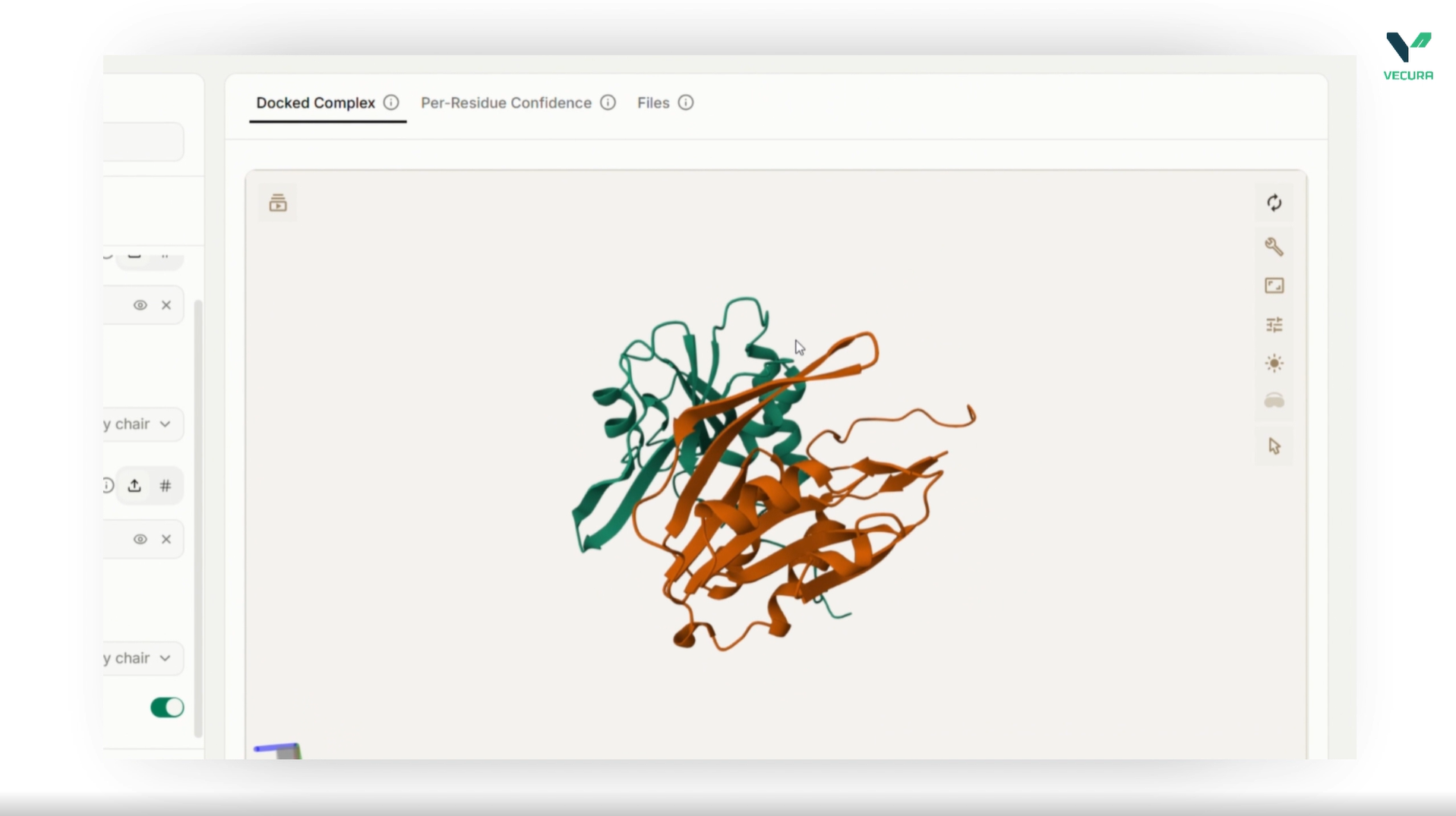
Generate multiple candidate docked poses for a receptor–ligand protein pair directly from monomer structures (apo, holo, or predicted), without computing multiple sequence alignments
-
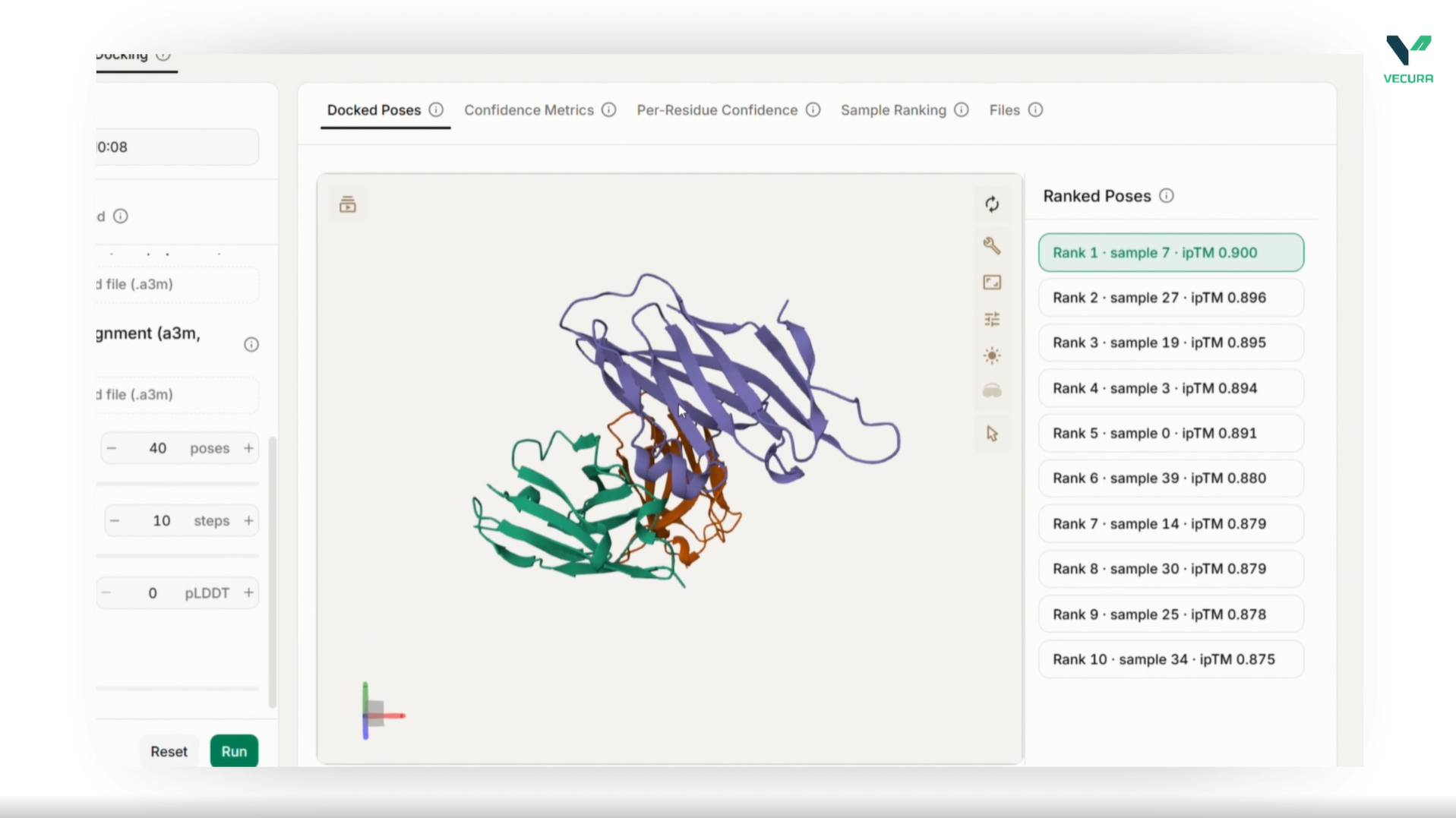
Rank and inspect poses using AlphaFold's own confidence metrics (ipTM, pTM, pLDDT) alongside interface-specific scores (ipSAE, pDockQ, pDockQ2, LIS, interface pLDDT) to identify the most reliable predictions
-
Explore alternative binding poses beyond the top-ranked prediction through a ranked sample bundle and per-sample metrics table
-
Visualize docking trajectories by saving intermediate denoising steps to observe how the ligand converges toward the bound pose
-
Filter low-confidence residues from AlphaFold-predicted monomer inputs using configurable pLDDT cutoffs before docking
-
Supply optional sequence alignment files to account for unresolved residues in monomer structures, improving docking accuracy
What the output means
The output provides a top-ranked docked complex structure in PDB format, along with a comprehensive suite of confidence scores—including ipTM (interface predicted TM-score), pTM, weighted pTM, mean pLDDT, ipSAE, pDockQ, pDockQ2, LIS, and interface pLDDT. Additionally, per-residue pLDDT values, a ranked set of the top 10 poses with their PDB structures, per-sample metrics for all generated samples, and an optional trajectory file showing intermediate docking steps are included for deeper inspection.
This output should be used to support scientific decision making. It does not replace experimental validation.
Why this matters
Protein-protein interactions underpin virtually every biological process, from immune recognition to signal transduction. Understanding how two proteins physically assemble at the atomic level is central to rational drug design, therapeutic antibody engineering, and basic structural biology. Traditional docking methods require extensive conformational sampling and scoring, while co-folding approaches like AlphaFold-Multimer and AlphaFold3—though powerful—depend on computationally expensive multiple sequence alignments and can struggle when input structures deviate from their bound conformations. AF2Dock occupies a distinct niche: it leverages the learned structural representations of AlphaFold-Multimer while operating in a fast, MSA-free, structure-based paradigm that is particularly well suited to antibody and nanobody engineering workflows where monomer structures are already available or easily predicted.
By making AF2Dock available on Vecura, researchers can integrate high-quality protein-protein docking predictions directly into their existing workflows—without managing GPU infrastructure, installing OpenFold dependencies, or configuring complex model checkpoints. The guided interface exposes key parameters such as sampling budget, denoising steps, and input confidence filtering, enabling users to balance speed and thoroughness for their specific use case, from rapid screening of antibody–antigen pairs to detailed exploration of alternative binding modes.
-
Developed by: Xu, Chu & Gray — Gray Lab, Johns Hopkins University
-
Source: GitHub Repository · README · Model Weights on Zenodo
-
Reference: Xu, Chu & Gray (2025). "Adapting Co-Folding Models for Structure-Based Protein-Protein Docking Through Flow Matching." bioRxiv preprint
Try AF2Dock on Vecura.
Open the model workspace and start evaluating it with your own inputs.