Accelerate Protein Design with FrameFlow, Now Available on Vecura
This update enables protein engineers and structural biologists to design novel protein backbones and complex motif-constrained scaffolds directly within the Vecura platform, bypassing the need for complex local infrastructure or manual CUDA environment management.
What is FrameFlow?
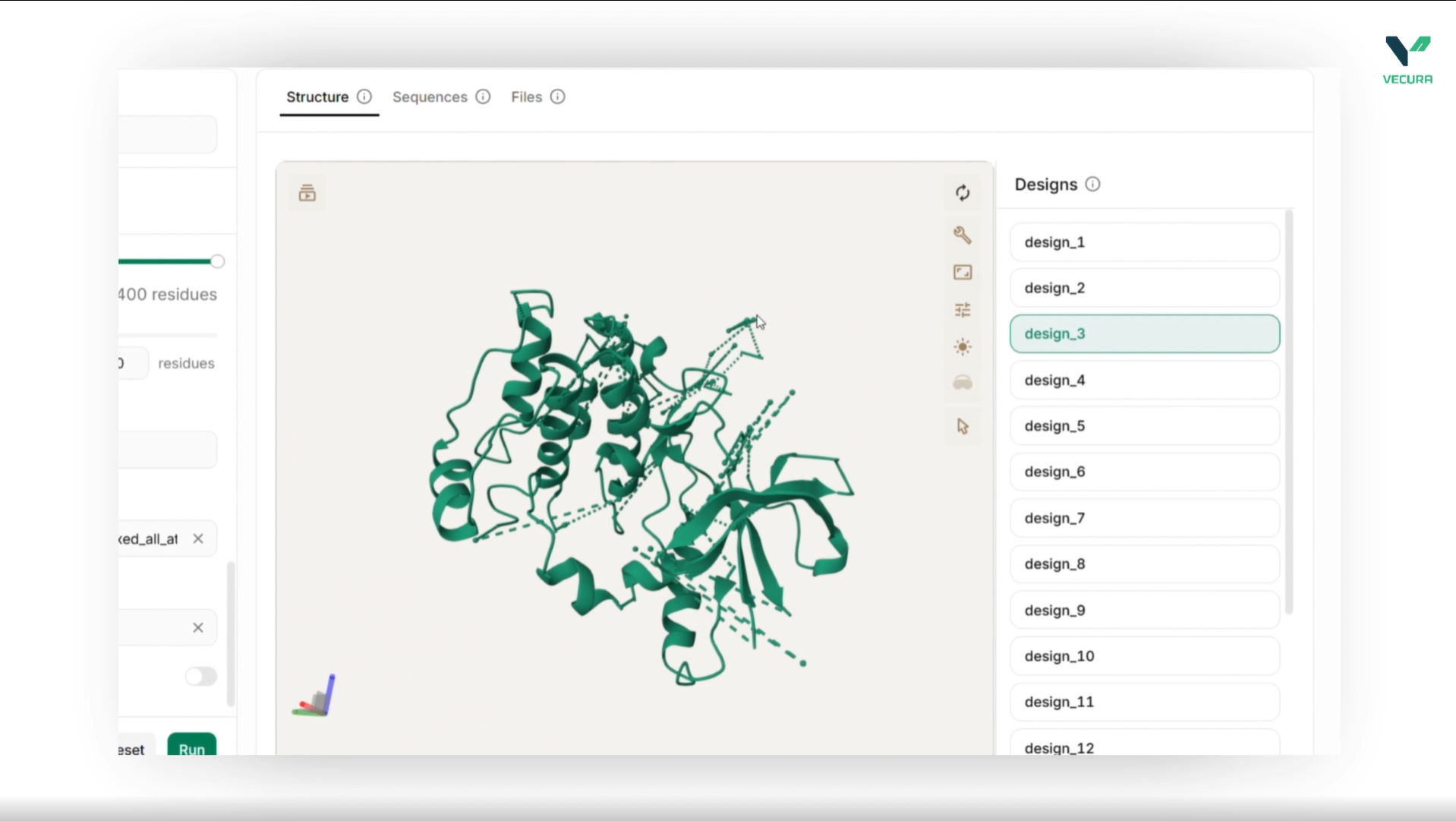
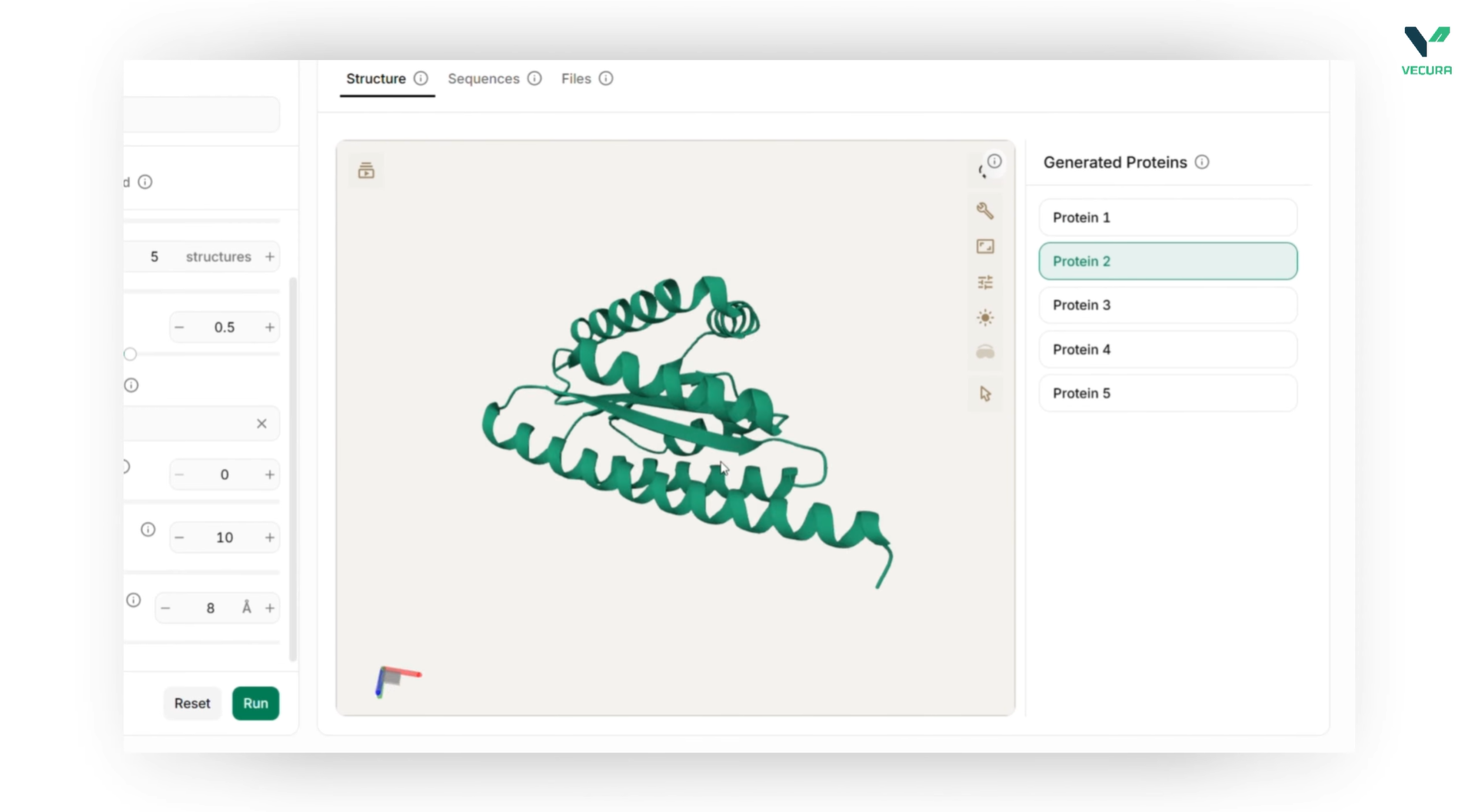
FrameFlow is a state-of-the-art generative model for de novo protein backbone design that utilizes SE(3) flow matching. By representing residues as SE(3) frames—capturing both rotation and translation—the model learns to bridge the path between random noise and structurally valid protein backbones. It offers both unconditional generation for diverse protein structures and specialized motif-constrained scaffolding.
It helps users design novel protein backbones or create structural scaffolds around essential functional motifs, such as binding loops or catalytic sites. It is especially useful for structural biologists and protein engineers who require structurally diverse backbones as a foundation for downstream sequence design and experimental validation.
What can users do with FrameFlow on Vecura?
With FrameFlow on Vecura, users can:
-
Generate novel protein backbones de novo for specific residue lengths, exploring new structural space without relying on templates.
-
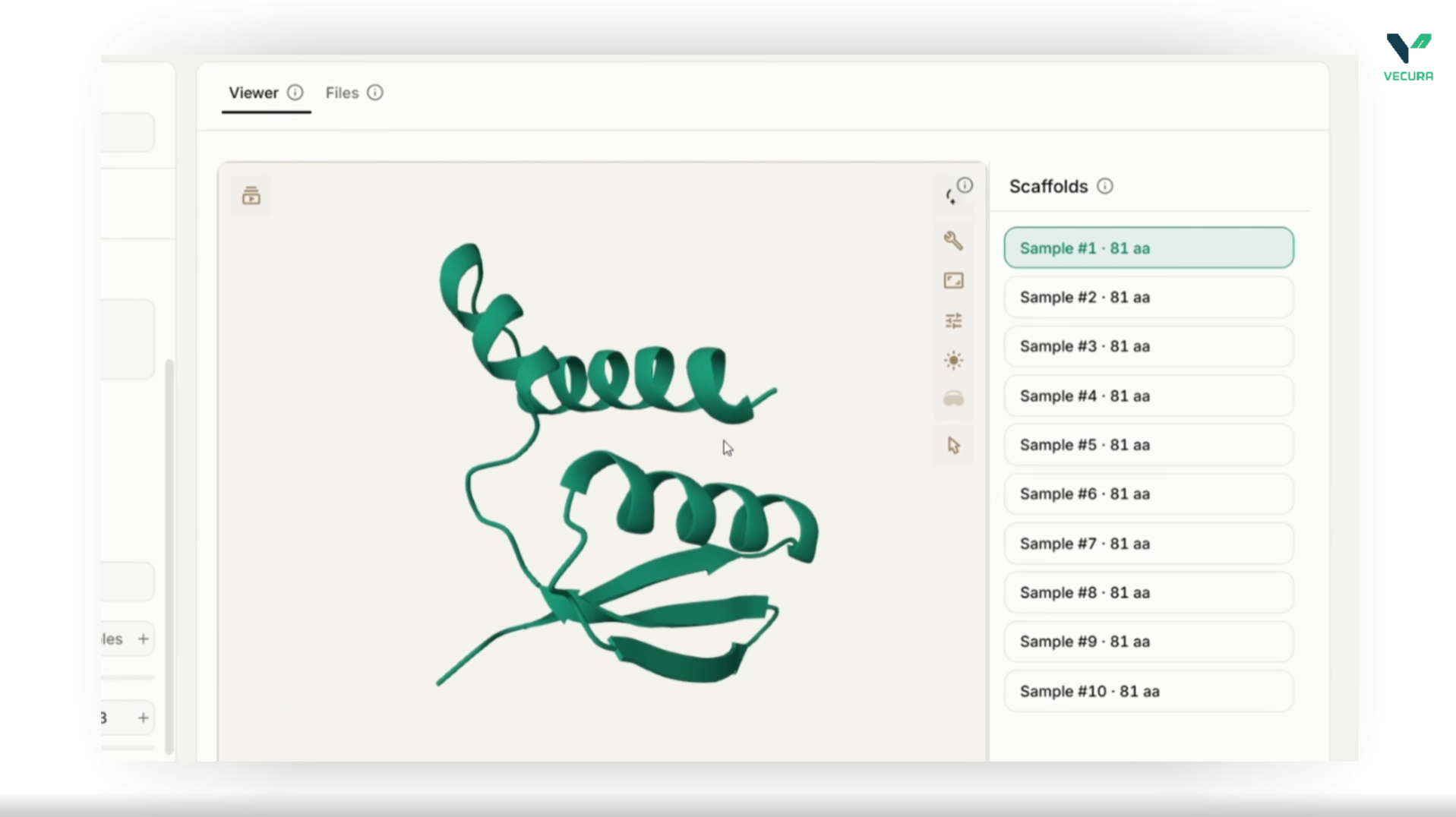
Perform motif-constrained scaffolding, where a functional 3D fragment is fixed in space while the model automatically designs the surrounding protein structure.
-
Leverage FrameFlow-guidance ("twisting") during motif scaffolding to steer the generation process for higher success rates on complex design tasks.
-
Configure inference settings such as the number of integration timesteps and self-conditioning to balance generation speed and structural accuracy.
What the output means
The output provides PDB-formatted text files containing the generated backbone coordinates. For unconditional generation, these files contain the novel backbone structure, while for motif scaffolding, they contain the requested motif fixed at its original coordinates, surrounded by the newly designed scaffold.
This output should be used to support scientific decision-making. It does not replace experimental validation. Since FrameFlow produces only backbone coordinates, it must be followed by sequence design tools (like ProteinMPNN) and structure prediction/validation tools (like AlphaFold2 or ESMFold) before experimental synthesis.
Why this matters
The ability to generate de novo protein backbones is a cornerstone of modern protein engineering, enabling the creation of custom enzymes, therapeutic binders, and novel molecular architectures. Traditional methods often rely on existing structural templates, which limits the diversity of the design space.
By employing SE(3) flow matching, FrameFlow allows researchers to explore the vast, untapped structural landscape of proteins. The integration of motif-scaffolding with guided "twisting" significantly lowers the barrier for designing proteins around specific functional requirements, accelerating the development of specialized therapeutics and synthetic biology components.
-
Developed by: Microsoft Research
-
Source: Official GitHub Repository
-
Reference: Improved motif-scaffolding with SE(3) flow matching (TMLR 2024)
Try FrameFlow on Vecura.
Open the model workspace and start evaluating it with your own inputs.