GeoDock Is Now Available on Vecura
This update enables structural biologists, computational drug designers, and biotech researchers to predict how two protein structures dock into a complex—complete with residue-level flexibility and per-residue confidence scores—through a guided workflow inside Vecura, without setting up complex GPU infrastructure or multiple-sequence alignment pipelines.
What is GeoDock?
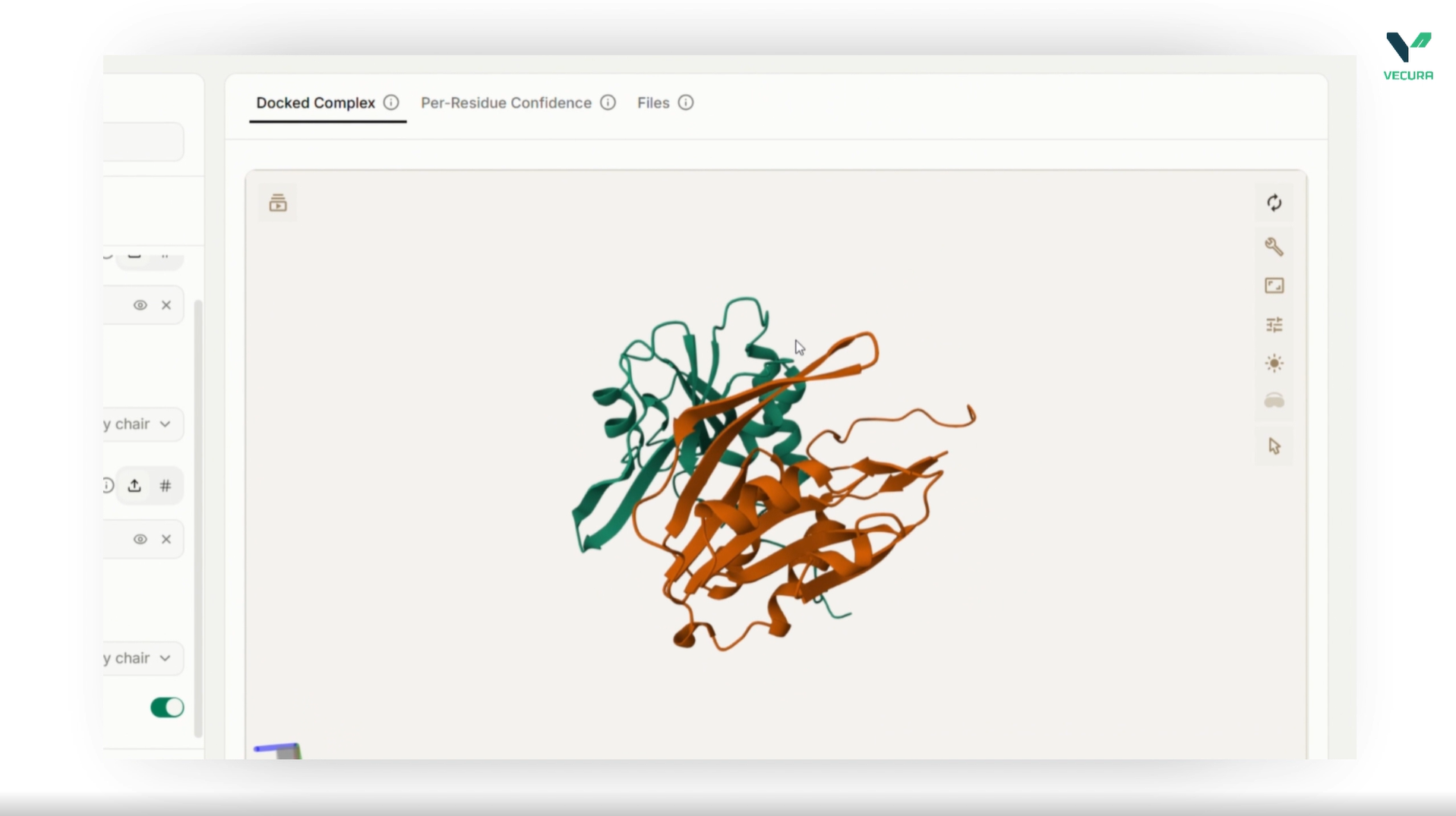
GeoDock is a multi-track iterative transformer network that predicts the docked structure of a protein-protein complex directly from the sequences and 3D backbone coordinates of two separate docking partners. Unlike classical rigid-body docking algorithms that search over a fixed set of poses and cannot accommodate conformational changes upon binding, GeoDock is flexible at the residue level: it iteratively refines per-residue backbone frames so the two partners can shift slightly to accommodate each other. Notably, it requires no multiple-sequence alignment (MSA)—only the two monomer structures and their sequences, encoded via ESM-2 650M embeddings.
It helps users rapidly generate structural hypotheses for protein-protein interactions, including antibody-antigen pairs, signalling complexes, and enzyme-substrate pairs. It is especially useful for structure-based studies where researchers already have (or can predict) monomer structures for each partner and need a fast, sub-second estimate of how they come together before committing to more expensive docking searches or downstream experimental validation.
What can users do with GeoDock on Vecura?
With GeoDock on Vecura, users can:
-
Dock two protein structures into a complex by providing PDB or CIF files for each partner, with optional chain selection and OpenMM-based restrained energy minimisation to relax minor clashes.
-
Evaluate docking accuracy against a native reference using the full DockQ metric family—including DockQ score, cRMS, iRMS, LRMS, Fnat, and per-partner/interface backbone RMSD—to quantify how well a predicted pose matches a known crystal structure.
-
Obtain per-residue confidence scores (predicted lDDT, 0–100) directly from the model's forward pass, enabling users to identify which regions of the predicted interface are most trustworthy.
-
Benchmark and compare docking results across different tools by scoring any predicted complex (from GeoDock or elsewhere) against a ground-truth structure using standardized CAPRI quality thresholds.
What the output means
The output provides a docked protein-protein complex as a PDB file (with chain A as the receptor and chain B as the ligand), per-residue predicted lDDT confidence scores, a mean confidence value, and—when a native reference is supplied—a comprehensive set of docking quality metrics including DockQ (0–1, with ≥0.23 indicating CAPRI acceptable quality), complex RMSD (cRMS), interface RMSD (iRMS), ligand RMSD (LRMS), fraction of native contacts (Fnat), and per-partner backbone RMSD values that quantify the residue-level flexibility applied during docking.
This output should be used to support scientific decision making. It does not replace experimental validation. GeoDock's docking success rate (43% top-1 on DIPS, 31% after training-set decontamination) trails specialised search-based docking tools and AlphaFold-Multimer, and its residue-level flexibility is modest in practice (typically under 1 Å of backbone movement), so predictions should be treated as fast structural hypotheses rather than definitive structures.
Why this matters
Protein-protein interactions (PPIs) are central to virtually every biological process—from immune recognition and cell signalling to enzyme regulation and viral entry. Understanding the three-dimensional structure of these complexes is essential for rational drug design, particularly in the development of biologics such as therapeutic antibodies, protein-based inhibitors, and engineered cytokines. However, experimentally determining complex structures via X-ray crystallography or cryo-EM is time-consuming, expensive, and often infeasible at the scale demanded by modern drug discovery pipelines. Computational protein-protein docking has long served as a bridge, but traditional methods rely on rigid-body search algorithms that cannot model the subtle but biologically important conformational adjustments proteins undergo upon binding.
GeoDock represents a meaningful step forward by combining the speed of deep learning inference (under one second per complex on a single GPU) with genuine residue-level flexibility and no dependency on evolutionary information from multiple-sequence alignments. This makes it particularly valuable in scenarios where MSAs are difficult to construct—such as for de novo designed proteins, rapidly evolving viral antigens, or synthetic antibody libraries—and where researchers need rapid structural hypotheses to triage candidates before investing in experimental validation. While its current flexibility is modest and its success rate trails some established methods, GeoDock's speed, simplicity, and MSA-free design open the door to large-scale docking screens and iterative design-test-learn cycles that were previously impractical with conventional tools.
-
Developed by: Gray Lab, Johns Hopkins University
-
Source: Official GitHub Repository (Graylab/GeoDock) · Colab Notebook · Full text on PMC
-
Reference: Flexible Protein-Protein Docking with a Multi-Track Iterative Transformer. Protein Science, 2023. DOI: 10.1002/pro.4862
Try GeoDock on Vecura.
Open the model workspace and start evaluating it with your own inputs.