Designing a Peptide to Hit LRRK2: A De Novo Generative Pipeline Against the ATP Pocket
A walkthrough of how modern protein design models behave when pointed at a hard, conserved kinase pocket, and what the output does and does not tell us.
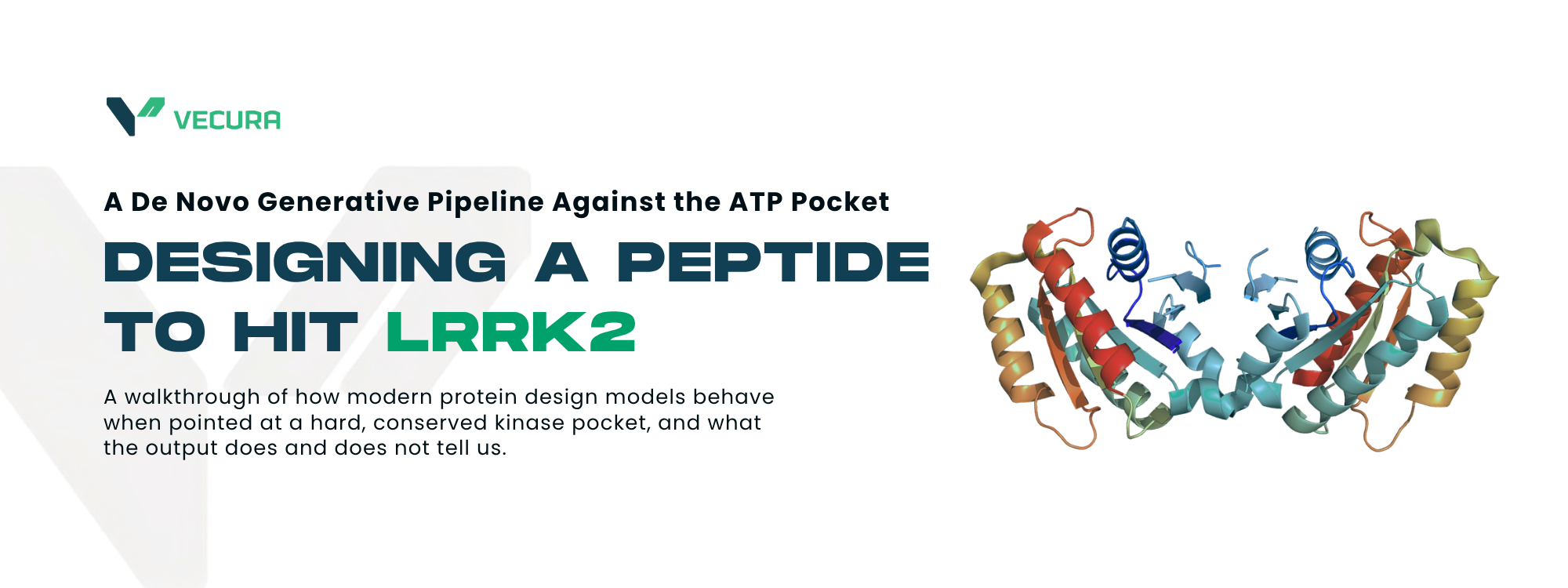
Designing a Peptide to Hit LRRK2: A De Novo Generative Pipeline Against the ATP Pocket
A walkthrough of how modern protein design models behave when pointed at a hard, conserved kinase pocket, and what the output does and does not tell us.
Why LRRK2, in brief
Parkinson's disease still has no therapy that slows the underlying neurodegeneration. Everything in routine use, from levodopa to deep brain stimulation, manages symptoms downstream of neurons that are already lost. That gap is what target-based strategies are trying to close, and leucine-rich repeat kinase 2 (LRRK2) is one of the most credible targets on the table.
Mutations in LRRK2 are the most common known genetic cause of familial Parkinson's, and the recurring theme is a gain of kinase function. The frequent G2019S variant sits in the kinase domain and raises its activity, and elevated LRRK2 activity is thought to impair lysosomal clearance and the vesicle trafficking that keeps dopaminergic neurons healthy. Because the overactivity appears relevant to a subset of idiopathic patients as well, the addressable population reaches beyond mutation carriers. LRRK2 phosphorylates a set of Rab GTPases, so the phosphorylation state of those Rabs gives a measurable readout of whether a drug is engaging the target in living patients.
Brain-penetrant small-molecule inhibitors have already shown that potent, selective central inhibition is achievable and broadly tolerated. The honest caveat is that LRRK2 is also expressed in lung, kidney, and immune cells, so chronic systemic inhibition risks on-target peripheral effects across what could be decades of exposure. That therapeutic-window problem is part of what motivates interest in modalities with cleaner selectivity, which is where a designed binder enters the picture.
The hypothesis, and the tension inside it
The question this piece explores is whether a rationally designed peptide could inhibit LRRK2 by binding inside the ATP pocket of the kinase domain and competing with ATP, shutting down the Rab phosphorylation that drives the downstream pathology. The structural premise is sound. Near-atomic cryo-EM structures resolve how ATP and small-molecule inhibitors sit in the kinase domain, which gives a designer an experimentally grounded template of the pocket geometry, the hinge contacts, and the catalytic residues a competitive binder must engage.
The argument for a peptide over another small molecule comes down to selectivity. A peptide presents a larger and more chemically varied contact surface, so in principle it can read out more of the residues that distinguish LRRK2 from the hundreds of other kinases in the kinome, and that wider interface is the structural basis for a selectivity advantage. A peptide scaffold also offers engineering handles small molecules lack, including non-natural amino acids, macrocyclization, and conjugation for delivery.
The counterargument has to sit right next to the hypothesis, because the ATP pocket is the hardest place to make the peptide case. The pocket is small, deep, and highly conserved, exactly the compact cleft that small molecules occupy efficiently and that flexible peptides bind poorly. A linear peptide pays a steep entropic penalty on binding, is vulnerable to proteases, and characteristically struggles to cross the blood-brain barrier, which is decisive for a brain target. So the credible version of the hypothesis is narrower than the general one. A constrained or macrocyclic peptide, rigidified to pay down the entropic cost and resist degradation, designed against the ATP-bound structure to grip the hinge and catalytic residues while reaching onto a less-conserved neighboring surface, is a candidate whose value lies in selectivity rather than raw potency.
A note on what follows. The pipeline below does not build the constrained, macrocyclic peptide the argument above points to. It generates linear backbones of 50 to 100 residues, which are small protein domains rather than drug-like peptides, and which carry the exact liabilities the hypothesis warned about: entropic flexibility, protease exposure, and almost no chance of crossing the blood-brain barrier unaided. This is worth stating plainly rather than glossing. What the run actually demonstrates is how a de novo generative stack behaves when aimed at this pocket. It is a methods exploration and a source of design lessons, not a candidate-nomination exercise. The closing sections take that framing seriously.
How the workflow was built
The pipeline is summarized in Figure 1. It chains four models, each handing its output to the next, with no experimental step in the loop.
Target preparation. PDB 6VP6 was used as the structural template, the highest-resolution cryo-EM structure capturing the LRRK2 kinase domain in its disease-relevant closed conformation, and the best available platform for docking-based inhibitor design. The ATP-binding pocket is organized around the glycine-rich loop (residues 1885 to 1906), the catalytic loop (1947 to 1957), and the catalytic base D1994. To give the design model a focused surface to bind against, residues 1810 to 2000 were extracted to serve as the target.
Backbone generation. RFdiffusion was run three times to generate three backbones, with lengths allowed to range from 50 to 100 residues.
Sequence design. Each backbone was passed to LigandMPNN, which generated three candidate sequences per backbone, for nine designs in total.
Structure validation. Each designed sequence was folded with Boltz-2 to predict its structure, and the predictions were superposed onto the parent RFdiffusion backbone with US-align to measure how faithfully each sequence recovered the intended fold.
One caveat applies across the whole chain. Boltz-2 and similar predictors are trained overwhelmingly on natural sequences and folds. De novo designs with near-zero native sequence identity sit outside that training distribution, so their confidence scores should be read as soft signals rather than calibrated probabilities.
You can try the workflow here.

Figure 1. The Vecura design workflow. Boltz-2 occupies the structure-validation stage, folding every designed sequence before backbone comparison.
Results
RFdiffusion: three backbones
The three runs produced backbones of 62, 67, and 81 residues (Figure 2). Each made contacts in the pocket region: the 62-residue backbone near I1933, M1989, and I1991; the 67-residue backbone near S1931, I1933, and N1999; and the 81-residue backbone near S1931, I1933, and I1991.
It is worth being precise about what this shows. The designs place residues against the ATP-pocket surface, which is the necessary starting condition for a competitive binder. It is not evidence of ATP competition. Competition is a functional property that only a biochemical assay, measuring how inhibition shifts with ATP concentration, can establish. At this stage the right claim is that the backbones are positioned plausibly, not that they compete with ATP.

Figure 2. Generated peptide backbones from RFdiffusion, shown against the LRRK2 kinase-domain target surface.
LigandMPNN: low-confidence, highly divergent sequences
LigandMPNN generated three sequences per backbone (Table 1). Two numbers stand out, and both point the same way. Overall confidence sits at 0.31 to 0.37, which is weak, suggesting the binder body outside the interface lacks stabilizing intramolecular contacts and that side-chain packing is imperfect. Sequence recovery is 1.5 to 4.9 percent, meaning the designs diverge almost entirely from any native sequence. Low recovery is expected and even desirable for de novo design, but combined with the low confidence it indicates the model is exploring unfamiliar sequence space without settling on a well-packed solution.
Table 1. Designed sequences from each backbone, with LigandMPNN overall confidence and sequence recovery.
| ID | Designed sequence | Overall confidence | Sequence recovery |
|---|---|---|---|
| 62_1 | LEEIIAEERASLRALGELLGTEEIILAAFEESVAKYELKLLSEVEQAAVREMGFAKVSNLMA | 0.374 | 4.8% |
| 62_2 | LEEIIKEERENLRKLGELLGTVEIIMEAFEESVAKYELKLLSEVEQRAVREMGFAKVSNLMA | 0.375 | 4.8% |
| 62_3 | MEEIIKEELENLRRLGELLGTEDIIVRAFEESVAKYELKLLSEVEQATVREMGFRKVSNLMA | 0.370 | 4.8% |
| 67_1 | SVDELARELALLDFVLEAARQVREGSPEQERESLEDIIARVRKTFPRTLAHLLERALRELEAAAAAA | 0.332 | 1.5% |
| 67_2 | SEEELARELALLDFVLEAARRRAEGSPEERRASPEEIFAQVEATFPRTLAHLLREAYERLLAQDAAA | 0.332 | 1.5% |
| 67_3 | SIDELADELALLDFVLEAARRRAEGSEEERRASLEEIFEQVRASFPRTLAHLLEAALRRLEAEAEAA | 0.327 | 1.5% |
| 81_1 | AQEKAEEYRRRIEETLRECAEEGRSIEEFLERMAEIEEEIAKELHWLEHFILFKGGDMAEGNKKALENVENLEKYLKELEE | 0.319 | 4.9% |
| 81_2 | DEALRQAAQERIAETLARCAAEGRDIETFLAEMAAILAELAEELHWLERFLLFRGGEMAEGMKKSLENVANLEAYLAQLLA | 0.308 | 4.9% |
| 81_3 | SAAAAAELVARIEAARAECAAEGKDILTFLKVMAEIEKEAAERYKWLQLFLLFRGGDMAEGNKKSLENVANLEAYLQSLLE | 0.313 | 4.9% |
Boltz-2: structure prediction and relative confidence
Each sequence was folded with Boltz-2. Run times on the Vecura platform ranged from under four seconds for the shortest designs to roughly eight seconds for the longest (Table 2), which is negligible and not a constraint on scaling the search.
Table 2. Boltz-2 prediction run times on the Vecura platform.
| Sequence ID | Boltz-2 run time (Vecura) |
|---|---|
| 62_1 | 3.8 s |
| 62_2 | 4.3 s |
| 62_3 | 4.2 s |
| 67_1 | 7.9 s |
| 67_2 | 6.4 s |
| 67_3 | 6.3 s |
| 81_1 | 7.1 s |
| 81_2 | 6.8 s |
| 81_3 | 7.9 s |
Reading the per-variant confidence with the caveat above in mind, a relative ordering emerges within each length class. Among the 62-residue variants, 62_2 carried the highest N-terminal pLDDT (78.9 to 85.2), 62_1 was intermediate (68.0 to 74.9), and 62_3 the lowest (47.7 to 63.0), consistent with N-terminal disorder or flexibility in the last case. Among the 67-residue variants, 67_2 was the most confident in the N-terminal region (74.8 to 79.0), with 67_1 and 67_3 lower. Among the 81-residue variants, 81_3 showed the highest N-terminal confidence and fastest convergence. These are relative rankings within a uniformly low-confidence set, not endorsements of any single design.
US-align: moderate fold recovery, mixed signals
Superposing each Boltz-2 prediction onto its parent backbone tested how well the designed sequence reproduces the intended fold. The picture is moderate across the board. For the 62-residue set, 62_1 was the best topological match (TM-score 0.591 over 46 aligned residues) with 62_3 a close second, while 62_2 fit the global fold worst despite a lower local RMSD, a reminder that a tight RMSD over a short stretch does not guarantee good overall topology. For the 67-residue set, 67_1 was the best match (TM-score 0.516, RMSD 2.82 Angstrom) with 67_2 nearly identical, and 67_3 the most divergent. For the 81-residue set, 81_2 was the best global match (TM-score 0.572) while 81_3 gave the tightest RMSD (1.74 Angstrom) over a shorter aligned region. The unifying observation is that nearly every TM-score falls in the 0.5 to 0.6 band. Designs in this range share the reference's general topology but are not high-fidelity reproductions of it. Read together with the LigandMPNN confidence and the cross-tool inconsistency in which design ranks best, the fair summary is that no single variant is convincingly folded and on-target.
Conclusion
This run is best read as a working demonstration of a de novo design pipeline pointed at a genuinely hard target, not as the discovery of a LRRK2 inhibitor. The stack runs end to end and cheaply, RFdiffusion places backbones against the ATP-pocket surface, LigandMPNN designs sequences for them, and Boltz-2 with US-align provides a fast structural readout. That plumbing working is the real result.
The biology and the metrics both counsel restraint. LigandMPNN confidence stayed at 0.31 to 0.37, US-align TM-scores clustered at 0.5 to 0.6, and the tools disagreed on which design looked best, so no variant is convincingly folded or validated. More fundamentally, the designs are 50 to 100 residue linear chains, which are exactly the floppy, protease-prone, blood-brain-barrier-impermeable objects the hypothesis identified as the wrong modality for this pocket. The pipeline did not test the idea the introduction actually argued for, which is a constrained or macrocyclic binder. None of this is failure. It is the expected output of a first generative sweep, and it tells us precisely what to fix.
Next-step recommendations
The following steps are ordered to close the largest credibility gaps first, before investing further compute in sequence exploration.
-
Align the modality with the hypothesis. Move from long linear chains to short, constrained designs. Restrict generated lengths to roughly 12 to 30 residues and impose macrocyclization or disulfide constraints so the design route matches the macrocyclic-peptide rationale rather than producing small protein domains.
-
Generate more, then filter hard. Three backbones and nine sequences is far too small a sample to expect a well-packed hit. Scale RFdiffusion to hundreds of backbones and LigandMPNN to tens of sequences each, then keep only designs that clear thresholds on confidence, predicted interface contacts, and fold recovery before anything advances.
-
Predict binding, not just structure. Boltz-2 and US-align confirm a design can fold and roughly matches its backbone. Neither estimates whether it binds LRRK2 or where. Add an explicit complex-prediction and docking step against 6VP6, and rank by predicted interface quality at the pocket, not by monomer pLDDT.
-
Test selectivity computationally. Selectivity is the entire reason for choosing a peptide, so it should be evaluated early. Counter-screen top designs in silico against a panel of related kinases to flag candidates that would also engage wild-type LRRK2 or off-target kinases in peripheral tissue.
-
Build toward a functional, ATP-competitive claim. The structural-proximity language should not become a competition claim without data. The decisive experiments remain biochemical: an ATP-competitive inhibition assay with an IC50 that shifts against ATP concentration, a kinome-wide counter-screen for the selectivity claim, and a cellular Rab-phosphorylation readout for target engagement, followed by proteolytic stability and brain-exposure testing.
-
Treat predictor confidence as out-of-distribution. Because these sequences sit far outside the training data of folding models, pLDDT and similar scores should be calibrated or cross-checked with orthogonal methods before being trusted to rank designs. Taken together, these steps turn a one-off generative sweep into a closed loop that could actually support a claim. The honest finish line for this project is not a confident design but a constrained candidate that survives a binding, selectivity, and stability gauntlet, with the structural prediction used to prioritize what gets tested rather than to stand in for the test.
Try Vecura now.
Bring your own inputs and start exploring what Vecura can do.