Protein Structure Prediction on Vecura: Models, Methods & Use Cases
From AlphaFold2’s breakthrough accuracy to Boltz‑2’s binding affinity predictions, protein structure prediction has leapt from theory into everyday research. On Vecura, scientists can now fold single chains in seconds, model complex assemblies, design antibodies, and even tackle cyclic peptides — all with AI‑powered precision. This guide breaks down the models, their strengths, and how to choose the right one for your experiment.
.png)
Protein Structure Prediction on Vecura: Models, Methods & Use Cases
Introduction
Protein structure prediction has become one of the most transformative breakthroughs in modern biology. Since AlphaFold3 stunned the scientific world in 2024 with all-atom prediction of biomolecular complexes — proteins, DNA, RNA, ligands, ions, and modified residues — new models have expanded the frontier further, predicting binding affinities, designing antibodies, and even folding cyclic peptides.
On Vecura, researchers now have access to a diverse ecosystem of models, each tailored for different needs: speed, accuracy, scale, or specialised tasks. This article breaks down the landscape, compares the models, and helps you choose the right one for your project.
Background
Protein structure prediction has become a cornerstone of modern biology, with applications spanning drug discovery (identifying binding pockets on previously intractable targets), protein engineering (designing enzymes, antibodies, and synthetic proteins), functional annotation of uncharacterised proteins, and disease research (revealing the structural consequences of pathogenic mutations) [1]. Traditional experimental methods — X-ray crystallography, cryo-EM, and NMR — remain the gold standard for structural validation but are slow, costly, and not always feasible [1, 2]. Computational prediction addresses this bottleneck, compressing weeks of experimental work into minutes. Proteins fold into unique 3-D shapes governed by a balance of physical forces: the hydrophobic effect (burial of non-polar residues away from solvent), backbone and side-chain hydrogen bonds (stabilising α-helices and β-sheets), electrostatic interactions (salt bridges between charged residues), and covalent disulfide bonds where cysteines are present [3]. Computational approaches to predicting these structures have evolved through four generations — homology modelling (template-based, fast but limited to known fold space), threading/fold recognition (matching sequences to known folds at low identity), ab initio/de novo methods (physics-based, historically limited to short proteins), and finally deep learning, which now dominates the field [1, 2]. Modern AI models exploit evolutionary co-variation signals from multiple sequence alignments (MSAs) or dense embeddings from protein language models (pLMs) to infer 3-D coordinates end-to-end — achieving accuracy that rivals experiment at a fraction of the cost [4, 5].
Protein Structure Prediction Models on Vecura
| Use Case | Recommended Model(s) | Why |
| Single-Chain Folding | ||
| Highest accuracy, homologs available | AlphaFold2, ColabFold | MSA-driven; benchmark-level accuracy |
| Fast / large-scale screening | MiniFold | 10–20× faster than ESMFold; lowest memory |
| Proteome-scale folding | ESMFold | No MSA; very fast; scales to thousands of sequences |
| Novel / de novo / orphan proteins | OmegaFold | Single-sequence; robust without evolutionary data |
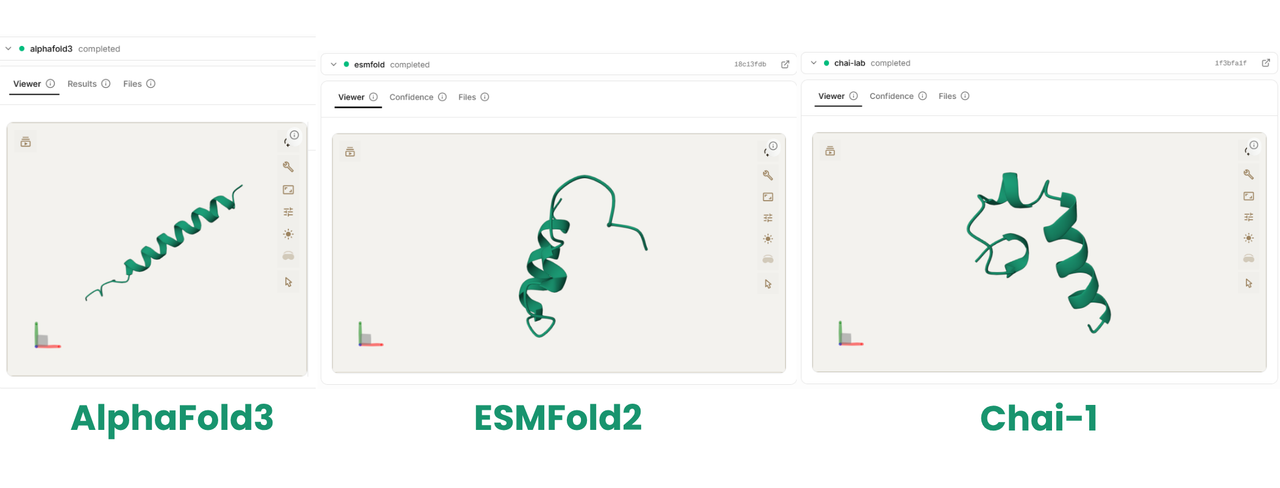
| Gold-standard complex prediction | AlphaFold3 | All-atom; proteins, DNA, RNA, ligands, ions, PTMs |
| Open-source AF3-class | Protenix, Chai-1 | AF3-level accuracy; open weights; cross-validation |
| GPU-accelerated throughput | OpenFold3 | NVIDIA NIM-optimised; production-scale |
| Independent cross-validation | RoseTTAFold3 | Different model family; ensemble diversity |
| Complex without MSA overhead | ESMFold2 | ESMC 6B pLM + diffusion; fast complex prediction |
| Protein–Ligand | ||
| Pose + binding affinity in one run | Boltz-2 | Only model combining co-folding with ΔG / Kd prediction |
| Pose only, gold-standard | AlphaFold3 | Best ligand RMSD on PoseBusters benchmark |
| Large-scale virtual screening | DiffDock, AutoDock Vina | Co-folding models too slow for >100 compounds |
| Antibodies | ||
| Structure from sequence | ABodyBuilder3 | Purpose-built for VH+VL; best CDR loop accuracy |
| Sequence design for a scaffold | AntiFold | Inverse folding; humanisation; affinity maturation |
| Cyclic Peptides | ||
| Macrocyclic / disulfide-constrained | HighFold | Only model with cyclic topology support (CycPOEM) |
| Cross-Validation | ||
| High-stakes / novel targets | AlphaFold3 + Chai-1 + RoseTTAFold3 | Convergent predictions across independent model families are more reliable |
This update is of 17 June. 2026. Vecura's library of models is expanding everyday.
⚠️ Notes
-
Predictions are static snapshots — proteins are dynamic.
-
Disordered regions (pLDDT <50) should not be interpreted as fixed structures.
-
Ligand poses are approximate; experimental validation is still essential.
-
Affinity predictions (Boltz-2) are best for binder/non-binder triage, not fine-grained ranking.
Conclusion
Protein structure prediction has shifted from a grand challenge to a practical tool. With Vecura’s diverse model catalog, researchers can now tailor predictions to their exact needs — whether it’s speed, accuracy, scale, or specialised tasks. Used wisely, these models accelerate discovery in drug development, protein engineering, and fundamental biology.
References
[1] Protein structure prediction powered by artificial intelligence: from biochemical foundations to practical applications. https://doi.org/10.3389/fmolb.2026.1767821
[2] AlphaFold3: An Overview of Applications and Performance Insights. https://doi.org/10.3390/ijms26083671
[3] The master molecule that built biology: How water shaped the chemistry of life. https://doi.org/10.1002/pro.70532
[4] CoEVFold suite: user friendly pipelines to visually represent protein coevolution. https://doi.org/10.64898/2026.01.26.701017
[5] ColabFold: making protein folding accessible to all. https://doi.org/10.1038/s41592-022-01488-1
立即试用 Vecura。
带上您自己的输入,开始探索 Vecura 的能力。