Antibody Design on Vecura: Models, Methods & Use Cases
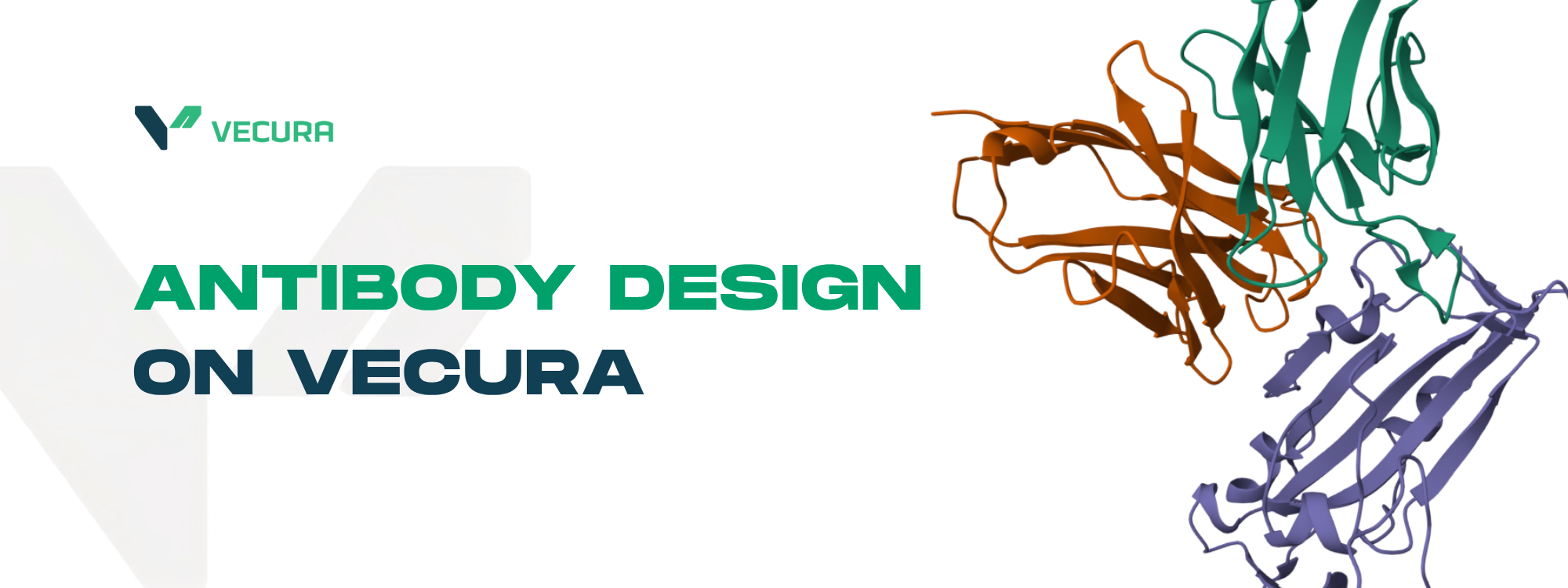
Antibody Design on Vecura: Models, Methods & Use Cases
Introduction
Therapeutic antibodies have become the dominant biopharmaceutical modality of the twenty-first century, and their engineering has decisively entered an AI-driven era in which generative models, structure predictors and property regressors operate at speeds and scales previously inaccessible to experiment alone. Vecura brings the entire modern antibody-design toolkit—generation, structure prediction, affinity maturation, developability screening and humanization—into one integrated platform, so a scientist can travel from antigen to a ranked, developable candidate without stitching together disparate codebases or compute environments. With access to 25+ antibody-focused models covering every stage of the design pipeline, Vecura represents a purpose-built answer to the complexity of contemporary antibody engineering.
Background
Why It Matters
Monoclonal antibodies are essential therapeutics across infectious, autoimmune and malignant disease, valued for their exquisite target specificity and clinical efficacy—yet traditional discovery platforms such as hybridoma immunization and phage-display library screening remain slow, labor-intensive and costly, often requiring months of iterative experimental cycles before a viable lead emerges [2][5]. AI and machine-learning approaches are now reshaping this landscape: deep learning accelerates sequence design, epitope–paratope prediction, affinity optimization, structure prediction and developability assessment simultaneously, compressing timelines and reducing the experimental attrition associated with purely empirical workflows [1][2][4]. A recurring and important finding across the literature is that neither purely computational nor purely experimental approaches maximize success; the most effective strategy couples in-silico design with iterative experimental validation in a closed-loop design–build–test cycle [2][4][6].
What It Is
Antibody design, in its modern computational form, refers to the generation and optimization of the variable domains—VH and VL—with particular emphasis on the six complementarity-determining region (CDR) loops that dominate antigen recognition, as well as the framework residues that govern structural stability, humanness and developability. The contemporary computational stack layered on top of this problem comprises several complementary paradigms. Protein and antibody language models learn the statistical "grammar" of natural antibody sequences from large curated repertoires such as the Observed Antibody Space (OAS), capturing evolutionary constraints and residue co-dependencies that inform sequence design and variant scoring [3][7]. Structure-prediction and inverse-folding models bridge sequence and three-dimensional structure, enabling structure-conditioned sequence design and accurate atomic-level pose estimation—a capability unlocked at scale by AlphaFold-class prediction accuracy [3]. Diffusion and flow-matching generative models push further still, co-designing CDR sequence and backbone geometry conditioned on a target antigen surface, bypassing the need for a starting antibody scaffold entirely [3]. Property-prediction models then triage the resulting candidate pools by affinity, viscosity, CDR flexibility and immunogenicity risk, providing a computational filter before expensive wet-lab synthesis [7].
Antibody Design Models on Vecura
The following table catalogs every antibody-focused model currently available on the Vecura platform, organized by functional role in the design pipeline. Each section reflects a distinct stage of the antibody engineering workflow, and models within a section can be used individually or chained together on Vecura's workflow canvas.
| Use Case | Models | Why |
| De Novo Antibody & Nanobody Generation (structure-based binder design) | ||
| Target-conditioned CDR + backbone co-design | DiffAb, Antibody Diffusion Properties | Diffusion co-design of CDR sequence and 3D structure conditioned on the antigen; the Properties variant adds developability guidance (ddG, hydropathy) |
| Structure-based de novo antibody/nanobody | RFantibody (recommended), IgGM | RFantibody pairs antibody-tuned RFdiffusion backbones + ProteinMPNN CDRs + RoseTTAFold2 in-silico filtering; IgGM is a generative foundation model for CDR/framework sequence + structure co-design |
| Universal / VHH nanobody binder design | BoltzGen (recommended), mBER Open, Promera | BoltzGen performs diffusion backbone + inverse folding + Boltz-2 refolding for antibody/nanobody CDRs; mBER Open is format-specific VHH design through AlphaFold-Multimer; Promera is an AF3-style cofolding de novo VHH designer |
| Antigen-conditioned paired sequence generation | MAGE (recommended), AbGPT | MAGE is a ProGen2 LLM generating paired VH/VL conditioned on an antigen sequence; AbGPT is a GPT-2 BCR heavy/light generator from a residue prompt |
| CDR Design & Inverse Folding (sequence from structure) | ||
| Antibody/nanobody inverse folding | AntiFold (recommended), AntiDIF | AntiFold scores and generates variable-domain sequences from IMGT-numbered PDBs; AntiDIF is antibody-specific discrete diffusion improving sample diversity |
| CDR redesign conditioned on antigen + light chain | IgDesign | CDR inverse folding conditioned on 3D structure with optional antigen and light-chain conditioning |
| Property-guided CDR sampling | NOS | Guided discrete diffusion sampling CDRs directly in sequence space toward optimized properties |
| Antibody Structure Prediction | ||
| Paired VH/VL structure | ABodyBuilder3 (recommended), ImmuneBuilder | Fast, accurate atomic VH/VL prediction with per-residue pLDDT confidence; ImmuneBuilder additionally covers nanobodies and TCRs |
| Conformational ensembles | ABB4-STEROIDS | SE(3) flow-matching samples antibody conformational ensembles (not just a single static pose) for flexibility-aware design |
| Affinity Maturation & Sequence Optimization | ||
| Nanobody optimization | EvoNB (recommended) | ESM2 fine-tuned on ~7.66 M nanobody sequences for mutation prediction and optimization |
| Structure-guided mutation scanning | Structural Evolution (ESM-IF1) | Structure-informed unsupervised mutation recommendation for antibody complexes, equivalent to a computational deep mutational scan |
| Guided affinity maturation & humanization | IgGM | Supports affinity maturation and framework redesign within one generative foundation model |
| Binding Affinity Prediction & Rescoring | ||
| Mutation ΔΔG on the complex | DDG Predictor (recommended) | Geometric-attention model predicting binding ΔΔG from WT vs. mutant antibody–antigen complexes |
| Unsupervised binding-energy scoring | DSMBind | SE(3) denoising score-matching predicts antibody–antigen (and protein–protein) binding energies without labeled training data |
| Docking-pose ranking | DeepRank-Ab | Geometric GNN + ESM2 ranks antibody–antigen docking models by predicted DockQ score |
| Interface binding probability | ImaPEp | Renders the paratope–epitope interface as an image and scores binding probability with a CNN ensemble |
| Epitope & Paratope Prediction | ||
| Paratope residue prediction | Paragraph (recommended), ParaSurf | Paragraph is an EGNN predicting per-residue paratope probability from IMGT-numbered PDBs; ParaSurf is a complementary surface-based paratope predictor |
| Epitope calculation | IgGM | Computes the antigen epitope surface to condition downstream generative design |
| Developability & Biophysical Property Prediction | ||
| Nanobody developability triage | Therapeutic Nanobody Profiler (recommended) | Six biophysical metrics with traffic-light flags for nanobody sequences |
| High-concentration viscosity | DeepViscosity | Ensemble ANN predicting 150 mg/mL mAb viscosity class (low vs. high cP) from VH/VL sequence |
| CDR loop flexibility | ITsFlexible | EGNN classifier scoring CDR3 conformational flexibility from a single 3D structure |
| Humanization | ||
| Deep-learning humanization + humanness scoring | BioPhi (recommended), IgGM | BioPhi combines the Sapiens humanization model and OASis 9-mer humanness evaluation; IgGM redesigns framework regions for humanization |
| Representation & Sequence Analysis (embeddings, likelihoods, numbering) | ||
| Antibody language-model embeddings & likelihoods | AbLang2 (recommended), AbLang, AntiBERTy, AbMAP | Paired/unpaired antibody PLMs producing embeddings, residue likelihoods and masked-residue restoration; AbLang2 is optimized for non-germline residues; AbMAP is tuned for structure/function prediction |
| Masked-residue design / naturalness (general protein, not antibody-specific) | AMPLIFY | Efficient general-purpose transformer PLM (UniRef/UniProt-trained) predicting mutation effects and masked residues; usable on antibodies but without antibody-specific training like AbLang2 |
| Light-chain pairing | Lichen | Generates compatible light chains for a given heavy chain and scores pairings by log-likelihood/perplexity |
| Numbering & annotation | ANARCII (recommended), ANARCI | IMGT/Kabat/Chothia/Martin/AHo numbering and chain typing for antibodies, TCRs, VHH/VNAR and scFv, plus PDB renumbering |
| Curated antibody database search | PLAbDab | Search 150 k+ paired antibody sequences/structures from patents and literature by sequence, structure or keyword |
Notes
• Natural pipeline order. Vecura organizes the models into a coherent sequence: number and annotate (ANARCII) → generate (RFantibody / DiffAb / MAGE) → predict structure (ABodyBuilder3) → score affinity (DDG Predictor / DSMBind) → triage developability (Therapeutic Nanobody Profiler / DeepViscosity) → humanize (BioPhi). Every stage can also be run as a standalone node or chained into a custom workflow on the Vecura canvas.
• Input preparation matters. Many generative models (DiffAb, AntiFold, IgDesign, RFantibody) require an IMGT-numbered PDB or a target antigen structure as input. Always prepare inputs with ANARCII and a structure-prediction model first; skipping this step is the most common source of runtime errors.
• In-silico scores prioritize; they do not certify. Computational affinity and developability scores narrow a large candidate space to a testable shortlist, but they are not a substitute for wet-lab characterization. The literature consistently emphasizes that closed-loop design–build–test iteration is the strategy most reliably associated with successful candidates.
• Nanobody/VHH has first-class coverage. The platform provides dedicated nanobody support at every stage: de novo generation (RFantibody, mBER Open, BoltzGen, Promera), optimization (EvoNB), structure prediction (ImmuneBuilder), developability triage (Therapeutic Nanobody Profiler) and numbering (ANARCII). Scientists working in the VHH format do not need to compromise with models built for conventional IgG.
• Developability should be assessed early, not as an afterthought. Viscosity (DeepViscosity), CDR flexibility (ITsFlexible), humanness (BioPhi / OASis) and biophysical flags (Therapeutic Nanobody Profiler) are inexpensive to run computationally but expensive to address in the clinic. Inserting these checks immediately after structure prediction—before investing heavily in affinity maturation—avoids the late-stage attrition that remains a leading cause of antibody program failure.
Conclusion
Vecura consolidates the modern AI antibody engineering stack end-to-end, giving computational biologists and drug-discovery scientists a single environment where every validated model from language-model embeddings to diffusion-based de novo generation is immediately accessible and composable. The strongest outcomes emerge when generative design, structure prediction, affinity scoring and developability filtering are combined systematically and iterated in dialogue with experimental data - a closed-loop philosophy that the platform is explicitly architected to support. Whether you begin with a single model to solve a focused problem or chain an entire pipeline on the workflow canvas, Vecura is designed to accelerate the journey from antigen to developable antibody candidate.
References
-
AI-Driven Design Platforms of Next-Generation Antibody Therapeutics — https://doi.org/10.1007/s41061-026-00554-y
-
Artificial intelligence advancements in monoclonal antibody development technology — https://doi.org/10.3389/fimmu.2026.1802038
-
Protein Design Enters the Artificial Intelligence Era: Foundations, Tools, and Emerging Paradigms — https://doi.org/10.34133/csbj.0105
-
Harnessing deep learning to accelerate the development of antibodies and aptamers — https://doi.org/10.1016/j.apsb.2025.12.017
-
A bio-inspired computational pipeline for antibody screening and repurposing — https://doi.org/10.1093/bib/bbag183
-
The role of bioinformatics algorithms in modern biopharmaceutical design — https://doi.org/10.34172/bi.33072
-
AI-Driven BCR Modeling for Precision Immunology — https://doi.org/10.3390/ijms27073296