ESM3: A Frontier Protein Language Model Now Available on Vecura
This update enables structural biologists, protein engineers, and computational biologists to predict protein structures, design novel sequences, annotate functions, and extract rich embeddings through a guided workflow inside Vecura — without setting up complex GPU infrastructure or managing model checkpoints.
What is ESM3?
ESM3 is a frontier generative masked language model built specifically for protein biology, developed by EvolutionaryScale and Chan Zuckerberg Biohub. It is the first model in the ESM family to jointly reason over three tracks of discrete tokens — sequence, structure, and function — allowing it to understand and generate proteins across multiple biological modalities from a single unified architecture. Trained with over 1×10²⁴ FLOPs on 2.78 billion natural protein sequences and scaling to 98 billion parameters in its largest checkpoint, ESM3 represents one of the most compute-intensive biological models ever created.
It helps users predict 3D protein structures from sequences, design amino-acid sequences that fold into target backbone structures, annotate protein functions with InterPro-style domain predictions, and extract per-residue and whole-protein embeddings for downstream machine learning pipelines. It is especially useful for researchers working on protein engineering, de novo protein design, structural characterization of unannotated proteins from metagenomic assemblies, and building ML classifiers on top of learned protein representations.
What can users do with ESM3 on Vecura?
With ESM3 on Vecura, users can:
-
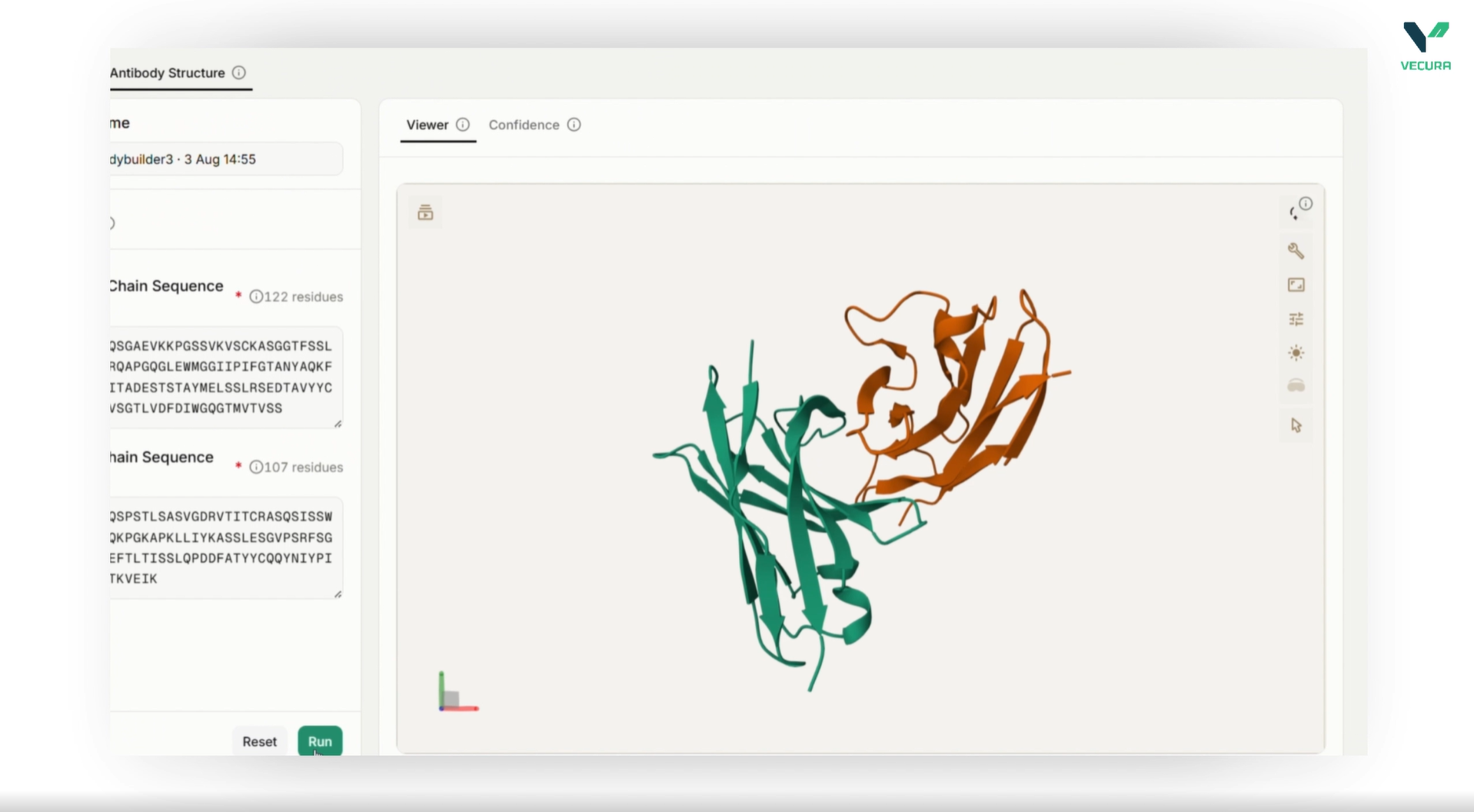
Predict protein 3D structures (forward folding): Submit a full or partially masked amino-acid sequence and receive a predicted all-atom PDB structure, complete with per-residue pLDDT confidence scores and a global pTM score. Multi-chain complexes are supported by separating chains with
|. -
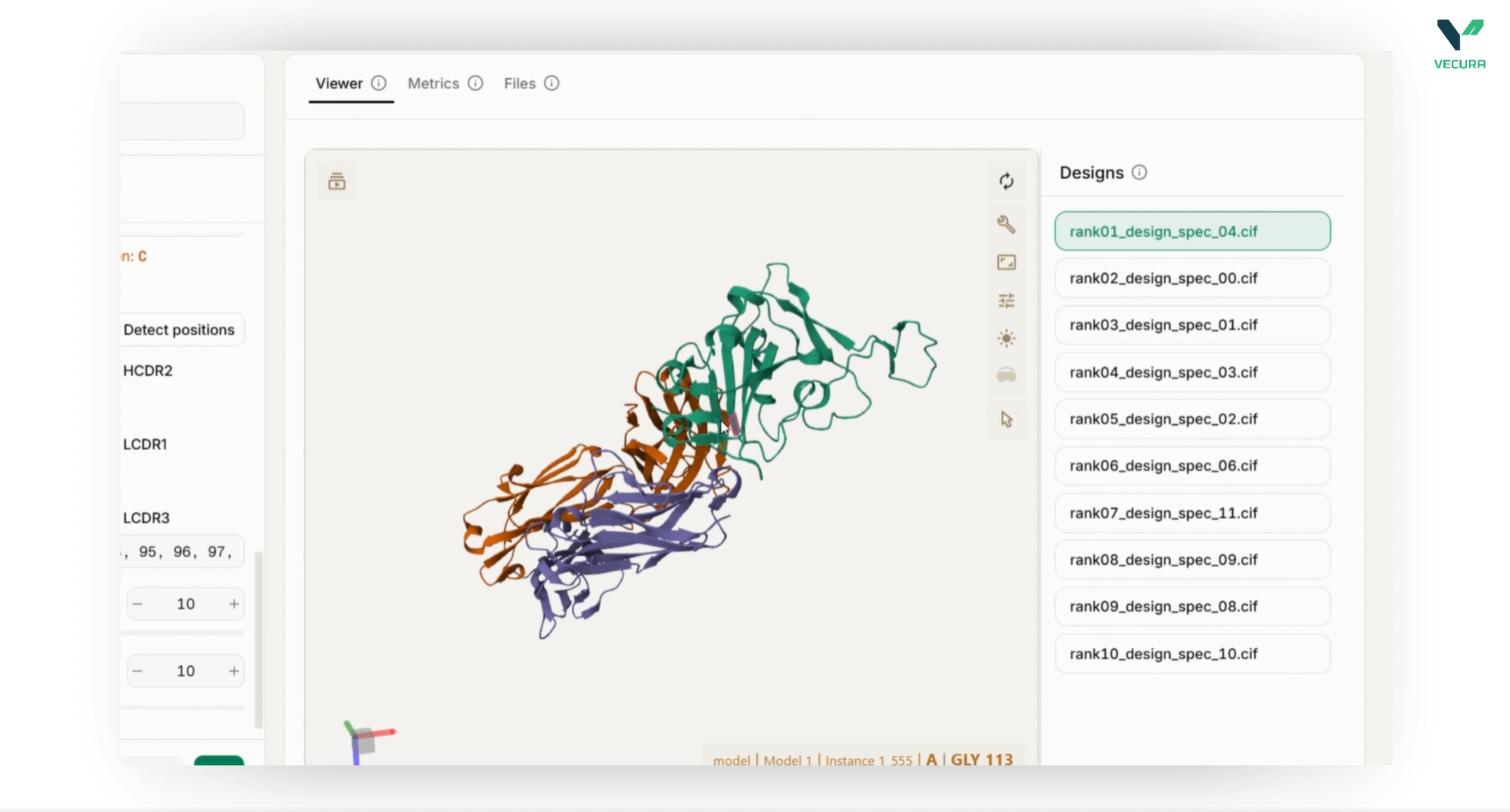
Design sequences for target structures (inverse folding): Upload a PDB backbone and let ESM3 iteratively unmask a novel amino-acid sequence conditioned on those coordinates — ideal for scaffold re-sequencing, expression optimization, or de novo design campaigns.
-
Annotate protein function: Provide a sequence and receive predicted InterPro/keyword-style function annotations with residue-level start/end spans, enabling rapid characterization of unannotated or poorly studied proteins without running full homology searches.
-
Extract protein embeddings and logits: Run a single forward pass to obtain per-residue hidden-state embeddings, a mean-pooled whole-protein fingerprint vector, and per-position sequence logits — ready to feed into downstream classifiers, similarity search, clustering, or mutation-scoring workflows.
What the output means
The output provides predicted 3D structures in PDB format with per-residue confidence scores (pLDDT, 0–100 scale) and a global predicted TM-score (pTM, 0–1), designed amino-acid sequences, function annotations with residue-level domain spans, and high-dimensional embedding vectors for each residue and the full protein.
pLDDT scores indicate local structural confidence — values above ~70 suggest a reliable local fold, while values below ~50 indicate regions where the prediction should be interpreted with caution. pTM provides a global fold-confidence proxy comparable to AlphaFold's metric. Function annotations map predicted domains to specific residue ranges and should be cross-referenced against known domain databases. Embeddings encode the model's learned representation and can be used as features for downstream tasks.
This output should be used to support scientific decision making. It does not replace experimental validation.
Why this matters
Protein structure prediction and design have historically required specialized, fragmented toolchains — one model for folding, another for sequence design, a separate pipeline for function annotation, and yet another for embeddings. ESM3 unifies all of these capabilities into a single model that reasons jointly across sequence, structure, and function, mirroring the way these properties are inextricably linked in real biology. By making ESM3 accessible through Vecura's guided workflow, researchers who lack dedicated ML engineering teams or GPU cluster access can now leverage a frontier-scale protein model for their daily work — from rapid structural characterization of a newly cloned construct to large-scale sequence design campaigns.
The ability to iteratively unmask tokens across multiple biological tracks also opens up workflows that were previously impractical: partial structural information can be combined with sequence data and sparse functional annotations to produce coherent, multi-modal predictions. This is particularly valuable in structural biology pipelines where experimental data is often incomplete — for example, when a low-resolution cryo-EM map provides backbone constraints but the sequence must be computationally threaded, or when a metagenomic assembly yields a novel sequence whose fold and function are both unknown. ESM3's generative, multi-track approach lets researchers treat these as a single inference problem rather than stitching together multiple tools with inconsistent assumptions.
-
Developed by: EvolutionaryScale / Chan Zuckerberg Biohub
-
Source: ESM3 GitHub Repository · ESM3 README · Open Weights on HuggingFace
-
Reference: Hayes et al., "Simulating 500 million years of evolution with a language model," Science (2024). DOI: 10.1126/science.ads0018
在 Vecura 上试用 ESM3
打开模型工作区,用您自己的输入开始评估