CodonFM (Encodon) Foundation Model Now Available on Vecura
This update enables researchers, bioinformaticians, and drug discovery scientists to analyze genetic variants, optimize codon sequences, and assess coding sequence fitness through a guided workflow inside Vecura, without setting up complex technical infrastructure.
What is CodonFM (Encodon)?
CodonFM (Encodon) is a suite of transformer foundation models developed by NVIDIA that operates directly on codon sequences—the natural triplet units of protein-coding genes—rather than treating DNA as individual nucleotides. Trained on over 131 million coding sequences from 22,000 species, the model learns contextual codon representations that capture synonymous substitution patterns, codon-usage bias, and sequence constraints governing expression and fitness.
It helps users predict variant effects, score sequence fitness, predict masked codons, and extract gene embeddings—all in zero-shot mode without requiring fine-tuning. It is especially useful for interpreting genetic variants in disease contexts (cancer hotspots, rare diseases, ClinVar records), optimizing mRNA therapeutic constructs, and exploring codon-level constraints in protein-coding genes.
What can users do with CodonFM (Encodon) on Vecura?
With CodonFM (Encodon) on Vecura, users can:
-
Score genetic variants: Calculate zero-shot log-likelihood ratios for single-codon substitutions to predict whether a mutation is tolerated or disruptive, directly from pretrained checkpoints
-
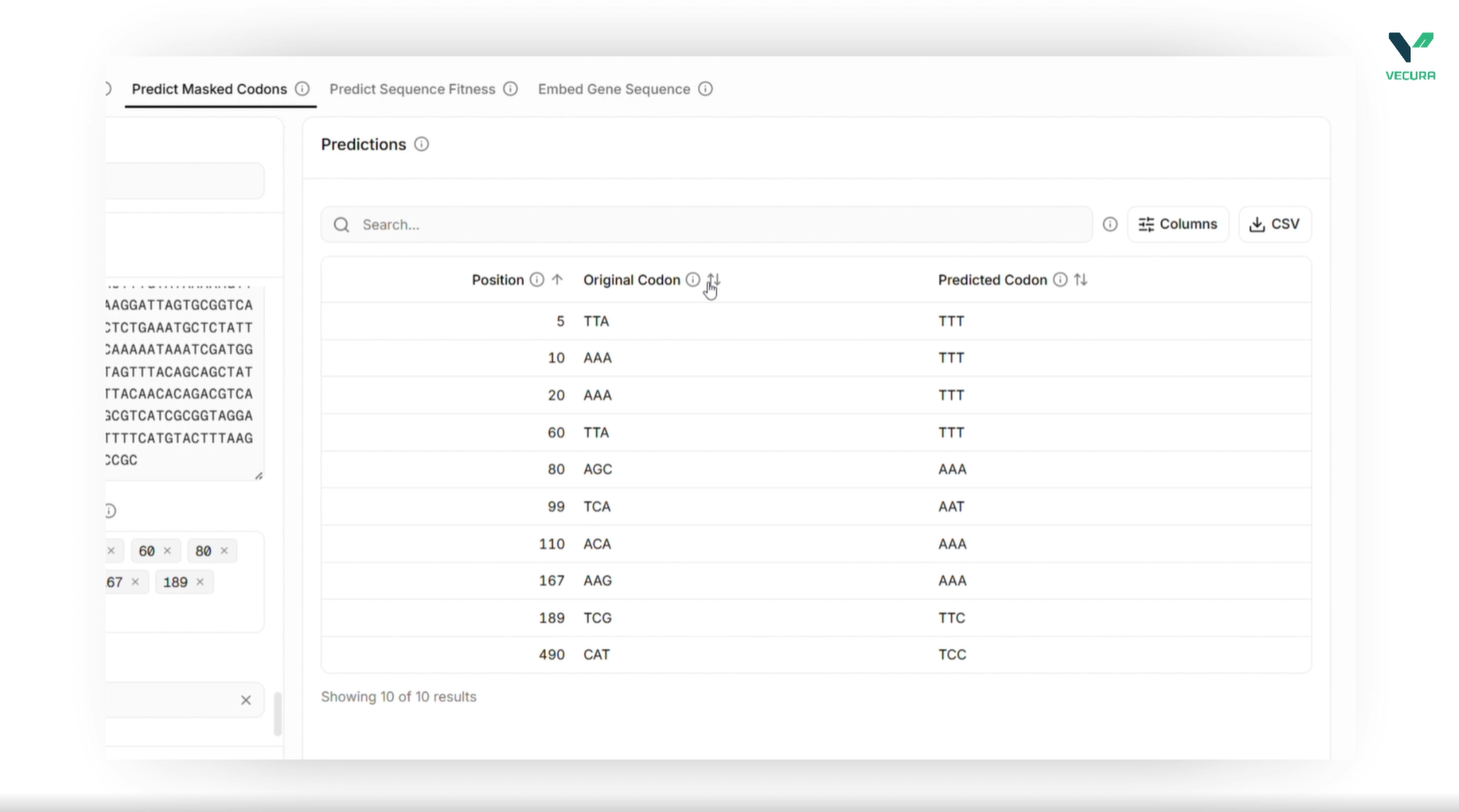
Predict masked codons: Mask specific positions in a coding sequence and retrieve full probability distributions over all 69 possible codons to explore sequence space and synonymous substitution tolerance
-
Assess sequence fitness: Generate pseudo-log-likelihood scores for entire coding sequences to compare wild-type versus codon-optimized variants and rank engineered constructs by naturalness
-
Extract gene embeddings: Obtain fixed-length 2048-dimensional CLS-token vectors for clustering gene families, similarity search, or as input features for downstream property prediction tasks
What the output means
The output provides multiple complementary analyses depending on your use case:
-
Likelihood ratios (for variant scoring): Reference-minus-alternate log-likelihood differences where positive values indicate the model prefers the reference codon and large negative values suggest the alternate is more natural in that context
-
Masked codon predictions: Per-position predicted codons with full log-probability distributions across the codon vocabulary, revealing which alternatives the model considers plausible
-
Fitness scores: Pseudo-log-likelihood scalars representing how natural the model considers an entire sequence, with higher values correlating with better-expressed or more-stable sequences
-
Embeddings: Dense vector representations capturing contextual codon-level features suitable for clustering, similarity analysis, or training lightweight classifiers
This output should be used to support scientific decision making. It does not replace experimental validation.
Why this matters
Codon-level language modeling represents a paradigm shift in how we analyze protein-coding sequences. Traditional approaches either treat DNA as independent nucleotides (losing reading-frame structure) or translate to amino acids (discarding synonymous variation). By tokenizing coding sequences as triplet codons, CodonFM captures the "grammar" of the genetic code—the evolutionary constraints, codon-usage biases, and contextual patterns that govern translation efficiency, mRNA stability, and protein yield. This is particularly important for mRNA therapeutic design, where synonymous codon choices dramatically impact expression levels, and for variant interpretation, where disease-causing mutations may involve synonymous changes that disrupt regulatory motifs or splicing signals.
The model's zero-shot performance on benchmarks like CancerHotspot, DDD-ASD, and ClinVar demonstrates that codon-level pretraining implicitly learns protein sequence constraints and functional relevance, even without explicit protein-level training. For researchers working with limited labeled data, this enables rapid variant prioritization and construct optimization without fine-tuning. The availability of multiple model sizes (80M, 600M, 1B parameters) and pretraining strategies allows users to balance computational cost against performance for their specific applications.
-
Developed by: NVIDIA (Clara open model family)
-
Source: CodonFM preprint (Darabi et al., 2025), Official GitHub repository
-
Reference: Darabi et al., 2025. "Learning the Language of Codon Translation with CodonFM." NVIDIA Research. Model weights available on Hugging Face and NGC under Apache-2.0 (code) and NVIDIA Open Model License (weights).
在 Vecura 上试用 CodonFM (Encodon)
打开模型工作区,用您自己的输入开始评估