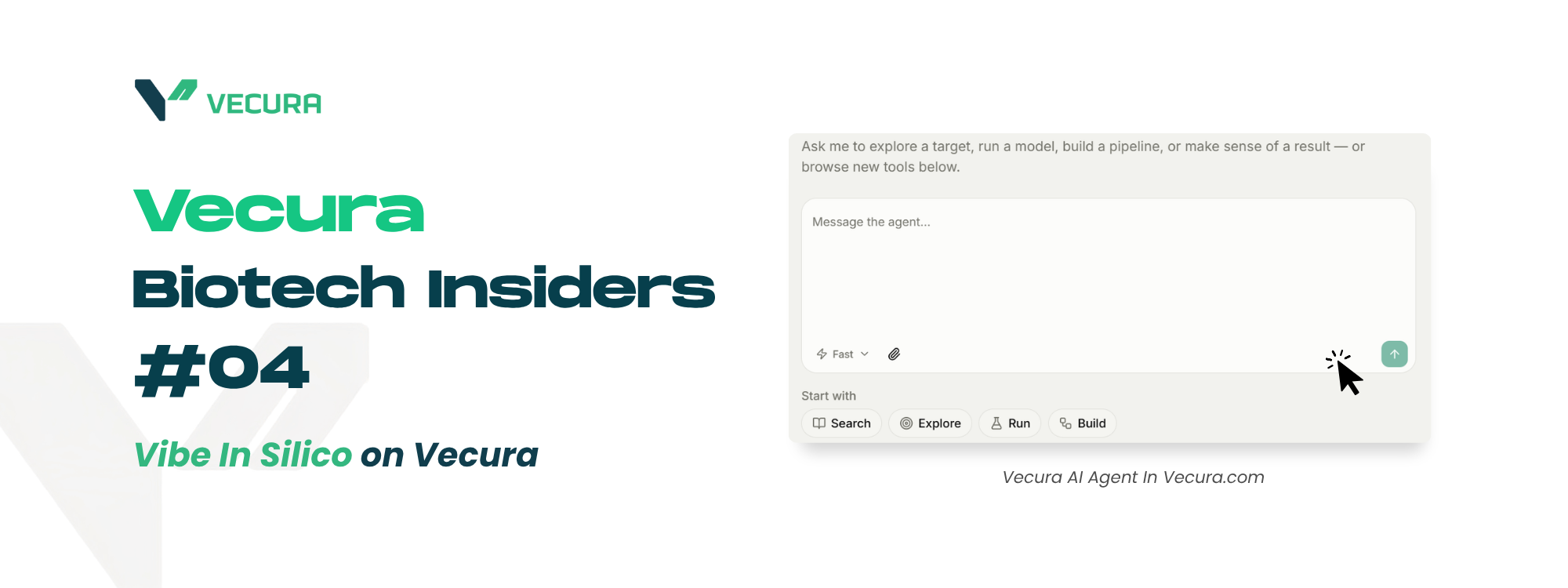
Vecura Biotech Insiders #04: Vibe in Silico on Vecura
In this Vecura Biotech Insiders feature, we explore a perspective on where agentic AI actually sits alongside physics-based simulation and learned prediction — and what's left to call "vibe in silico" once you subtract what the agent actually computed.
A User-Shared Perspective From The Vecura Community
Agentic AI has quietly become one more thing computational biology runs — but unlike a simulation or a trained model, it doesn't compute on biology at all. It reasons about biology in language, and that distinction is worth being precise about before trusting what it produces.
In this fourth edition of Vecura Biotech Insiders, we highlight a perspective shared with the Vecura team by Danh Nguyen: a look at where agentic AI actually fits among the computational methods researchers already use, and what changes when an agent is added to a modeling pipeline.
Research Context: Two Established Modes
Computational biology has long relied on two grounded modes of computing on biology directly.
The first runs the mechanism itself. GROMACS, one of the most widely used molecular dynamics tools in computational biophysics, simulates proteins and drug molecules atom by atom using Newton's equations — no training data, just physics, step by step. You encode the forces, hit run, and the biology unfolds.

Figure 1: GROMACS on Vecura
The second learns from data. AlphaFold — the model that won its makers a share of the 2024 Nobel Prize in Chemistry — maps amino acid sequence to 3D structure statistically, trained on every protein structure ever experimentally solved. ESMFold, RoseTTAFold, and AlphaFold 3 follow the same recipe: a large biological dataset in, a neural network learns the patterns, predictions out.

Figure 2: AlphaFold3 on Vecura
Different approaches — one runs the mechanism, the other learns from data — but both compute directly on biological space: atoms, forces, sequences, structures.
Where Agents Fit In
Agents that plan and execute multi-step research workflows are not a new idea. Calling tools, chaining steps, and critiquing intermediate results is something agentic systems have done for a while.
What's changed is how thoroughly that agent layer now sits across the rest of the stack. Rather than running alongside physics-based simulation and learned prediction as a separate track, today's agents call both directly — deciding when to run an MD simulation, when to fetch a structure prediction, and when to reason on their own. BioDiscoveryAgent, for instance, designs genetic perturbation experiments and beats trained optimization baselines by 21% even with no external tools at all — a useful edge case, since it isolates what the agent's own reasoning looks like on its own. SpatialAgent runs an entire spatial biology pipeline end to end, tested on 2 million cells, threading that same reasoning through genuine data at every stage.

Figure 3: What each one actually reads
The part worth naming precisely is what's left when the agent isn't calling anything grounded: pure language-based inference, drawn from a training corpus of papers and databases rather than from a simulation or a dataset. Danh's term for this is "vibe in silico" — not a rival third category that's coexisted with physics and learned models all along, but the ungrounded remainder of an agent's output once you subtract what it actually computed.
Grounded vs. Ungrounded, Within One Agentic Workflow
| What It's Computed On | Trust It To the Extent That... | |
| It calls a physics-based tool (MD, docking, free energy) | The mechanism itself | You trust the force field and the sampling |
| It calls a learned-model tool (AlphaFold and descendants) | Biological data | You trust the training set and whether it generalizes |
| It reasons on its own, without calling either | Text about biology | You trust a well-read literature review that occasionally hallucinates — useful for hypotheses, not sufficient for evidence |

Figure 4: Nothing gets both
Why Vecura Helps
Vecura is built around this same merge. Given a scientific goal in plain language, Vecura assembles the computational campaign itself — drawing on roughly 1,000 curated models and 50 standardized modules, with an agent deciding what to call and in what order. That agent routinely calls both physics-based and learned-model tools within a single run.
The governing principle: the agent decides what to run, not what's true. When a step needs a database value, a predicted structure, or a chemistry calculation, the platform runs the tool and works from what comes back — with every output labeled by its basis, so a grounded value is never confused with the agent's own inference. Any figure in a final report traces back to the model, data, and parameters that produced it.
| Risk of Ungrounded "Vibe" Reasoning | How Vecura Addresses It |
| Plausible-sounding but unverified claims | Every value traces back to the model, data, and parameters behind it |
| Language-based inference mistaken for a computed result | Sourced values are explicitly separated from the agent's own inference |
| Confidence hard to assess after the fact | Each output is labeled by its basis, so grounding can be checked at a glance |
A Note on Scientific Interpretation
This isn't a claim that agentic reasoning is somehow less valid than physics-based simulation or learned prediction — all three have a place in a modeling pipeline. The point is narrower: within a single agentic result, the grounded and ungrounded parts can look identical unless a workflow makes the distinction explicit.
Try Source-Traceable Workflows on Vecura
Danh's perspective highlights a practical principle for AI-assisted computational biology:
Do not treat every part of an agentic result as equally grounded. Ask which parts were computed, and which were inferred. Trace each value back to its source. Separate a sourced fact from an inference.
Bring your research questions to Vecura and explore agentic workflows that keep sourced values and model inference distinct, across a single platform.
Run source-traceable workflows on Vecura
立即试用 Vecura。
带上您自己的输入,开始探索 Vecura 的能力。