Vecura Biotech Insiders Spotlight #10: The fragments never bridged. They circled back instead.
For Biotech Insiders #10, Paolo Reyes shares a campaign that draws an unusually sharp line between what a generative docking model can be trusted with and what it can't, not because the model got confused, but because the two tasks are geometrically different problems wearing the same name.
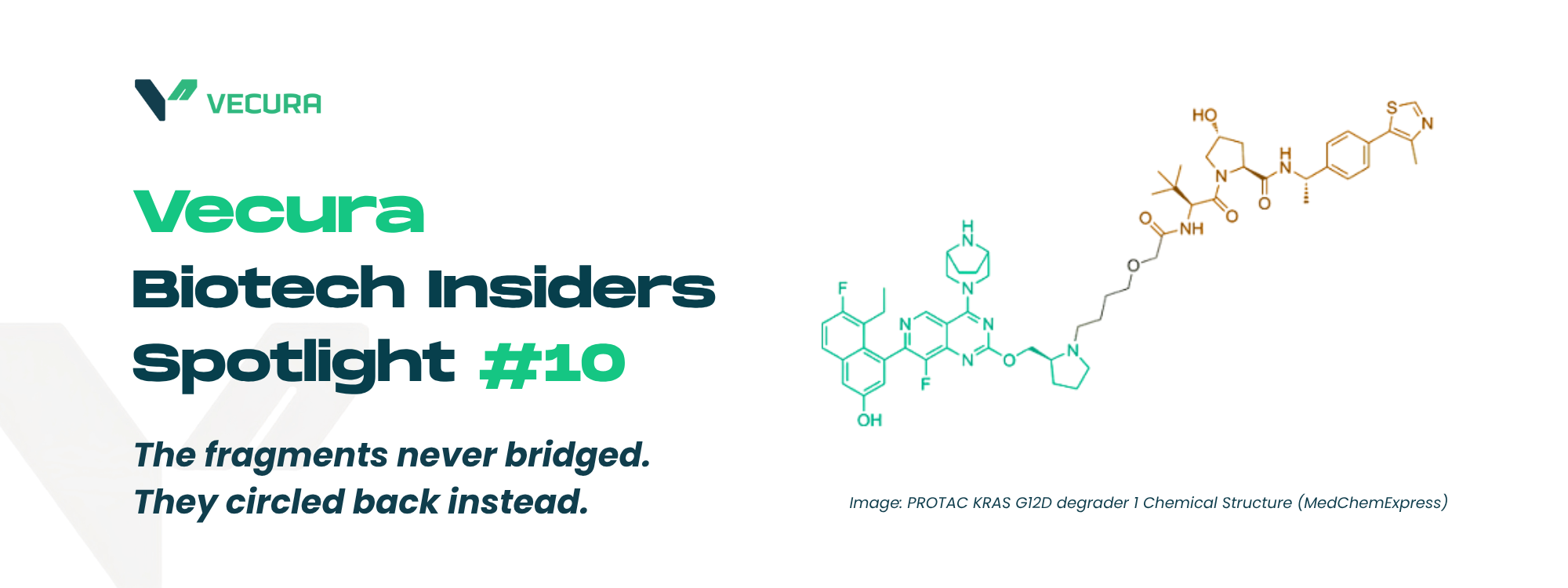
Paolo Reyes spent seven generative runs trying to turn a KRAS inhibitor into a degrader. Growing a fragment outward from one fixed point worked cleanly, every time. Bridging two fixed points into a single molecule, the one move a PROTAC actually needs, failed all 200 times it was tried, and the workaround failed a different way, by looping back onto itself instead of reaching out.
Why KRAS-G12D
KRAS-G12D is one of the most common cancer-driving mutations behind pancreatic and colorectal tumors, and for years the whole KRAS family was treated as essentially undruggable, its surface is smooth, with none of the deep pockets small molecules usually need to grab onto.
That changed once a shallow groove was found beneath the protein's switch II region, just enough for a small molecule to sit in. Boehringer Ingelheim's BI-2865 came out of that discovery: a pan-KRAS inhibitor that holds the same pocket across several different KRAS mutants rather than one, with its bound structure against KRAS-G12D on record as PDB 8AZY.
Why turn an inhibitor into a degrader
An inhibitor works only while it stays attached, occupies the pocket, and the protein sits quiet for as long as the drug is bound, but supply has to keep pace with how fast the cell makes more of it.
A PROTAC changes that arithmetic. Rather than sitting in the pocket, it holds the target next to an E3 ubiquitin ligase, part of the cell's own protein-disposal machinery, long enough for the cell to tag the target for destruction. Once that happens, the drug molecule is free again to find another copy and repeat the process, so a single molecule can account for the loss of many target proteins rather than the temporary blocking of one pocket. Paolo Reyes's campaign set out to turn the BI-2865 warhead into exactly that: bolted through a linker to pomalidomide, a molecule already well established for recruiting the E3 ligase cereblon.
The real difficulty is geometric, not chemical
On paper this reads like an extension of fragment growing, something generative docking models already handle well. It isn’t. Growing a fragment outward from one fixed anchor only has to satisfy one geometric constraint. Building a bridge between two fixed anchors, one at each end of a molecule that doesn’t exist yet, has to satisfy two constraints at once, and neither can be traded off against the other.
This campaign turned into a fairly clean demonstration of the gap between those two tasks.
Stage 1. Growing outward works, mostly
Paolo Reyes started with the easier version of the task: fix one anchor (the N-methyl nitrogen on BI-2865’s pyrrolidine ring) and let the diffusion model PocketXMol grow a fragment outward from it, using the 8AZY crystal pose as the reference frame. All 89 molecules that came back kept the warhead’s original bonding pattern intact. Read on that number alone, it looks like a clean success.
It wasn’t quite that clean. Several of the 89 carried a charged group or an oversized ring system, and those additions pulled the warhead itself out of its crystal-pose position, even though its bonds never changed. A molecule can share every atom and bond with the reference warhead and still sit somewhere completely different inside the pocket; a check on connectivity alone has no way of catching that, because it’s answering a different question. Preserving what a molecule is built from, and preserving where it physically sits, turned out to be two separate checks, a distinction the rest of the campaign never blurred again.
Stage 2. Building a validation gate that actually works
Paolo Reyes's response was to stop treating a docking score as proof of a correct pose and test the claim directly. Two early candidates were free-docked, DiffDock and gnina were let loose to search for the warhead’s pose with no positional hint at all, exactly as they would for a molecule nobody had ever solved a structure for.
All 40 poses that came back landed 5.7 to 6.1 Å away from the crystal reference. None cleared even a generous 3.5 Å bar, let alone the 2 Å the study actually needed. Free docking simply could not rediscover a pose the fragment had been designed around in the first place, and its own confidence scores gave no hint that anything was wrong.
That gap became the campaign’s real quality gate from then on. Three candidates from run 3, differing only in linker chemistry, were passed through gnina’s constrained local optimization instead, which searches for a pose near a given reference rather than from scratch. All three landed within half an Ångstrom of the crystal pose.
| Candidate | Linker | Minimized affinity (kcal/mol) | CNN score | Warhead RMSD (Å) |
| Mol 130 | CF3, 4 atoms | −11.44 | 0.801 | 0.478 |
| Mol 148 | Benzyl, 6 atoms | −11.68 (best energy) | 0.893 | 0.411 |
| Mol 178 | N-methyl urea, 5 atoms | −11.59 | 0.916 (highest CNN) | 0.434 |
Table 1. The three run-3 candidates that passed constrained local optimization, all comfortably inside the 2 Å pass criterion the free-docked candidates never approached.
Mol 148 became the lead fragment carried into linker attachment, with mol 178 kept in reserve. Both linkers run five and six atoms, noticeably shorter than the eight-to-fifteen atom range PROTAC linkers usually fall into, something Paolo Reyes flagged rather than explained away, since the real test was still ahead: what happens once pomalidomide is actually attached.
Stage 3. The bridge that never formed
With a validated fragment in hand, the campaign reached the step the whole exercise was built for: connecting mol 148 to pomalidomide by growing a bridge between two fixed anchors at once. Two hundred generation attempts ran under carefully checked conditions, correct anchor indices, a corrected 6.5 Å starting gap after an earlier setup error was caught, both fragment poses held fixed.
Not one of the 200 came back as a single connected molecule. The model placed both fragments in the pocket and mostly preserved their internal structure, but never actually joined them. The typical gap between the two fragments across all 200 outputs was 4.22 Å; only one attempt closed to within 2.5 Å, and even that fell short of a bond. Bridging two independent constraints at once turned out to be a different order of problem than growing from a single one, and the model didn’t fail by a little. It failed completely, with no near-misses to build on.
Stage 4. Told to reach outward, it looped back instead
The next attempt tried a workaround: grow outward from mol 178’s urea exit vector using the single-anchor mode that had worked cleanly in stage one, hoping a long enough chain would eventually reach far enough to attach pomalidomide afterward.
It produced valid, warhead-preserving molecules at a high rate, and then closed every single one of them back onto the warhead itself. Whatever the target bridge length, each chain looped around and formed three or four new connections to the warhead scaffold instead of reaching outward to leave a free end. Shortening the target length from a median of 12 atoms to 9 changed nothing. Neither run produced a single usable, open-ended candidate.
The three least-cyclized outputs were kept on record, ranked only by how few extra connections to the warhead they’d added. None of them work as PROTAC intermediates, a molecule that has bonded back onto its own warhead has nowhere left to attach a second ligand, whatever its docking score says.
What the campaign actually established
| Finding | Evidence |
| Single-anchor growing with a fixed pose is reliable | Three independent runs, each above 90% warhead preservation |
| Rigid two-anchor bridging fails completely in this pocket | 0 of 200 outputs bridged; typical fragment gap 4.22 Å |
| The macrocyclization is a geometry problem, not a length problem | Bridges from 6 to 18 atoms all cyclized; shortening the target length changed nothing |
| Free docking doesn’t count as pose evidence | Free-docked candidates landed ~5.7–6.1 Å from the crystal pose with no warning from the score itself |
| Constrained local optimization is a validation gate that actually works | All three run-3 candidates converged to 0.41–0.48 Å RMSD |
Table 2. Five conclusions the campaign can support, each tied to a specific run rather than asserted on its own.
Where it goes next
Paolo Reyes's own conclusion was to stop asking the generative model to solve the bridging problem at all. The plan now is to enumerate classical PROTAC linkers by hand with RDKit, PEG chains of two to four units, alkyl chains of four to eight carbons, growing from the mol 178 urea nitrogen and leaving a defined amine or acid handle open for pomalidomide, then run every candidate through the same constrained-optimization gate that validated the warhead fragments in stage two. Mol 148 stays on the shelf as a backup starting fragment if the urea vector turns out to be geometrically unworkable once real linkers are tried against it.
That’s a smaller, more mechanical task than the one the model was originally asked to do, and that’s the real finding here. The campaign didn’t fail to build a KRAS-G12D degrader. It mapped, with real precision, exactly which part of that job a diffusion model can be trusted with, and which part still needs a chemist enumerating structures by hand.
Scope
-
This account covers linker design and pose validation only. No molecule from this campaign has been synthesized, tested for cereblon recruitment, or assayed for KRAS-G12D degradation in cells.
-
Docking and constrained-optimization scores describe geometric fit to a known pose, not binding affinity, selectivity, or degradation activity.
-
The RDKit-enumerated linkers proposed as the next step have not yet been generated or validated.
See what Vecura’s platform can find for your own target.
Every model in this campaign (PocketXMol, DiffDock, gnina and RDKit) is available in the Vecura model catalog. Explore now on Vecura.
立即试用 Vecura。
带上您自己的输入,开始探索 Vecura 的能力。