De Novo Design of Sartan-Like AT1R Binders for Companion-Animal Kidney Health
A Vecura workflow, chaining generative small-molecule design, structure-based docking, ADMET prediction and toxicophore-constrained redesign against the angiotensin II type 1 receptor. What the platform surfaced was not a drug candidate but something more useful, a quantified account of the potency-safety tradeoff that governs this chemotype.
A Vecura workflow, chaining generative small-molecule design, structure-based docking, ADMET prediction and toxicophore-constrained redesign against the angiotensin II type 1 receptor. What the platform surfaced was not a drug candidate but something more useful, a quantified account of the potency-safety tradeoff that governs this chemotype.
Chronic kidney disease is the defining chronic illness of the ageing cat. Roughly a third of cats over fifteen carry it, and once it is diagnosed the remaining life expectancy is measured in a couple of years rather than a decade. The renin-angiotensin-aldosterone system sits close to the centre of that decline. Angiotensin II acting at the type 1 receptor raises intraglomerular pressure, drives proteinuria, and proteinuria in turn predicts faster loss of function, which is why blockade of the angiotensin II type 1 receptor is an established point of intervention in feline CKD rather than a speculative one. This case study is the answer, and it is a candid one. The pipeline worked end to end. It produced binders, it flagged their liabilities, it redesigned them, and in doing so it walked directly into the central structural problem of this target. That collision is the result worth reporting.
| 93 valid de novo molecules | 4 models chained, one platform | 0.91 → 0.40 DILI on the lead chemotype | 54 redesigned analogues |
Why AT1R, and why this is a methods demonstration
It is worth being precise about what this study is and is not. AT1R blockade in cats is not an open question. Telmisartan is already licensed for cats under the trade name Semintra, indicated for the reduction of proteinuria associated with chronic kidney disease and for systemic hypertension, and in a randomised non-inferiority trial in 224 client-owned cats it reduced urine protein-to-creatinine ratio comparably to benazepril. The target is validated, the pharmacology is understood, and a marketed product occupies the space.
That is exactly why it makes a good testbed. A de novo campaign against a well-characterised receptor with a known ligand class gives you ground truth. If the pipeline recovers the binding chemistry that medicinal chemistry already knows to be essential, that is a signal the workflow is doing real structural reasoning rather than generating plausible-looking noise. If it then discards that chemistry in pursuit of a safety objective and pays a measurable price in binding, that too is informative. Both of those happened.
The workflow
Four models ran in sequence on Vecura, with no manual handoff between them. PocketXMol generated de novo small molecules against the receptor pocket. AutoDock Vina scored them. ADMET-AI profiled the toxicity of the top binders. REINVENT4 then redesigned the leading compound under structural-alert constraints derived from that profile, and the redesigned set went back through docking and ADMET for a second read.
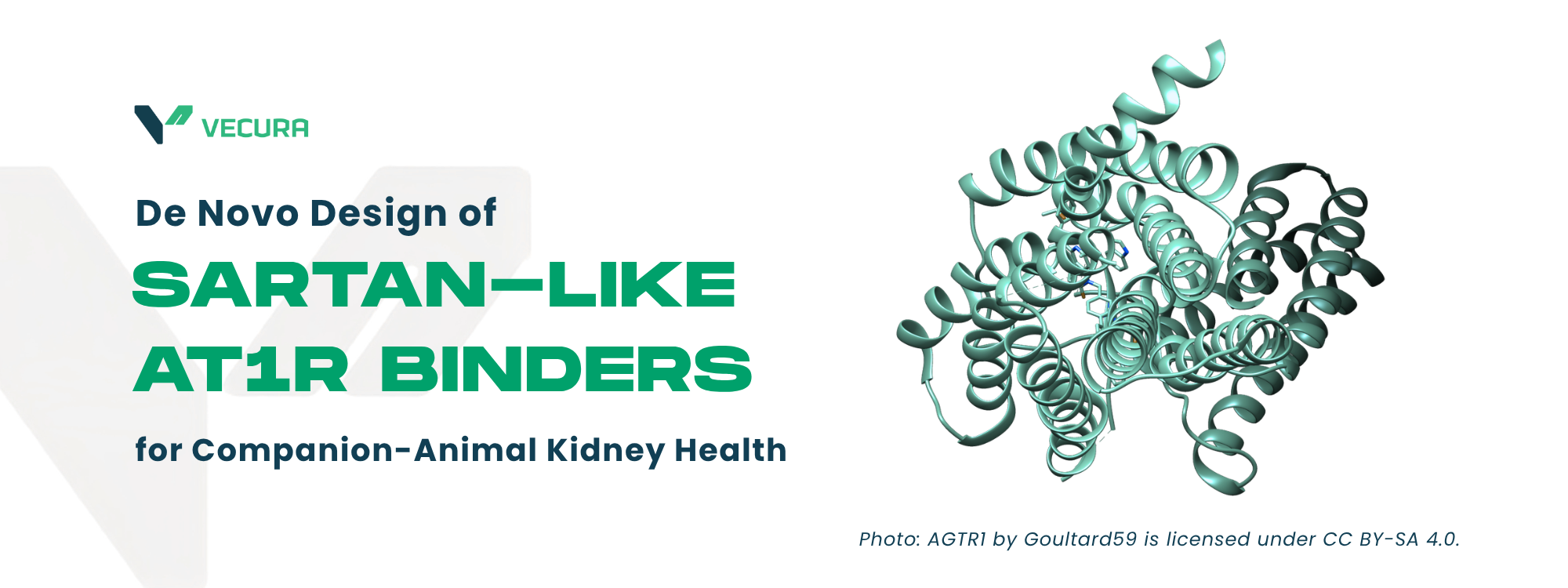
Target structure. The receptor was taken from PDB 4ZUD, the 2.8 Å crystal structure of the human AT1R in complex with the inverse agonist olmesartan. This structure, and its close relative 4YAY with the antagonist ZD7155, established the canonical ARB binding mode. Olmesartan is anchored primarily by Tyr35, Trp84 and Arg167 in extracellular loop 2, and mutation of Arg167 to alanine abolishes binding of both peptide and non-peptide ligands. Hold on to Arg167. It becomes the whole story later.
Step 1. Generative design
PocketXMol was tasked with generating 100 sartan-like small molecules against the 4ZUD pocket. Ninety-three came back with valid SMILES, a 93 percent validity rate that is unremarkable in the good sense, which is to say the generator behaved.
Step 2. Docking
All 93 valid molecules were docked into 4ZUD with AutoDock Vina, pocket centre [-41, 63, 28]. Every one docked successfully, with binding affinities spanning -10.5 to -6.6 kcal/mol. The top of that range is a respectable computed affinity for a de novo series and gave a clear set of ten compounds to profile.
Step 3. Toxicity profiling
The ten highest-affinity compounds went through ADMET-AI. The cleanest of them, a fluorophenyl-pyrazole bearing an isoquinoline acetic acid (MW 389, cLogP 4.5), was the only molecule in the set with a single endpoint above 0.5 and carried the lowest mean toxicity score at 0.219. Its full profile is in Table 1.
Table 1. ADMET-AI profile of the best-scoring compound from the first-pass docked set. It is clean on nine endpoint families and fails badly on one.
| Endpoint | Probability | Read |
|---|---|---|
| AMES (mutagenicity) | 0.14 | Low |
| hERG (cardiac) | 0.34 | Low |
| Carcinogenicity | 0.43 | Moderate |
| ClinTox | 0.44 | Moderate |
| SR-p53 (genotoxic stress) | 0.05 | Very low |
| SR-MMP (mitochondrial) | 0.08 | Very low |
| SR-HSE / SR-ATAD5 | 0.02 / 0.03 | Very low |
| NR panel (AR, ER, AhR, aromatase) | all < 0.16 | Very low |
| LD50 (Zhu) | 3.13 | Mid |
| DILI (hepatotoxicity) | 0.91 | High |
| DILI is the story, and it is not confined to one molecule. Predicted hepatotoxicity ran between 0.79 and 0.98 across all ten top binders. The label of “cleanest compound” is therefore relative, and it is relative within a set where every member carries a liver liability. A workflow that reported only the composite or only the best-in-class score would have hidden this. Reporting the full endpoint panel is what made it visible. |
Fragmenting the lead: what is actually driving DILI
Rather than accept the flag and move on, the lead compound was fragmented and screened against known DILI and structural-alert toxicophores using RDKit SMARTS. The result was informative. The compound does not contain the anilide or carbamic-acid-aniline motif that drove hepatotoxicity flags in several of its analogues. No aniline, no anilide, no carbamate, all scanned negative. Its DILI signal comes from a different combination, set out in Table 2.
Table 2. Structural features driving the predicted hepatotoxicity of the lead compound, ranked by mechanistic weight.
| Structural feature | Weight | Mechanistic basis |
|---|---|---|
| Arylacetic acid (Ar–CH₂–COOH) | Primary alert | The classic NSAID acid liability. Carboxylic acids form reactive acyl glucuronides that covalently modify hepatic proteins, the mechanism behind diclofenac, bromfenac and zomepirac hepatotoxicity. |
| High lipophilicity (cLogP 4.5) with four flat aromatic rings | Contributory | Chen’s rule-of-two, where cLogP at or above 3 combined with poor aqueous solubility predicts DILI. Planar polyaromatics also promote CYP-mediated bioactivation. |
| para-Fluoroaryl and fused isoquinoline | Contributory | Electron-rich fused aromatics are oxidised by CYPs to arene oxides and quinone-imine electrophiles, with the para-fluorine acting as a metabolic soft spot. |
The primary alert is the arylacetic acid. This is the classic NSAID acid liability, the functional group whose acyl glucuronide metabolites covalently modify hepatic proteins and which sits behind the withdrawal or restriction of diclofenac, ibufenac, bromfenac and zomepirac. It is a well-understood, mechanistically grounded flag, and it is not something you engineer around by trimming logP.
Constrained redesign
The three firing features were encoded as custom SMARTS alerts and passed to REINVENT4 as penalties, with the lead compound as the starting point (Table 3). The objective was straightforward, hold the chemotype and drive the toxicity endpoints down.
Table 3. Custom alert SMARTS supplied to REINVENT4.
| Toxicophore | SMARTS pattern |
|---|---|
| (Het)arylacetic acid | [c]-[CH2]-CX3[OX2H1,OX1-] |
| para-Fluoroaryl | [F][c]1[cH][cH]c[cH][cH]1 |
| Fused isoquinoline | c1ccc2ccncc2c1 |
REINVENT4 returned 54 molecules. These were profiled through ADMET-AI on five safety endpoints, AMES for mutagenicity, DILI for liver injury, hERG for cardiac risk, ClinTox for clinical trial toxicity failure, and the Lagunin carcinogenicity model, combined into an unweighted composite where lower is safer.
Table 4. The ten least-toxic redesigned compounds, ranked by composite safety score. Lower is safer throughout.
| Rank | SMILES | Composite | AMES | DILI | hERG | ClinTox | Carc. |
|---|---|---|---|---|---|---|---|
| 1 | CCc1ccn(Cc2cn(CC(=O)O)c(C)n2)n1 | 0.137 | 0.066 | 0.448 | 0.003 | 0.073 | 0.097 |
| 2 | Cc1nc(Cn2ccc(C(C)C)n2)cn1CC(=O)O | 0.141 | 0.074 | 0.402 | 0.006 | 0.082 | 0.142 |
| 3 | CC(C)(C)c1ccn(Cc2ccn(CC(=O)O)c2)n1 | 0.152 | 0.042 | 0.403 | 0.008 | 0.095 | 0.211 |
| 4 | Cc1ccn(Cc2ccc(CCC(=O)O)nc2)n1 | 0.168 | 0.043 | 0.566 | 0.002 | 0.143 | 0.088 |
| 5 | CCc1ccn(Cc2ccc(CCC(=O)O)nc2)n1 | 0.172 | 0.052 | 0.575 | 0.003 | 0.110 | 0.119 |
| 6 | Cc1cc(C)n(Cc2ccc(CC(=O)O)nc2)n1 | 0.178 | 0.039 | 0.610 | 0.002 | 0.144 | 0.097 |
| 7 | Cc1ccn(Cc2ccc(C(C)C(=O)O)nc2)n1 | 0.183 | 0.028 | 0.672 | 0.002 | 0.107 | 0.108 |
| 8 | CCc1ccn(Cc2ccc(C(C)C(=O)O)nc2)n1 | 0.184 | 0.032 | 0.669 | 0.002 | 0.086 | 0.131 |
| 9 | Cc1cc(C)n(Cc2nc(CC(=O)O)cc3c2CCC3)n1 | 0.184 | 0.075 | 0.529 | 0.011 | 0.197 | 0.108 |
| 10 | Cc1ccn(Cc2cccc(CC(=O)O)c2)n1 | 0.186 | 0.065 | 0.520 | 0.007 | 0.147 | 0.191 |
On the safety axis this is a genuine improvement. The best redesigned compound has a composite of 0.137, hERG at 0.003 and AMES at 0.066. DILI, the endpoint that motivated the whole exercise, fell from 0.91 on the parent to between 0.40 and 0.67 across the top ten, with the best sitting near 0.40. Cardiac and mutagenic risk are essentially cleared. What REINVENT4 did, structurally, was strip the lipophilic polyaromatic bulk, the fused isoquinoline and the para-fluorophenyl, and rebuild the molecule around compact heteroaromatic cores with a retained acidic head group. Lower cLogP, fewer flat rings, fewer bioactivation handles.
Potency–Safety Tradeoff Revealed
The redesigned top ten went back into AutoDock Vina against 4ZUD. Every one docked. The binding affinities ranged from -8.1 to -6.2 kcal/mol.
Set that against the first-pass range of -10.5 to -6.6 kcal/mol and the trade is plain. The best available binder in the series lost roughly 2.4 kcal/mol of computed affinity, which is not a rounding error. It is the difference between a promising hit and a compound you would struggle to justify progressing. Safety improved. Binding degraded. The two moved in opposite directions, and they did so for a reason that is written into the receptor.
Arg167 is the reason. Every clinically used sartan carries an acidic group, a tetrazole in losartan and valsartan, a carboxylate in others, and that acidic group forms the critical salt bridge to the guanidinium of Arg167 in extracellular loop 2. The crystallography is unambiguous on this. Olmesartan uses its tetrazole and carboxylate to engage Arg167, ZD7155 does the same, and alanine substitution at that position abolishes ligand binding altogether. The acidic head group is not decoration. It is the anchor.
Which means the arylacetic acid that ADMET-AI correctly identified as the dominant hepatotoxicity liability is, at the same time, sitting on the pharmacophore. The reactive-metabolite risk and the binding energy are carried by overlapping chemistry. This is not a failure of the generative model or of the toxicity predictor. Both were right. It is a property of the target, and it is precisely the kind of constraint a discovery programme needs to know about in week one rather than in year two.
The redesigned molecules preserved an acidic function and so retained some engagement, which is why they still dock in a plausible range rather than falling off the receptor entirely. But the aromatic scaffold that REINVENT4 pared back was contributing the hydrophobic contacts with Trp84 and the surrounding pocket, and removing it cost affinity. The honest reading of this run is that a naive safety objective, applied without a potency constraint in the same scoring function, will walk a series downhill.
What this means for a feline programme
| The species gap is the most important caveat in this document. Every toxicity model used here, ADMET-AI, DILI, hERG, AMES, the Tox21 panels, is trained on human and rodent data. Cats are not small humans, and on this specific liability they are worse. Felidae carry a pseudogenised UGT1A6 and a disabled UGT2B, leaving them profoundly deficient in glucuronidation. That deficiency is the reason paracetamol and aspirin are dangerous in cats. It also means that a carboxylic acid whose principal hepatic risk runs through acyl glucuronide formation cannot be assumed to behave in a cat the way a human-trained model predicts. The mechanism may be attenuated, or the parent may simply persist and find another route to harm. A human DILI probability of 0.40 is not a feline DILI probability of 0.40. It is not, in any rigorous sense, a feline number at all. |
There is a second, smaller gap. 4ZUD is a human AT1R structure. Feline AT1R is highly homologous and the ARB binding site is well conserved, which is why telmisartan works in cats at all. The toxicity predictors used in this workflow are primarily trained on human and rodent datasets, while docking was performed against a human AT1R crystal structure. Although feline AT1R is highly conserved, species-specific metabolism and receptor differences should be incorporated in subsequent optimization through feline-specific structural models and experimental validation.
The compounds in Table 4 represent computationally prioritized starting points for further optimization rather than preclinical candidates. They are a well-characterised starting series with a known structural problem and an explicitly unquantified species risk.
What Vecura contributed
One platform, four models, no handoff. PocketXMol, AutoDock Vina, ADMET-AI and REINVENT4 ran as a single orchestrated workflow. The output of each stage fed the next without file shuffling between environments or bespoke glue code, and the toxicophore SMARTS derived at step four were fed back into the generator at step five inside the same run.
The full panel, not the composite. The DILI liability was visible because every endpoint was reported rather than collapsed into a single score. A composite alone would have shown the lead compound as clean. The workflow that surfaces the one bad endpoint among nine good ones is the workflow that saves a programme from a late failure.
The tradeoff was measured, not assumed. Because docking ran on both the original and the redesigned sets, the potency cost of detoxification is a number rather than a suspicion. That is the finding this run actually produced, and it now defines the objective function for the next iteration.
Where this goes next
The obvious next move is to stop optimising safety and potency in sequence and start optimising them together. A multi-parameter objective that scores docking affinity and DILI probability in the same function, rather than passing a detoxified set to a docking run afterwards, would let the search find the region where an acidic anchor is retained in a metabolically softer context. Bioisosteric replacement of the carboxylate is the specific lever, and it is a well-trodden one, since the tetrazole in losartan exists precisely because it holds the acidic pharmacophore while altering the metabolic profile.
Beyond that, a feline AT1R homology model, a feline-adjusted view of the metabolic liability, and eventually a CRO handoff for in vitro binding and hepatocyte tox in the correct species. None of that is a shortcut. It is the ordinary path, and the value of running this pipeline was to arrive at the right starting point on it in days rather than months.
A fair word on scope. This was an in silico run end to end. Every affinity is a docking score, not a measured Ki, and Vina scores are known to rank inconsistently at the resolution that separates a -8.1 from a -10.5. Every toxicity value is a prediction from a human-trained model applied, in intent, to a feline programme. Several SMILES in the first-pass set carried strained or unusual valence states that warrant a structural audit before any of them are taken seriously. None of these caveats undermines the operational finding, which is that the platform ran four models as one workflow, correctly identified the dominant liability of the chemotype, and quantified what it costs to remove it. The most valuable outcome of this study was not the identification of a development candidate, but the rapid characterization of the design landscape surrounding AT1R ligands. By integrating generative design, docking, safety profiling and constrained redesign into a single workflow, Vecura identified the structural basis of the potency–safety tradeoff within days, providing a data-driven foundation for the next round of optimization.
| Bring your target to Vecura and run generative design, docking, ADMET and constrained redesign as one workflow. Find the tradeoff that governs your chemotype before it finds you. |
立即试用 Vecura。
带上您自己的输入,开始探索 Vecura 的能力。