Making Water Visible: How Generative AI Can Support Protein Structure Research
SuperWater, a generative AI framework developed to predict water molecule positions around biomolecular complexes, offers a new approach to this longstanding computational challenge.

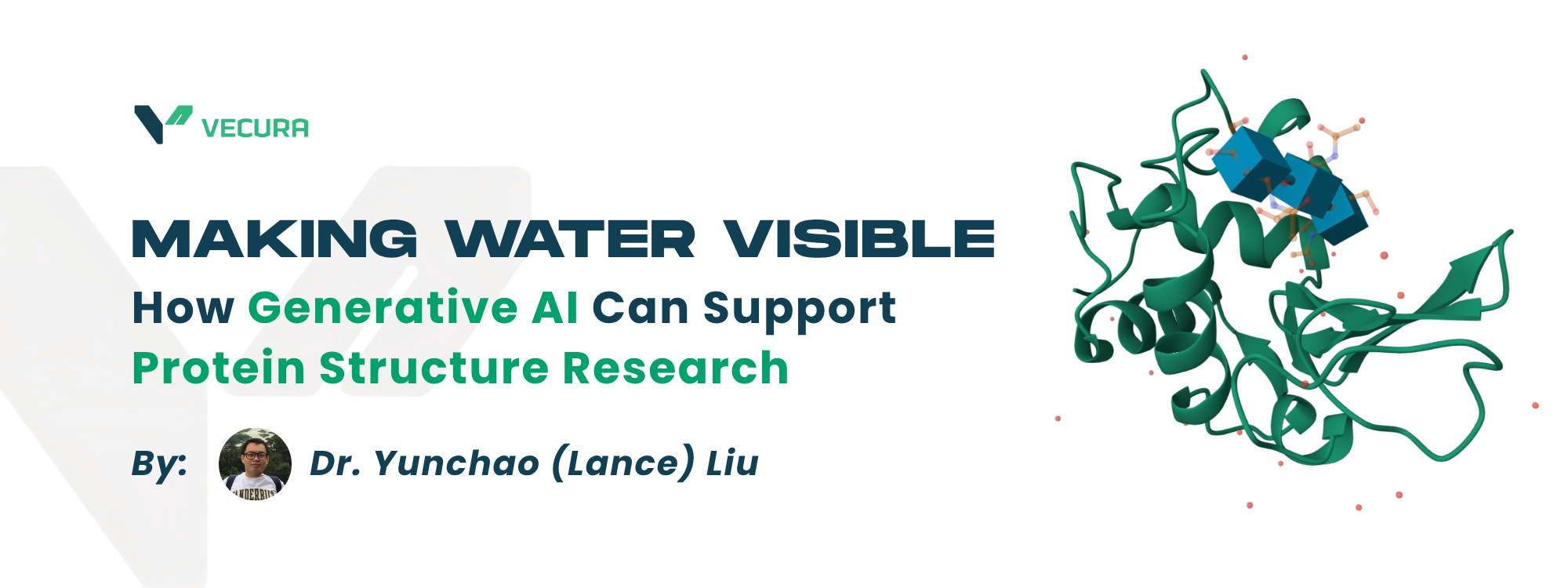
Water is fundamental to biological systems, yet the individual water molecules surrounding proteins are often difficult and expensive to model. SuperWater, a generative AI framework developed to predict water molecule positions around biomolecular complexes, offers a new approach to this longstanding computational challenge.
During the first AI4Life Innovation Talk, Dr. Yunchao (Lance) Liu, Scientist at A*STAR Singapore and co-author of SuperWater, explained why structural water matters, how the model works, and where AI-generated water predictions could support molecular discovery workflows.
Speaker: Dr. Yunchao (Lance) Liu, Scientist at A*STAR Singapore
Host: Giang Nguyen, Co-founder and CEO of NYB.AI
Event: AI4Life Innovation Talks #01
Date: 9 July 2026
Why Water Molecules Matter
Most biological processes take place in an aqueous medium, where water acts as a dynamic participant rather than a passive solvent. It directly influences protein structure, conformational stability, molecular recognition, and intermolecular interactions.
This role is especially critical within protein binding pockets.
Water molecules may form bridges between a protein and a ligand, occupy regions that affect ligand positioning, or contribute to the thermodynamic balance of binding. Changes to these local water networks can significantly alter molecular interactions.
In one example discussed during the session, disruption of a binding-site water network was associated with a 1,000-fold decrease in binding affinity. This illustrates why understanding the location of water molecules can be important when interpreting protein–ligand interactions or investigating changes caused by mutations.
Water should therefore be considered part of the binding environment and, in many cases, part of the binding energy equation.
The Computational Trade-Off
Researchers generally represent water in molecular simulations through either implicit or explicit approaches.
Implicit water models
Implicit methods treat water as a continuous solvent medium rather than representing each molecule individually. They are computationally efficient and can be useful for many large-scale calculations.
However, because individual water positions are not represented, these methods may overlook local water networks that influence specific molecular interactions.
Explicit water models
Explicit approaches represent individual water molecules around a protein. This can provide a more detailed picture of hydration sites, water-mediated interactions, and the organisation of water within binding pockets.
The trade-off is computational cost.
Established methods such as molecular dynamics combined with 3D-RISM, WaterMap, or GIST can require days of computation. Knowledge-based or Monte Carlo approaches may require hours, while more recent deep-learning methods have reduced prediction time to minutes.
This leads to a central research question:
Can AI model individual water molecules with greater accuracy while reducing the computational cost of explicit-water prediction?
Introducing SuperWater
SuperWater approaches water placement as a generative modelling problem.
Rather than searching for water positions through an extensive physical simulation, the framework learns the statistical distribution of experimentally observed water molecules around biomolecular complexes. It then predicts possible water positions for a new input.
At the centre of the framework is a score-based diffusion model. During training, the model learns how experimentally observed water positions can be progressively perturbed into random positions and how that process can subsequently be reversed.
During inference, the model begins with randomly distributed water points and iteratively moves them towards locations that are more consistent with the protein environment.
Each predicted water molecule is represented as a single point rather than as a complete H₂O molecular structure. The objective is to predict the likely position of the water oxygen around the protein surface.
Building the Training Dataset
SuperWater was trained using high-resolution biomolecular complexes selected according to several criteria:
-
Biomolecular complexes length between 100 and 500 residues
-
Structural resolution of approximately 1.5 Å
-
Sufficient water coverage relative to the number of protein residues
-
Water molecules located within 4 Å of the protein surface
-
Structures containing interactions with proteins, ligands, ions, or nucleic acids
The final dataset was divided into:
-
13,674 structures for training
-
1,709 structures for validation
-
1,709 structures for testing
This dataset allowed the model to learn water distributions across diverse structural environments rather than focusing exclusively on one type of binding site or protein complex.
How the SuperWater Workflow Operates
The SuperWater workflow combines generative prediction with a separate confidence assessment.
1. Representing the protein environment
The protein structure and water network are converted into graph representations. Relationships between the protein and water positions are also represented through a cross-graph.
2. Generating candidate water positions
A score-based diffusion model generates possible water locations around the protein.
An SE(3)-equivariant graph neural network is used so the model can process three-dimensional structures while preserving the correct geometric relationships when a protein is rotated or translated.
3. Repeating the sampling process
Multiple sets of candidate water positions are generated. These repeated samples help the system identify regions where predictions consistently converge.
4. Filtering predictions
A confidence model evaluates the generated candidates and classifies whether each position is likely to represent a true or false water site.
This stage is important because a generative model may produce plausible candidates that are not sufficiently supported by the structural environment.
5. Calculating final positions
The remaining candidate points are grouped into clusters. The centre of each cluster is then calculated to produce the final predicted water positions.
The resulting structure can be compared with experimentally observed water molecules or used for further structural analysis.
From Days of Simulation to Seconds of Inference
One of the most notable aspects of SuperWater is its reported runtime.
While physics-based water sampling approaches can require hours or days, SuperWater can generate predictions in approximately 40 seconds under the presented setup.
This does not mean that generative AI replaces every physics-based simulation. Molecular dynamics and free-energy methods provide information that a static water-position prediction model may not capture, including temporal behaviour, energetic transitions, and longer-range solvent effects.
Instead, SuperWater may provide a faster method for generating an initial hydration hypothesis.
Researchers could use these predictions to:
-
Identify likely hydration sites around a protein
-
Examine water networks within binding pockets
-
Support the interpretation of protein–ligand interactions
-
Prepare structures for docking or further simulation
-
Prioritise regions for more computationally intensive analysis
-
Compare hydration patterns across protein variants
The practical value lies in making explicit-water analysis more accessible at earlier stages of a workflow.
Predicting Water Across Different Structural Environments
The presentation demonstrated SuperWater predictions across several types of systems.
Protein surfaces
For proteins such as Carbonic Anhydrase II, the model was used to predict water distributions around the broader protein surface.
Protein–ligand systems
For a PHIP protein structure, predicted water molecules were visualised in the context of a bound ligand. These predictions may help researchers investigate whether specific water molecules mediate water-bridged contacts, stabilize the bound conformation, or undergo energetic displacement upon ligand binding.
Protein–protein interfaces
The model was also applied to protein–protein environments, including an NDM1–meropenem complex. This illustrates that the underlying approach is not restricted to conventional small-molecule binding pockets.
The ability to work across multiple structural contexts may be particularly useful for exploratory research, where hydration patterns can differ considerably between exposed protein surfaces, enclosed pockets, and molecular interfaces.
Key Takeaways from the Session
Water molecules can directly influence protein structure, binding affinity, and molecular recognition. Omitting them may simplify computation, but it can also remove information relevant to the biological system being studied.
SuperWater addresses this challenge through a score-based diffusion model that generates likely water positions around protein structures, followed by a confidence model that filters the predictions.
The framework demonstrates several important opportunities:
-
Generative AI can support explicit-water modelling at a substantially lower computational cost.
-
Predicted hydration sites may provide useful starting points for structural analysis, docking, and simulation.
-
Confidence filtering and clustering are essential for converting generative samples into interpretable molecular positions.
-
AI predictions should be treated as research hypotheses that remain connected to experimental evidence and physical validation.
Explore SuperWater on Vecura
SuperWater has been onboarded to Vecura, an agentic AI platform for molecular discovery and life science research.
Researchers can access the model through a shared environment designed to reduce the engineering work required to deploy and connect scientific AI tools.
Explore SuperWater on Vecura: https://vecura.com/en/updates/superwater
About AI4Life Innovation Talks
AI4Life Innovation Talks is a recurring online series connecting life science researchers with scientists developing emerging AI models, methods, and research workflows.
Each session focuses on the scientific motivation behind a technology, how it works, its limitations, and how it may contribute to real-world life science research.
Follow AI4Life for upcoming talks: https://www.linkedin.com/company/135304483
About the Speaker
Dr. Yunchao (Lance) Liu is a Scientist at the Bioinformatics Institute, A*STAR Singapore. His research interests lies in AI drug discovery (small molecule for RNA/proteins) via geometric deep learning/ reinforcement learning/ generative models.
立即试用 Vecura。
带上您自己的输入,开始探索 Vecura 的能力。