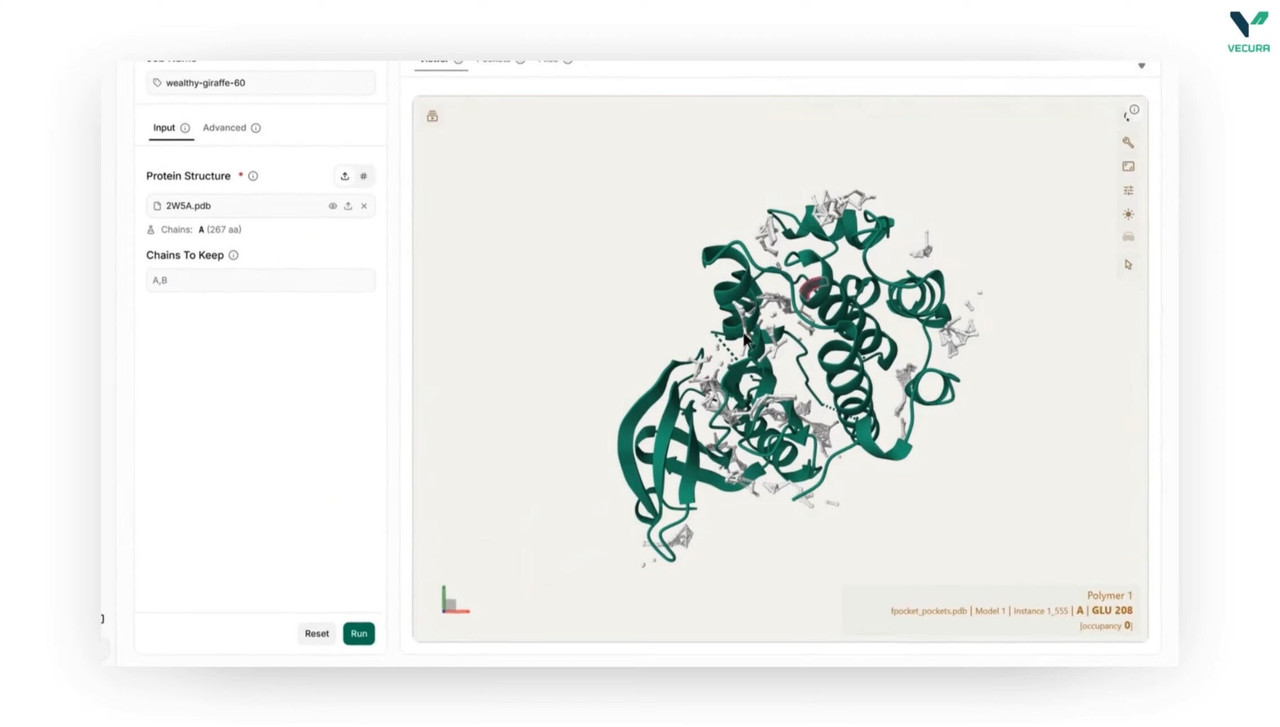
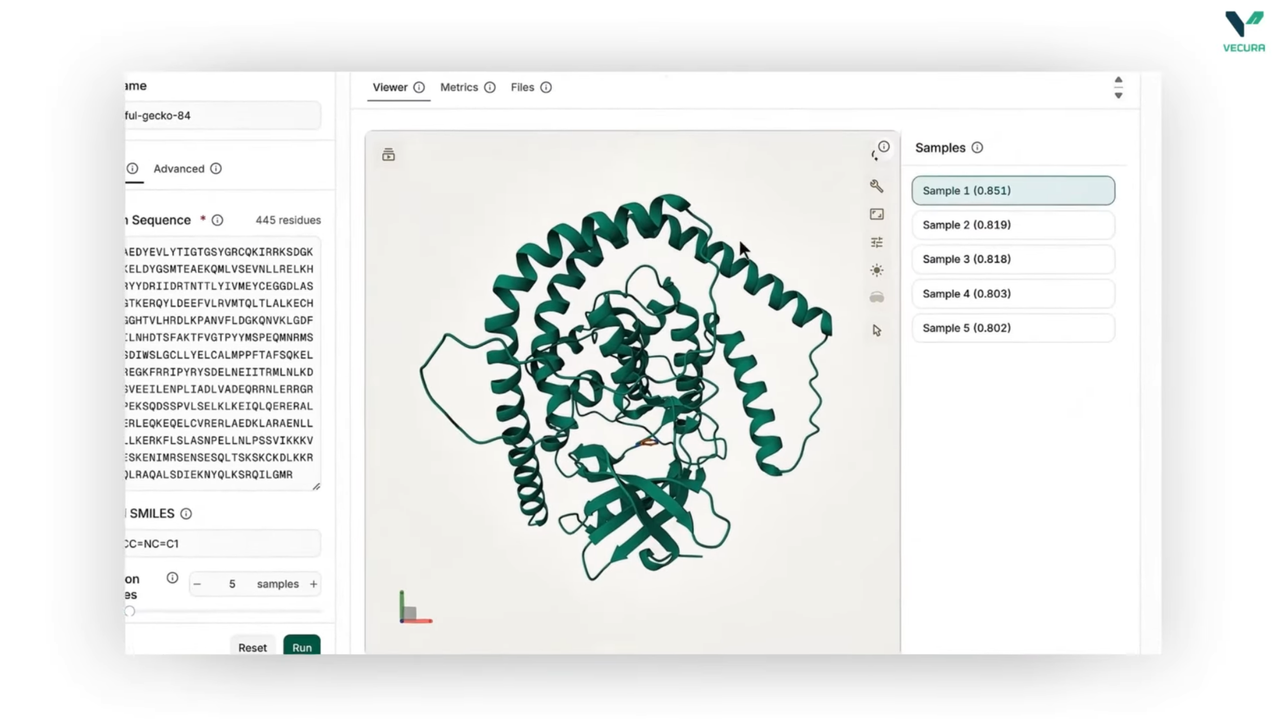
Nesso-1 Is Now Available on Vecura: Fast Protein–Ligand Binding Affinity Prediction Without the Infrastructure Hassle
This update enables drug discovery researchers and computational chemists to predict protein–ligand binding affinity directly from sequence and molecular structure through a guided workflow inside Vecura, without setting up GPU clusters or complex technical infrastructure.
What is Nesso-1?
Nesso-1 is an open-source, coarse-grained cofolding model developed by Valence Labs (Recursion) that predicts protein–ligand binding affinity directly from a protein's amino-acid sequence and a small molecule representation (SMILES, CCD code, or SDF). Unlike traditional structure-based models such as AlphaFold3 or Boltz-2, Nesso-1 does not require multiple-sequence alignment (MSA) searches or produce 3D structures—it trades pose prediction for speed, completing a single prediction in approximately one second on a single GPU. It uses frozen ESM-2 protein embeddings and a 48-block Pairformer trunk to generate token-level pairwise representations, which are then fed into a two-member ensemble that outputs both a continuous potency estimate and a binder/non-binder classification.
It helps users rapidly rank and filter thousands of candidate compounds against a protein target of interest, providing both a predicted binding affinity score and a confidence signal for each prediction. It is especially useful for hit identification and lead triage in the earliest stages of drug discovery, where teams need to evaluate large compound libraries before committing to costly wet-lab assays.
What can users do with Nesso-1 on Vecura?
With Nesso-1 on Vecura, users can:
-
Predict drug–target interaction — Estimate how tightly a small molecule binds to a protein target using only the target's sequence and the compound's SMILES string, CCD code, or SDF file—no crystal structure, docking pose, or MSA required.
-
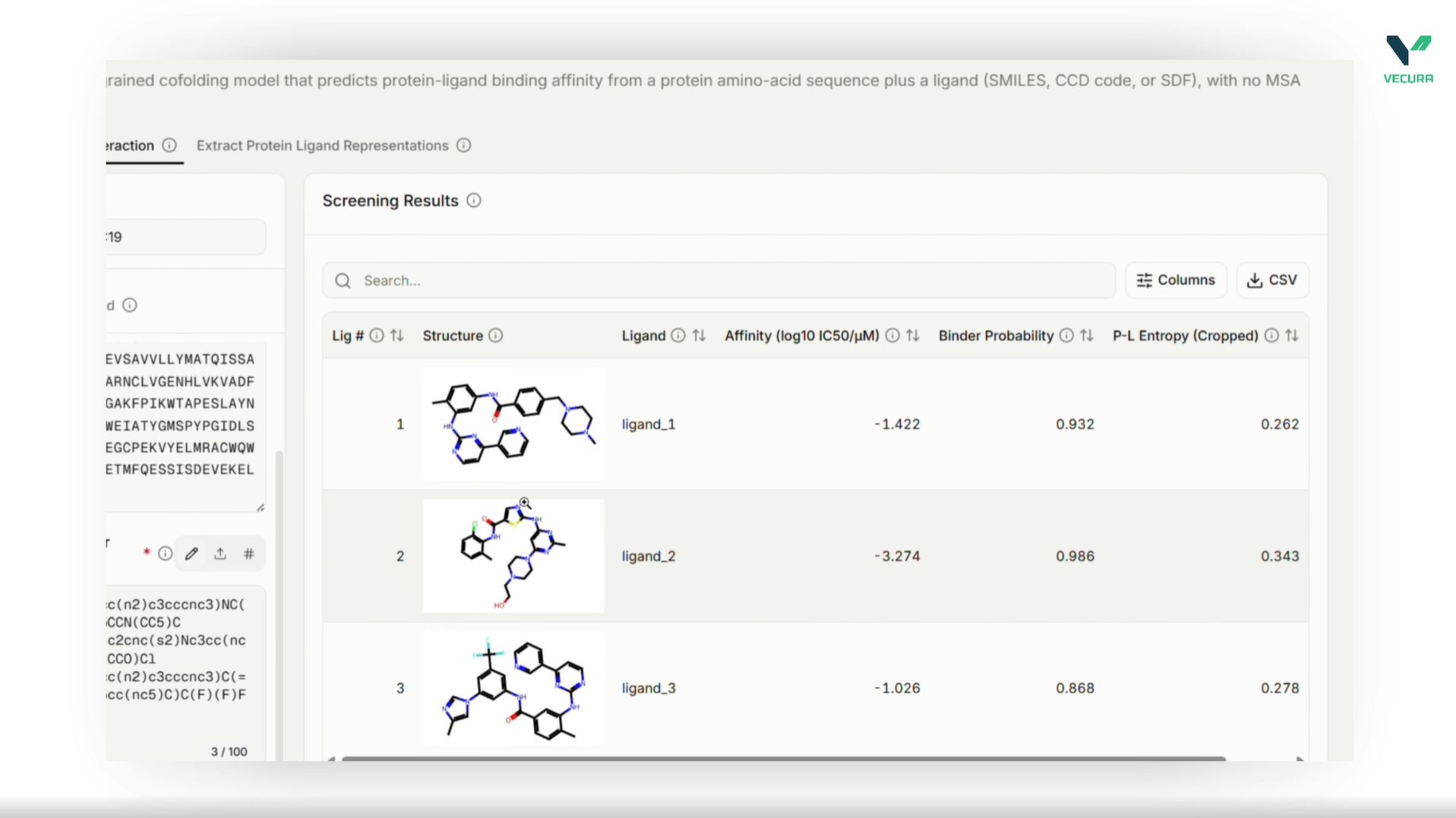
Rank and triage compound libraries — Sort candidate molecules by predicted binding affinity (log₁₀ IC₅₀) and filter hits using the built-in binder/non-binder probability score to prioritize the most promising compounds.
-
Assess prediction confidence — Evaluate the reliability of each affinity prediction using the protein–ligand distogram entropy score (entropy_crop_pl), which flags predictions where the model could not confidently place the ligand relative to the protein.
-
Extract protein–ligand representations — Download the model's internal pairwise representation tensors for downstream tasks such as building custom classifiers, clustering compounds by predicted binding mode, or fine-tuning a specialized affinity head on proprietary assay data.
What the output means
The output provides a predicted binding affinity score expressed as log₁₀(IC₅₀ / µM), where lower values indicate stronger binding (approximately −3.0 ≈ 1 nM, 0.0 ≈ 1 µM, +2.0 ≈ 100 µM). It also includes a binder/non-binder probability for categorical screening, individual predictions from two ensemble members (whose spread serves as an uncertainty proxy), and distogram entropy metrics that serve as confidence gates—particularly entropy_crop_pl, where values near 0.0 indicate the prediction should not be trusted. Additionally, raw pairwise representation tensors are available for downstream modeling.
This output should be used to support scientific decision making. It does not replace experimental validation.
Why this matters
Predicting how tightly a drug candidate binds to its biological target is one of the most fundamental tasks in early-stage drug discovery. Traditional computational approaches—molecular docking, free-energy perturbation, and even recent AI cofolding models—have been limited by either accuracy or speed. Structure-based deep learning models like Boltz-2 and AlphaFold3-style diffusion architectures achieve strong predictive performance but require 20 seconds to over a minute per prediction, making large-scale virtual screening campaigns computationally expensive and slow. For teams evaluating millions of compounds across multiple targets, this bottleneck directly constrains how much science they can explore.
Nesso-1 demonstrates that thoughtful coarse-grained model design can break the traditional speed–accuracy tradeoff. By removing the atomistic diffusion module and substituting frozen ESM-2 embeddings for costly MSA searches, the model achieves comparable or superior accuracy to state-of-the-art cofolding models while running over 10× faster—more than 20× faster on larger proteins. This speed enables researchers to screen substantially larger chemical libraries, iterate more rapidly through design cycles, and integrate binding affinity prediction into autonomous drug discovery workflows that were previously impractical at scale. As an open-source model trained entirely on public data and released under Apache-2.0, Nesso-1 also lowers the barrier to entry for academic and smaller biotech teams who lack access to proprietary infrastructure.
-
Developed by: Valence Labs, Recursion
-
Source: GitHub Repository · Model Card · Model Weights (HuggingFace)
-
Reference: Nesso-1 Technical Report (Valence Labs, Recursion, 2026)
Vecura で Nesso-1 を試す。
モデルワークスペースを開き、ご自身の入力で評価を始めましょう。