MAGE is Now Available on Vecura: Accelerating Monoclonal Antibody Design
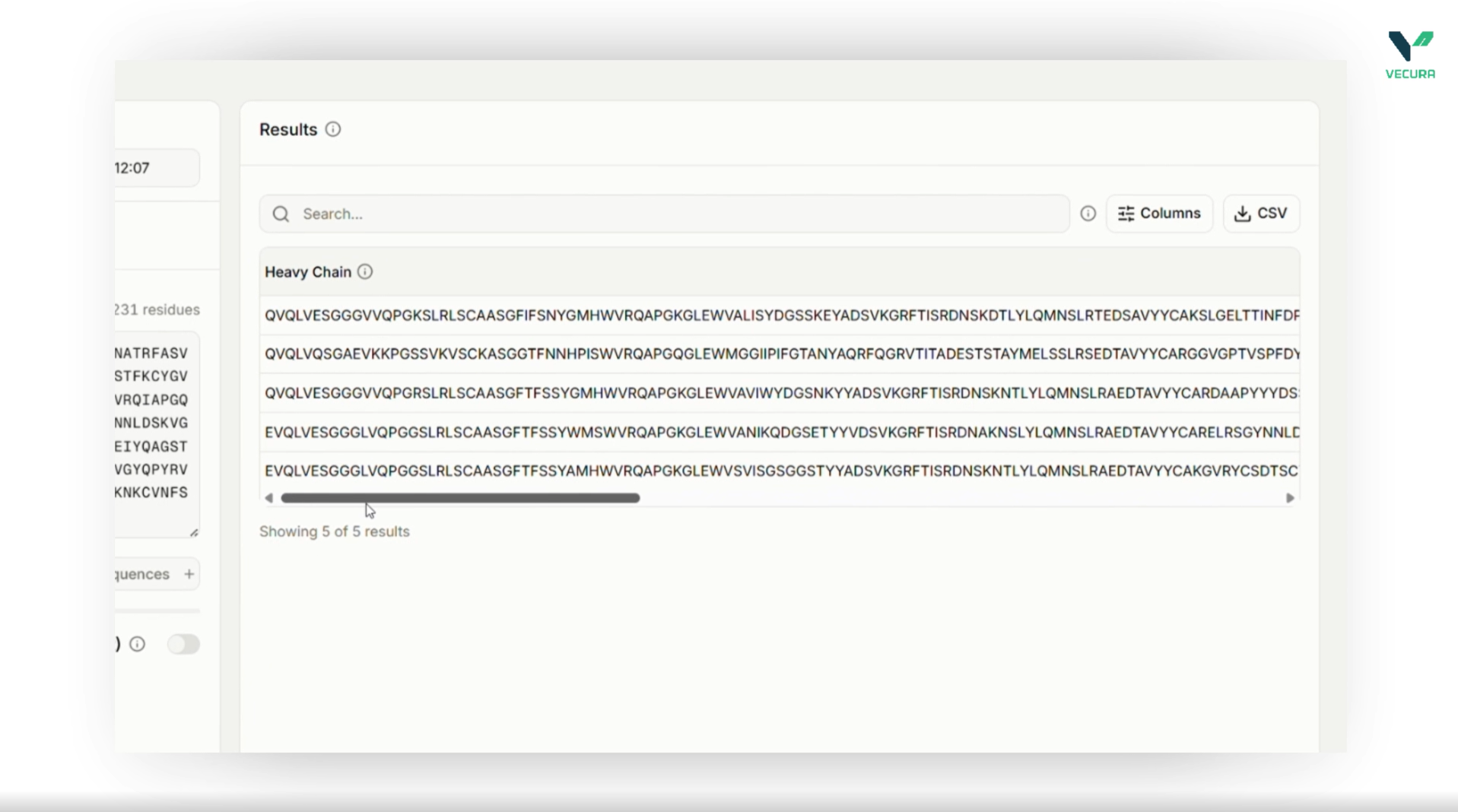
This update enables immunologists and biopharma researchers to design novel, paired heavy-light antibody variable-region sequences through a guided workflow inside Vecura, without setting up complex technical infrastructure.
What is MAGE?
MAGE (Monoclonal Antibody GEnerator) is a fine-tuned ProGen2 protein language model designed to streamline the discovery of therapeutic antibodies. By training on curated, naturally paired antibody datasets, this generative model is capable of outputting both heavy and light chain variable region sequences in a single, co-dependent decoding pass.
It helps users design novel antibody candidates conditioned directly on the amino-acid sequence of a target antigen. It is especially useful for rapid early-stage antibody screening, therapeutic candidate generation against emerging pathogens, and streamlining wet-lab discovery pipelines.
What can users do with MAGE on Vecura?
With MAGE on Vecura, users can:
-
Condition Antibody Generation on Target Antigens: Input cleaned target antigen sequences (such as receptor-binding domains or viral glycoproteins) to steer generative design.
-
Generate Paired Heavy-Light Chains Simultaneously: Generate fully paired antibody variable region sequences in a single auto-regressive run, avoiding the need to pair chains post-generation.
-
Tune Sequence Diversity and Confidence: Customize generation parameters, including temperature and nucleus sampling (
top_p), to control the balance between high-confidence structural conservation and highly diverse candidate novelties. -
Scale Up Candidate Libraries: Easily request multiple paired candidate sequences (
num_antibodies) in batches to feed directly into computational docking and virtual screening assays.
What the output means
The output provides a structured list of paired heavy-chain and light-chain variable-region amino-acid sequences in standard single-letter codes, accompanied by the raw, unparsed string output. The model uses a [SEP] delimiter to natively divide the generated heavy-chain from the light-chain sequence, ensuring structural context is preserved between the paired chains.
This output should be used to support scientific decision making. It does not replace experimental validation.
Why this matters
In the domain of biotherapeutics, discovering functional monoclonal antibodies against a specific target has traditionally been a slow, costly, and resource-intensive endeavor, relying heavily on animal immunizations or synthetic library screening. While deep learning has begun to accelerate this process, many models generate heavy and light chains independently. This artificial separation poses a major challenge, as the physical binding affinity of an antibody depends on the highly coordinated interaction of both chains folding together. Generating them separately often leads to paired structural mismatches during experimental testing.
MAGE overcomes this barrier by generating both chains sequentially in a single pass of a fine-tuned ProGen2 language model. By treating the paired heavy-light sequences as a continuous language generation task conditioned on the target antigen, MAGE learns to capture the subtle co-evolutionary and structural interdependencies between the two chains. This allows researchers to skip complex pairing heuristics and go straight from antigen sequence to co-designed, paired antibody candidates in seconds—democratizing advanced computational immunology and accelerating the path to downstream assay validation.
-
Developed by: Wasdin et al. at the Crowe Lab, Vanderbilt University Medical Center (VUMC).
-
Source: MAGE GitHub Repository & HuggingFace Model Hub.
-
Reference: Wasdin, P., et al. (2024). MAGE: Monoclonal Antibody GEnerator. Built upon Salesforce Research's ProGen2 Base Model.
Vecura で MAGE を試す。
モデルワークスペースを開き、ご自身の入力で評価を始めましょう。