BoltzGen Now Available on Vecura: Universal Protein Binder Design
This update enables researchers and biotech scientists to design novel protein binders, peptides, and therapeutic candidates through a guided workflow inside Vecura, without setting up complex GPU infrastructure or managing large model weights.
What is BoltzGen?
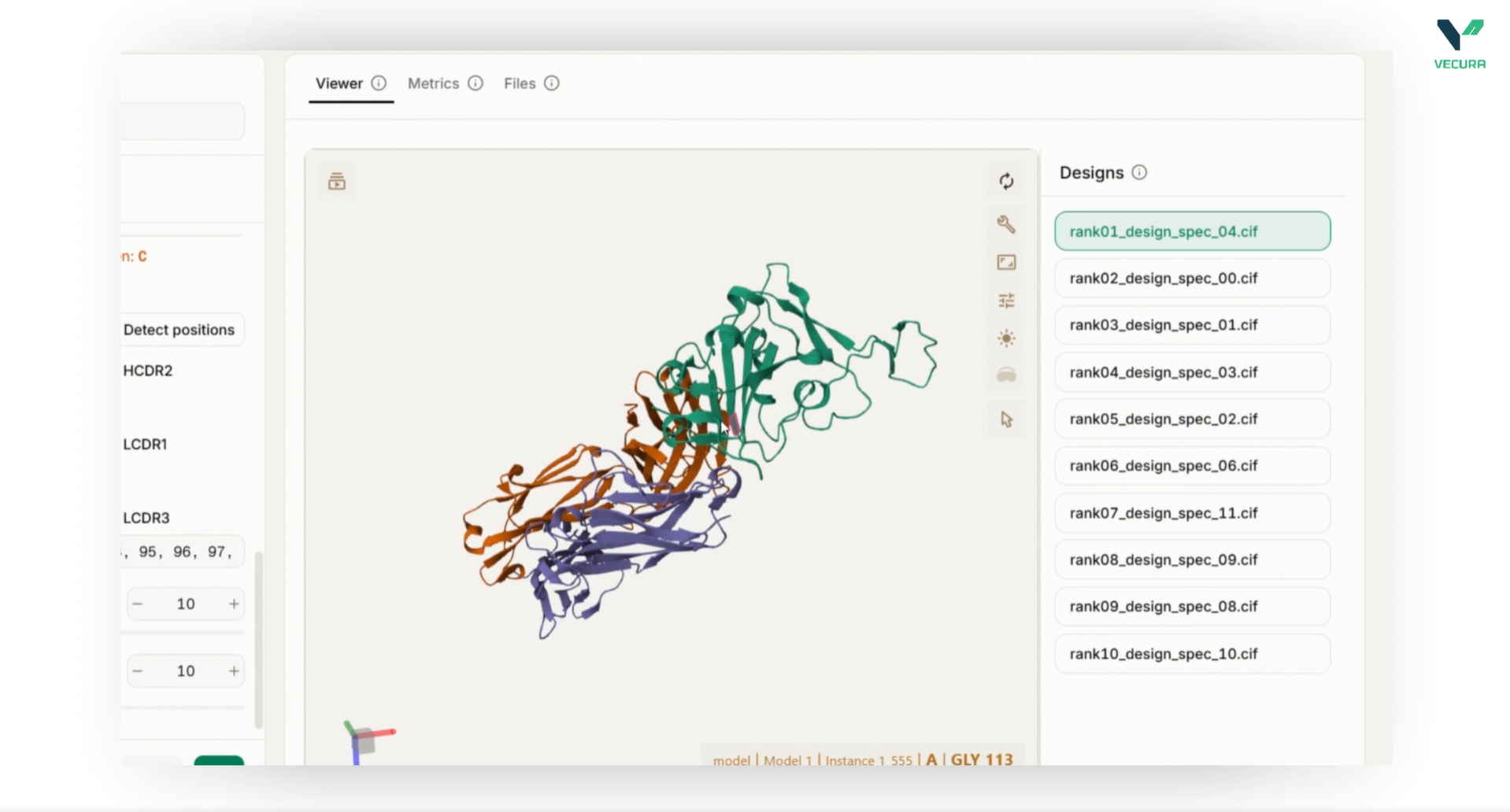
BoltzGen is an all-atom generative model that designs proteins and peptides across all modalities to bind a wide range of biomolecular targets. It unifies design and structure prediction in a single model, achieving state-of-the-art folding performance by combining diffusion-based backbone generation, inverse folding with ESM-IF1, and high-accuracy refolding with Boltz-2.
It helps users create novel binding proteins, cyclic peptides, antibody CDRs, and nanobody CDRs from scratch—without requiring pre-existing scaffolds. It is especially useful for therapeutic development campaigns targeting novel proteins, peptides, or small molecules where traditional binder discovery methods fall short.
What can users do with BoltzGen on Vecura?
With BoltzGen on Vecura, users can:
-
Design de novo protein binders against any target structure with customizable length constraints and binding site specifications
-
Generate cyclic peptides and antibody/nanobody CDR loops conditioned on provided framework structures
-
Redesign existing protein interfaces to optimize binding affinity and specificity
-
Create small-molecule-targeting proteins for drug development and biosensor applications
What the output means
The output provides ranked CIF structure files of binder-target complexes, a comprehensive metrics CSV covering interface confidence scores (ipTM, pLDDT), hydrogen bonds, buried surface area, and secondary structure composition, plus summary scores for the top-ranked design.
This output should be used to support scientific decision making by prioritizing candidates for wet-lab validation and gene synthesis. It does not replace experimental validation—computational predictions must be confirmed through binding assays, structural studies, and functional testing.
Why this matters
Protein binder design sits at the heart of modern therapeutics, diagnostics, and synthetic biology. Creating high-affinity binders against novel targets traditionally required extensive experimental screening, phage display libraries, or structure-guided engineering—processes that are time-consuming, expensive, and often fail against challenging targets like disordered proteins or small molecules.
BoltzGen represents a paradigm shift by achieving low nanomolar affinity results roughly 66% of the time against novel targets with less than 30% sequence similarity to known binders. This success rate on problems most models don't attempt demonstrates that unified generative models can tackle real-world biomolecular design challenges that were previously considered intractable, accelerating the path from target identification to validated therapeutic candidates.
-
Developed by: MIT Jameel Clinic (Hannes Stärk and team)
-
Source: bioRxiv preprint and official GitHub repository
-
Reference: https://doi.org/10.1101/2025.11.20.689494 | https://github.com/HannesStark/boltzgen
Vecura で BoltzGen を試す。
モデルワークスペースを開き、ご自身の入力で評価を始めましょう。