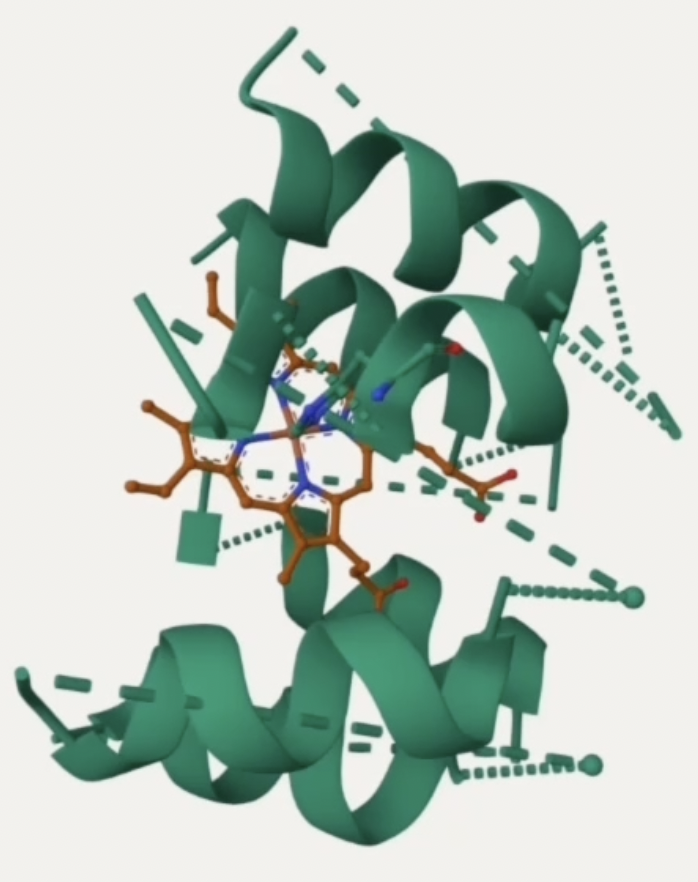
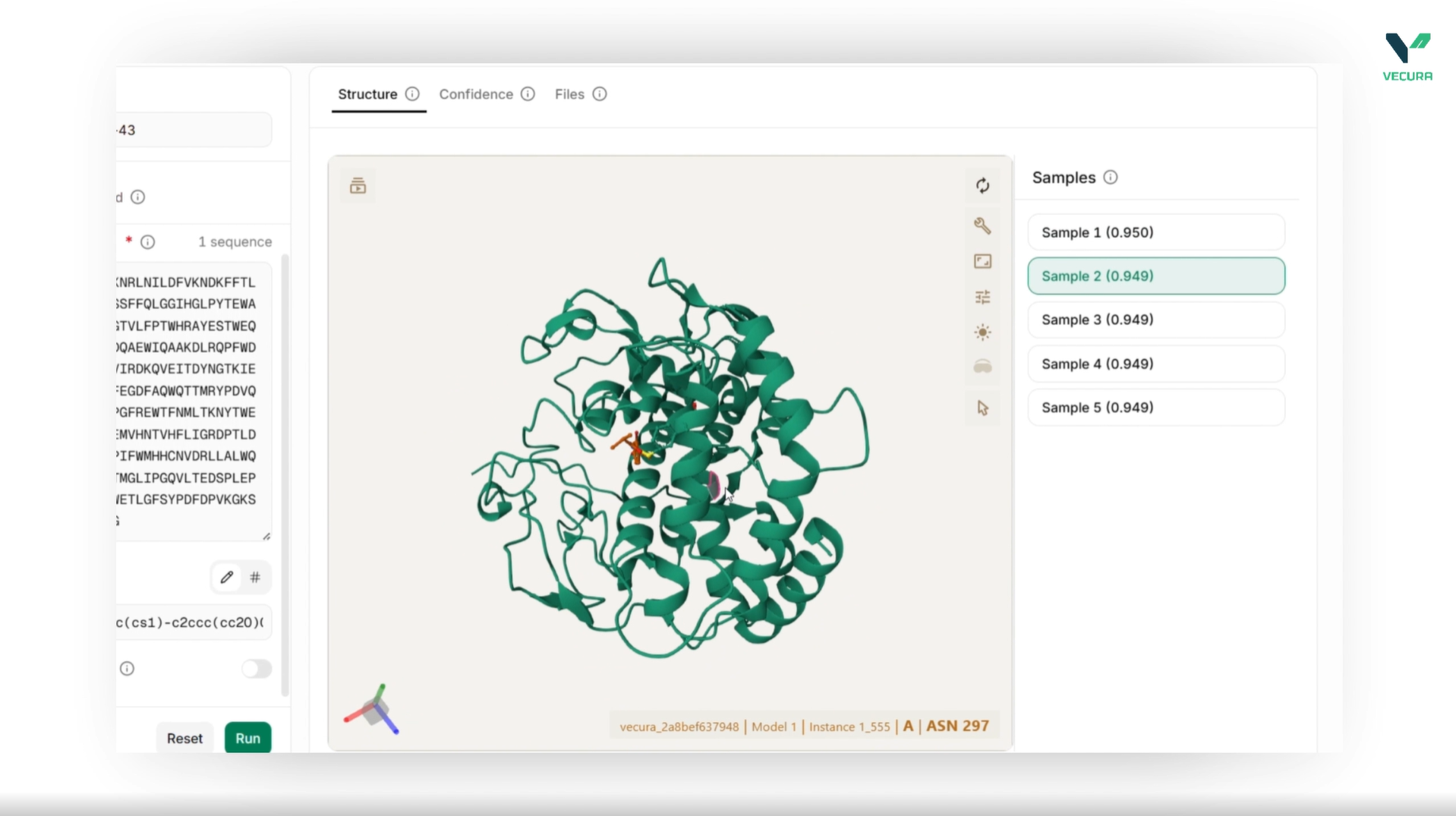
BioEmu2 is Now Available on Vecura
This update enables structural biologists and computational chemists to predict biomolecular structures, sample conformational ensembles, and simulate molecular dynamics through a guided workflow inside Vecura, without setting up complex GPU infrastructure or managing diffusion model deployments.
What is BioEmu2?
BioEmu2 (Biomolecular Emulator) is a roughly 500-million-parameter all-atom diffusion foundation model developed by Microsoft Research AI for Science. It predicts folded 3D structures, samples equilibrium conformational ensembles, and propagates molecular structures forward in time for systems composed of proteins, nucleic acids, ligands, glycans, and other chemical components.
It helps users generate all-atom three-dimensional coordinates for biomolecular systems using a single set of model weights that address three related scientific questions: what a system looks like when folded, which range of shapes it adopts at equilibrium, and where a given structure ends up after a chosen time lag. It is especially useful for researchers who need conformational ensembles, alternative structural states, or short time-ordered motions of proteins, complexes, or protein-ligand systems without running computationally expensive full molecular-dynamics simulations.
What can users do with BioEmu2 on Vecura?
With BioEmu2 on Vecura, users can:
- Predict folded biomolecular structures by providing protein sequences, RNA/DNA chains, small-molecule ligands (via PDB Chemical Component Dictionary codes or SMILES), or a PDB ID, and receive accurate all-atom 3D structures with heuristic sharpening applied.
- Sample equilibrium conformational ensembles to explore the full range of shapes a biomolecular system adopts, enabling the discovery of alternative states, flexible regions, and ligand-induced conformational shifts without running traditional molecular-dynamics simulations.
- Propagate structures forward in time by supplying a starting structure and a lag time in nanoseconds (up to 1,000 ns), generating time-ordered trajectories that show where the system moves over successive steps — effectively emulating short molecular-dynamics trajectories through learned transfer operators.
- Define complex multi-component systems using a system YAML that supports modified residues, branched glycans, extra covalent bonds, contact restraints between residues, and custom chain IDs, or convert existing Boltz-1 and Boltz-2 input YAMLs for seamless compatibility.
What the output means
The output provides a set of all-atom 3D coordinate files in XTC format (paired with topology PDB and mmCIF files), a resolved system YAML documenting the exact system that was sampled, and a physicality report that labels each generated frame based on geometry checks including bond lengths, steric clashes, valence, and topology consistency.
For structure prediction and equilibrium sampling, each frame represents an independent conformational sample. For propagation runs, frames are organized into time-ordered trajectories with metadata indicating the trajectory index, step number, and simulated time in picoseconds.
This output should be used to support scientific decision making. It does not replace experimental validation. Importantly, BioEmu2 does not produce per-structure confidence scores such as pLDDT or PAE — the physicality report is a geometry check, not a measure of how likely a structure is to be correct. Sampling frequencies are also not calibrated as Boltzmann probabilities or free energies, so quantitative binding-affinity or absolute free-energy prediction remains out of scope.
Why this matters
Understanding the dynamic behavior of biomolecules — how proteins fold, how complexes rearrange, how ligands bind and unbind — is fundamental to drug discovery, enzyme engineering, and basic molecular biology. Traditional molecular-dynamics simulations can capture these phenomena but require enormous computational resources, often demanding thousands of GPU-hours for meaningful timescales. Structure prediction tools like AlphaFold provide static snapshots but do not capture the conformational diversity that is essential for understanding function.
BioEmu2 bridges this gap by using a diffusion-based generative approach to efficiently sample conformational ensembles and emulate short-timescale dynamics, all from a single ~500M-parameter model with open weights under the MIT license. By making BioEmu2 available through Vecura's guided workflow, researchers can access these capabilities without managing GPU clusters, installing complex dependency stacks, or handling diffusion model inference pipelines — lowering the barrier to advanced biomolecular simulation for structural biology labs and computational chemistry teams worldwide.
- Developed by: Microsoft Research AI for Science
- Source: GitHub Repository, Model Card, and Documentation
- Reference: BioEmu2 GitHub Repository · Model Weights on Hugging Face · bioRxiv Preprint: Scalable emulation of protein equilibrium ensembles with generative deep learning
Vecura で BioEmu2 を試す。
モデルワークスペースを開き、ご自身の入力で評価を始めましょう。