Using Boltz-2.1 for Structure Confidence Screening in a De Novo Protein Design Workflow
How the Vecura platform runs Boltz-2.1 through the API as the structure-validation engine inside a multi-model design pipeline, folding nine designed sequences with ten sampled models each and turning per-structure confidence into a triage signal for what to carry forward.
How the Vecura platform runs Boltz-2.1 through the API as the structure-validation engine inside a multi-model design pipeline, folding nine designed sequences with ten sampled models each and turning per-structure confidence into a triage signal for what to carry forward.
De novo protein design has a validation problem in the middle of the pipeline. Generative models such as RFdiffusion and LigandMPNN can propose backbones and sequences faster than most teams can check them, and the bottleneck moves to a single question asked over and over: Does this designed sequence actually fold into the shape we intended, and how confident can we be in the answer?
On the Vecura platform, Boltz-2.1 addresses this by folding each designed sequence with ten sampled models and reporting per-structure confidence, giving the design loop a concrete signal for which candidates are structurally credible and which are not.
This case study walks through a real run on Vecura: a de novo peptide-design pipeline aimed at the ATP pocket of the LRRK2 kinase domain, a target of interest in Parkinson's disease. The biology is the backdrop. The point of the piece is the validation step, where Boltz-2.1 took nine designed sequences, folded each with ten sampled models, and returned confidence scores that let us rank and filter the designs.
| 10 | 9 | 3 |
|---|---|---|
| Sampled models folded per sequence | Designs screened in one pass | Models chained on one platform |
Where Boltz-2.1 sits in the workflow
The pipeline chains four stages on the Vecura platform, summarized in Figure 1. A target surface is extracted from the LRRK2 structure, RFdiffusion generates candidate backbones, LigandMPNN designs sequences onto each backbone, and then Boltz-2.1 folds every designed sequence, with ten sampled models each, so its confidence can be scored. Try the workflow here.
Boltz-2.1 is the validation engine. Generative models are confident about what they propose but say nothing about whether a proposed sequence will actually adopt the intended fold. Boltz-2.1 closes that gap. It takes each LigandMPNN sequence and predicts a full three-dimensional structure, which the workflow then reads through its per-structure confidence to judge how credibly the design folds. Without a folding step in this slot, the design loop has no way to tell a plausible sequence from an implausible one.
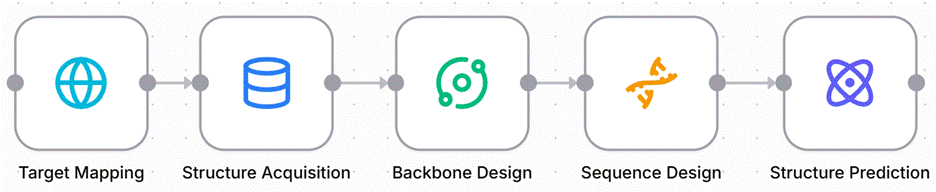
Figure 1. The Vecura design workflow. Boltz-2.1 occupies the structure-validation stage, folding every designed sequence with ten sampled models to produce a confidence signal for triage.
What Boltz-2.1 delivered on Vecura
Ten models per design, one confidence read
The design goal here was confidence, not raw speed. Across nine designs spanning 62 to 81 residues, Boltz-2.1 folded each sequence ten times through the API and returned the most confident model of the set, with total inference times ranging from 48 to 138 seconds per design (Table 1). Sampling ten models rather than one guards against a single unlucky fold and gives a firmer read on whether a sequence adopts a compact structure at all. The output of the step is a ranked, filterable set of designs, each carrying a confidence score the pipeline can act on before deciding what to carry into the next round.
Table 1. Boltz-2.1 inference times and top-model structure confidence on the Vecura platform, by design. Ten models were sampled per sequence; the most confident of each length class is bold.
| Design | Length (residues) | Inference time (10 models) | structure_confidence |
|---|---|---|---|
| 62_1 | 62 | 78 s | 0.731 |
| 62_2 | 62 | 78 s | 0.763 |
| 62_3 | 62 | 48 s | 0.625 |
| 67_1 | 67 | 138 s | 0.686 |
| 67_2 | 67 | 78 s | 0.705 |
| 67_3 | 67 | 78 s | 0.686 |
| 81_1 | 81 | 108 s | 0.745 |
| 81_2 | 81 | 138 s | 0.695 |
| 81_3 | 81 | 78 s | 0.694 |
A structure you can triage on
A confidence read is only useful if it discriminates, and in this run it did. Each prediction carries a structure_confidence score alongside complex_pLDDT, pTM, and a predicted distance error, which together separate designs worth advancing from designs that need rework.
Within each length class, the scores ordered the candidates clearly. Among the 62-residue designs, 62_2 came back most confident at 0.763 structure_confidence and 0.818 complex_pLDDT, while 62_3 scored lowest at 0.625 with the highest predicted error of the group. The 67-residue class was led by 67_2 at 0.705, and among the 81-residue designs, 81_1 came out on top at 0.745 with the strongest pTM of the whole run at 0.715. That said, the absolute values are modest across the board, so these rankings sort candidates relative to one another rather than certifying any of them as well folded.
Validation that flags weak designs is doing its job. Several designs in this early run came back with modest confidence, which is exactly what you want a validation step to surface. The value of a folding step is not that it blesses every design, but that it tells you which ones are structurally credible and which are not, so compute and downstream effort flow only to the candidates that earn it. Boltz-2.1 gave that read on every design in this pass.
A full structure, not just a score
Because Boltz-2.1 returns a full three-dimensional structure rather than a score alone, each design comes out of the step as an inspectable model, not just a number. That leaves the door open to downstream structural analysis when a candidate warrants it, whether visual inspection of the fold, comparison against the design intent, or docking against the target.
In this run, the structures served their immediate purpose, which was to carry the confidence signal used for triage, while remaining available for any closer look a promising design earns later. Having model and confidence together, produced inside a single orchestrated pipeline, is the workflow advantage Vecura is built to deliver.
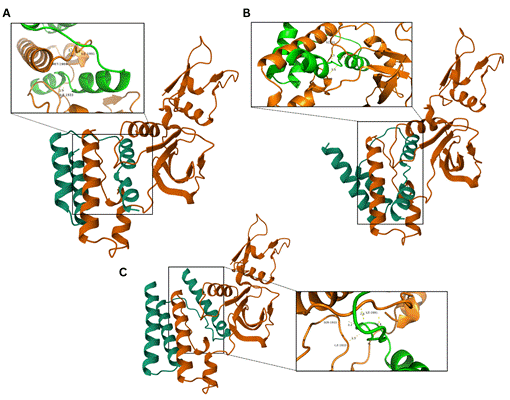
Figure 2. RFdiffusion-generated backbones at the LRRK2 kinase-domain target surface, the design context from which the LigandMPNN sequences in this study were produced. (A) 62-residue peptide. (B) 67-residue peptide. (C) 81-residue peptide.
Why run Boltz-2.1 on Vecura
The same set of models can be a stitched-together mess or a single coherent pipeline depending on where it runs, and this case study is really about the second. Three things made the validation step work.
One platform, one pipeline. RFdiffusion, LigandMPNN, and Boltz-2.1 ran together on Vecura without stitching environments, moving files between services, or managing separate infrastructure for each model. Boltz-2.1 was called through its API from inside the same workflow, so even a model that is not onboarded on the platform slotted into the pipeline without leaving it. The design loop lived in one place.
Depth where it counts. Sampling ten models per sequence rather than a single fold gives a steadier confidence read and reduces the chance that one unlucky prediction decides a design's fate.
A signal you can act on. Per-structure confidence plus full models meant every design came back rankable and filterable, so the pipeline could triage automatically instead of asking a human to inspect each one.
A fair word on scope. This was an early, exploratory run, and the confidence scores were modest across the board, as first-pass de novo designs often are, so the results rank designs against each other rather than certify any of them as well folded. Confidence scores from any folding model should also be read with care for de novo sequences, which sit outside the natural-sequence data these models are trained on, and reporting only the most confident of ten sampled models trims the low tail rather than describing the full spread. None of that changes the operational result this piece is about. On Vecura, Boltz-2.1 screened a full generation of designs in one orchestrated pass and produced the per-structure confidence signal needed to decide what comes next.
Bring your own design pipeline to Vecura and run Boltz-2.1 confidence screening as part of one orchestrated workflow. Fold, rank, and filter a full generation of designs before your next iteration.
About Vecura
Vecura is NYB.AI’s agentic discovery platform for life science R&D. It connects AI models, scientific tools, biological data, retrieval systems, accelerated computing, and autonomous workflows into one operational environment. By turning fragmented research steps into structured, repeatable workflows, Vecura helps teams shorten discovery cycles, evaluate candidates with greater confidence, and prioritize high-potential molecules for the next stage of development.
今すぐVecuraを試す
自分の入力を持って、Vecuraができることを探求しましょう