RNAPro is Now Available on Vecura
This update enables structural biologists and drug discovery researchers to predict RNA 3D structures from sequence data through a guided workflow inside Vecura, without setting up complex GPU infrastructure or managing multiple dependencies.
What is RNAPro?
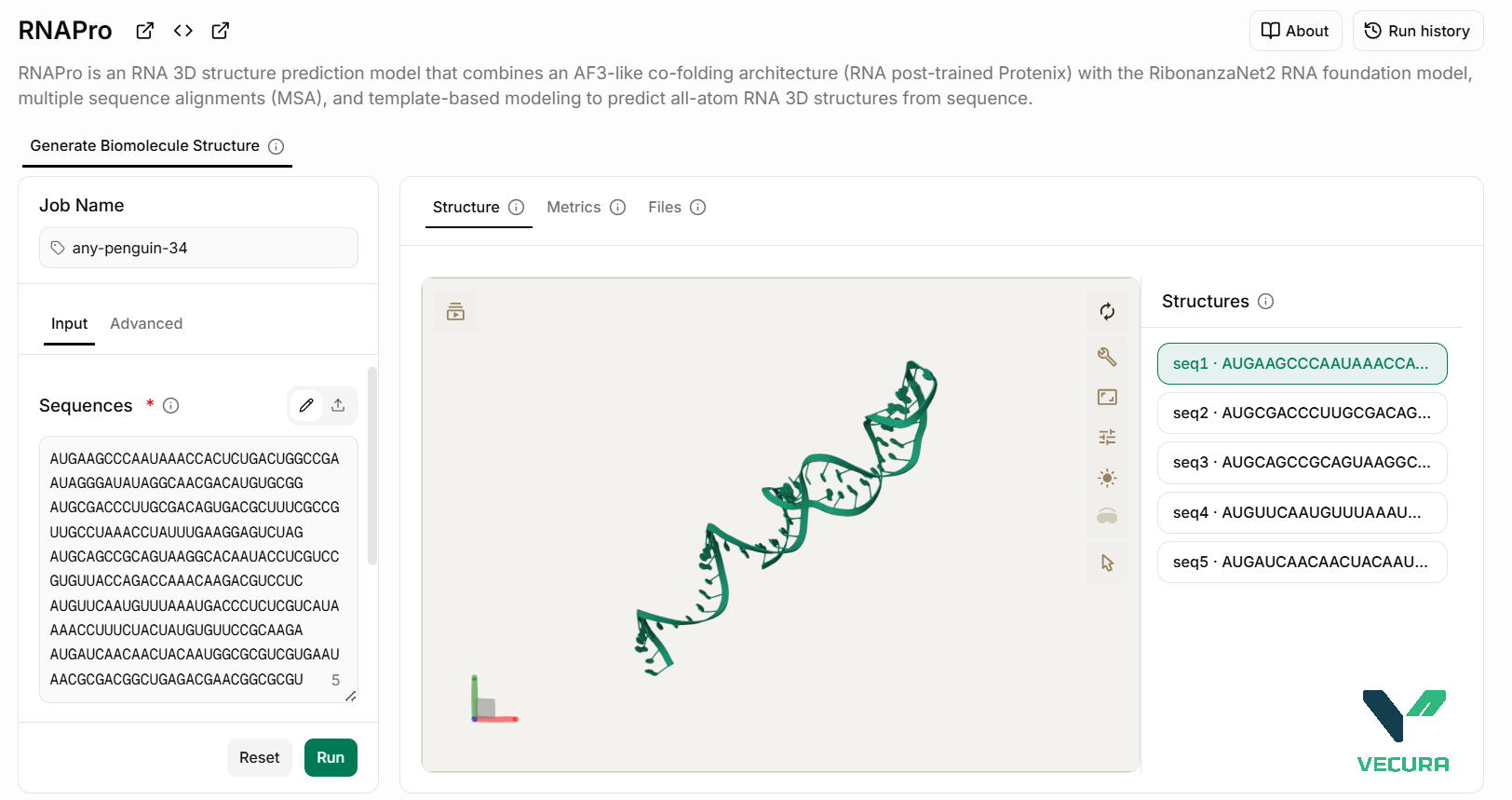
RNAPro is a 488-million parameter deep learning model that predicts the three-dimensional structure of RNA molecules from their nucleotide sequences. It combines an AlphaFold3-style co-folding architecture (Protenix) with the RibonanzaNet2 RNA foundation model, multiple sequence alignments, and template-based modeling to generate all-atom RNA structures in mmCIF format.
It helps users determine atomic-level RNA coordinates for downstream applications like molecular docking, antisense oligonucleotide design, and virtual screening. It is especially useful for predicting structures of RNA targets where experimental data is scarce or unavailable, filling a critical gap in structural biology similar to what AlphaFold achieved for proteins.
What can users do with RNAPro on Vecura?
With RNAPro on Vecura, users can:
- Predict all-atom RNA 3D structures from nucleotide sequences with per-atom confidence scores
- Incorporate multiple sequence alignments and template data to improve prediction accuracy
- Generate multiple candidate structures per sequence and rank them by quality metrics
- Export predicted structures in standard mmCIF format compatible with PyMOL, ChimeraX, and other molecular visualization tools
What the output means
The output provides predicted RNA 3D structures in mmCIF format, with each atom carrying a pLDDT confidence score (0–100) in the B-factor column. Higher pLDDT values indicate more reliable predicted positions. The output also includes confidence metrics: mean pLDDT, global predicted distance error (GPDE), predicted template modeling score (pTM), and interface pTM (ipTM) for multi-entity predictions. A ranking score derived from pTM/ipTM helps identify the highest-quality structure among multiple candidates.
This output should be used to support scientific decision making. It does not replace experimental validation.
Why this matters
RNA structure determines biological function—catalytic activity, regulatory binding, and therapeutic targeting all depend on the precise three-dimensional arrangement of nucleotides. However, high-quality RNA structures are far rarer in public databases than protein structures, creating a bottleneck for RNA-targeted drug discovery and basic research. While AlphaFold revolutionized protein structure prediction, RNA remained a challenging frontier due to its flexibility, diverse functional roles, and limited experimental data.
RNAPro addresses this gap by providing end-to-end RNA structure prediction that combines the proven AlphaFold3 architecture with RNA-specific innovations like RibonanzaNet2 embeddings and lightweight C1' backbone templates. This enables researchers to rapidly generate structural hypotheses for RNA molecules, accelerating the design of antisense oligonucleotides, small molecule docking studies, and synthetic RNA constructs without waiting for experimental structure determination.
- Developed by: NVIDIA in collaboration with Stanford Das Lab and winning teams from the Stanford RNA 3D Folding Kaggle competition
- Source: Model card and official GitHub repository
- Reference: bioRxiv preprint, GitHub repository, Model weights on HuggingFace
Try RNAPro on Vecura.
Open the model workspace and start evaluating it with your own inputs.