ESMFold2 is now available on Vecura
This update enables life science researchers to predict the 3D structure of biomolecular complexes directly from sequence data, through a guided workflow inside Vecura, without setting up complex technical infrastructure.
What is ESMFold2?
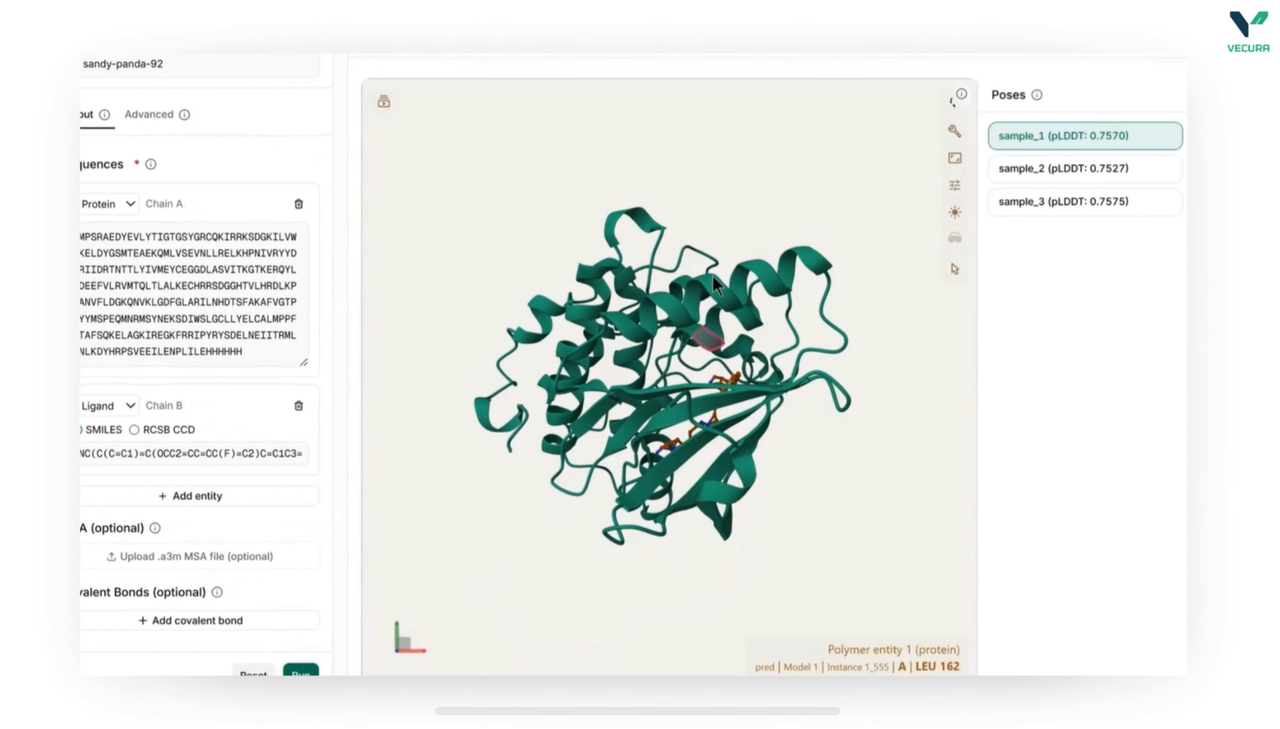
ESMFold2 is an advanced all-atom 3D biomolecular structure prediction model that can predict the structures of proteins, RNA, DNA, ligands, and multi-chain complexes from sequence data alone. It combines a 6 billion-parameter protein language model (ESMC) with a diffusion-based architecture to generate highly accurate 3D coordinates. It is particularly valuable for researchers who need to understand the structural details of complex biomolecules without having access to experimental structures. It helps users to predict the 3D structure of biomolecular complexes directly from their sequences, even when these complexes are composed of different chain types such as proteins, RNA, and small-molecule ligands. It is especially useful for drug discovery, where understanding the interactions between proteins and potential drugs at the atomic level is crucial.
What can users do with ESMFold2 on Vecura?
With ESMFold2 on Vecura, users can:
- Predict high-resolution 3D structures of biomolecular complexes from sequence data alone.
- Obtain confidence metrics, including per-residue pLDDT scores and global pTM/ipTM, which help in assessing the reliability of the predicted structures.
- Perform iterative refinement to improve the accuracy of the predicted structures.
- Generate multiple independent predictions to explore the conformational space of the biomolecule.
- Include additional information like MSAs or covalent bonds to further refine the predictions.
- Export the predicted structures in mmCIF format, suitable for visualization and analysis in molecular modeling software.
What the output means
The output provides the all-atom 3D structure of the input biomolecular complex in mmCIF format, along with confidence measures such as pLDDT scores, pTM, and ipTM. These metrics give an indication of the reliability of the predicted structure. High pLDDT scores and pTM values suggest a more reliable prediction. The output also may include a Predicted Aligned Error (PAE) matrix, which gives insight into the predicted relative positioning of different regions within the biomolecule. This output should be used to support scientific decision making. It does not replace experimental validation.
Why this matters
The ability to predict the 3D structure of biomolecular complexes accurately and efficiently is critical for advancing our understanding of biological processes and for the development of new therapeutics. ESMFold2 represents a significant step forward in computational structural biology, offering a powerful tool for researchers to gain insights into the structural properties of biomolecules. By making this technology accessible through Vecura, it enables a broader range of scientists to leverage these capabilities without the need for specialized infrastructure or expertise.
- Developed by: Evolutionary Scale (Chan Zuckerberg Biohub)
- Source: Official GitHub repo, HuggingFace model card (biohub/ESMFold2), HuggingFace model card (biohub/ESMFold2-Fast)
- Reference: ESMC & ESMFold2 Preprint
Try ESMFold2 on Vecura.
Open the model workspace and start evaluating it with your own inputs.