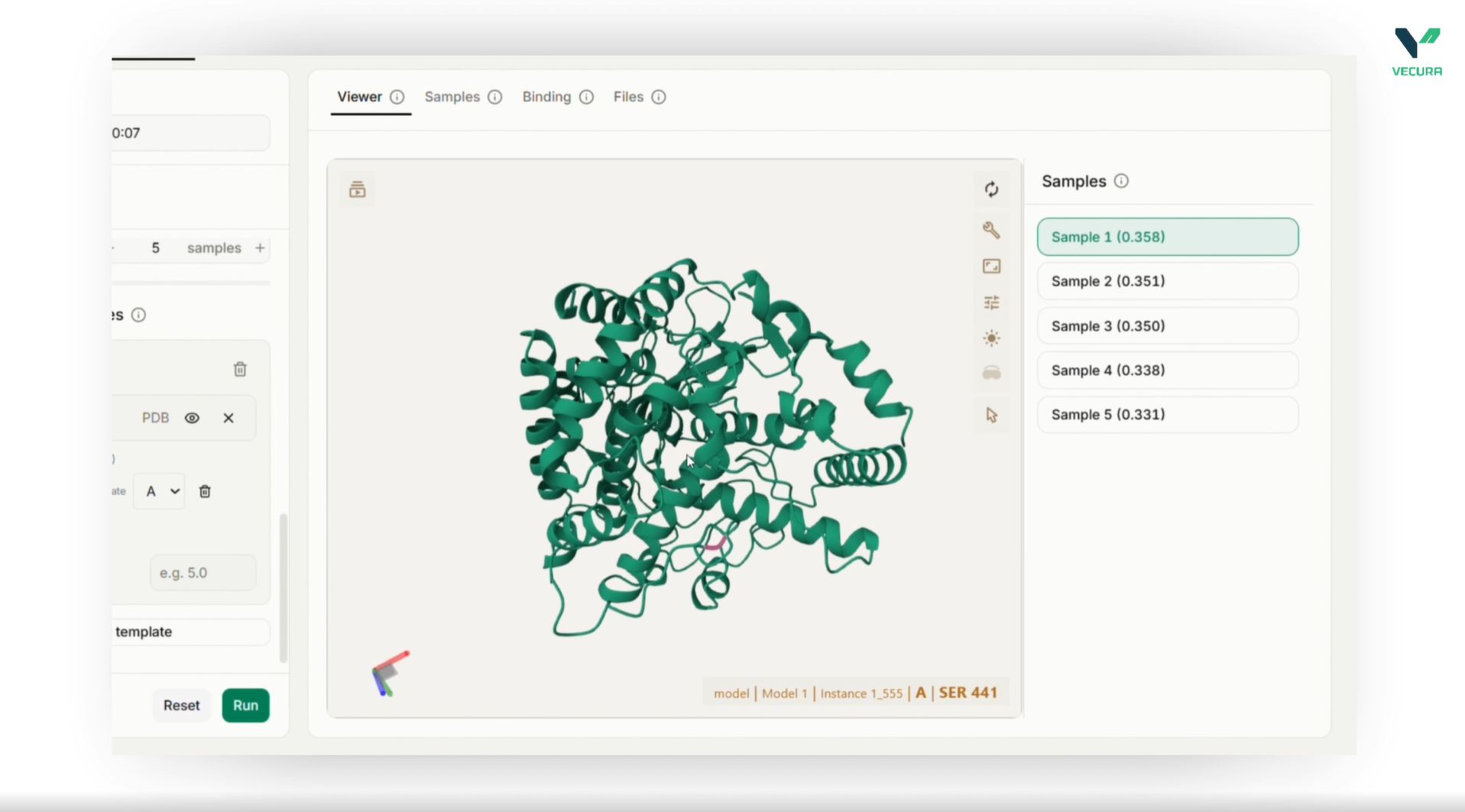
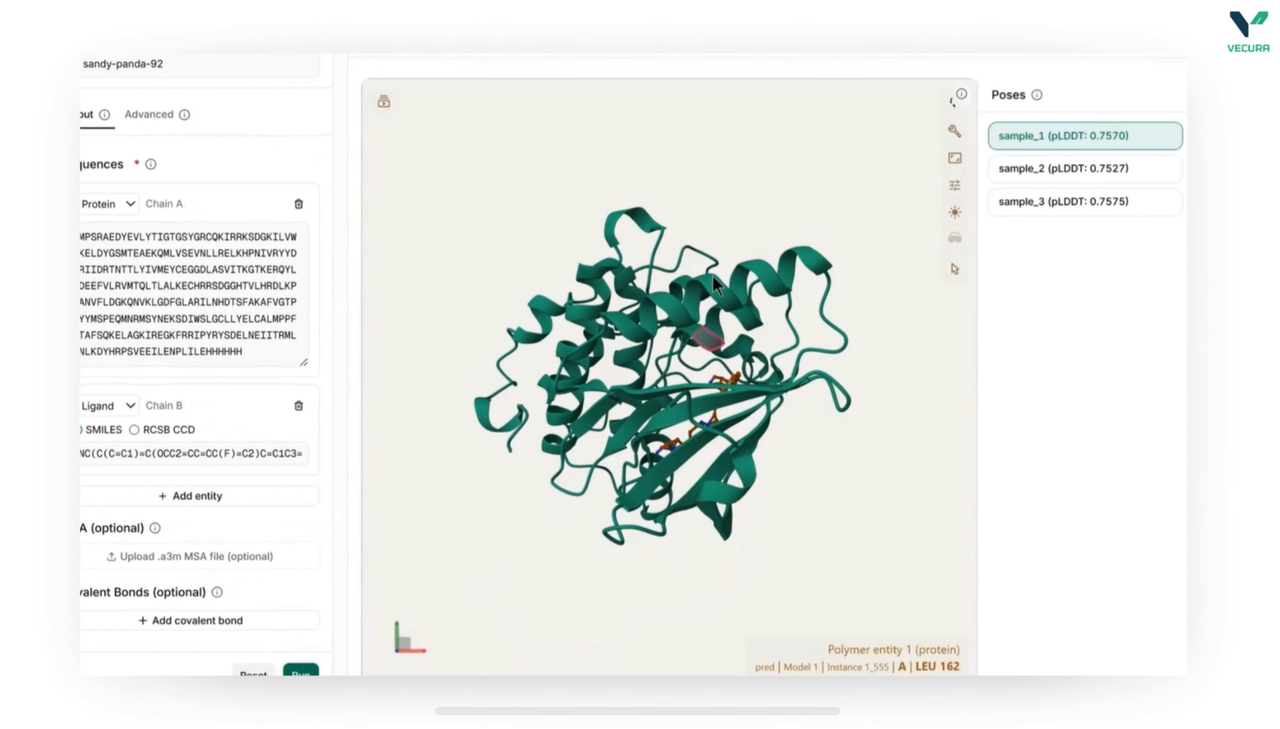
OpenDDE is now available on Vecura
This update enables structural biologists and drug discovery researchers to predict 3D structures of biomolecular complexes through a guided workflow inside Vecura, without setting up complex technical infrastructure.
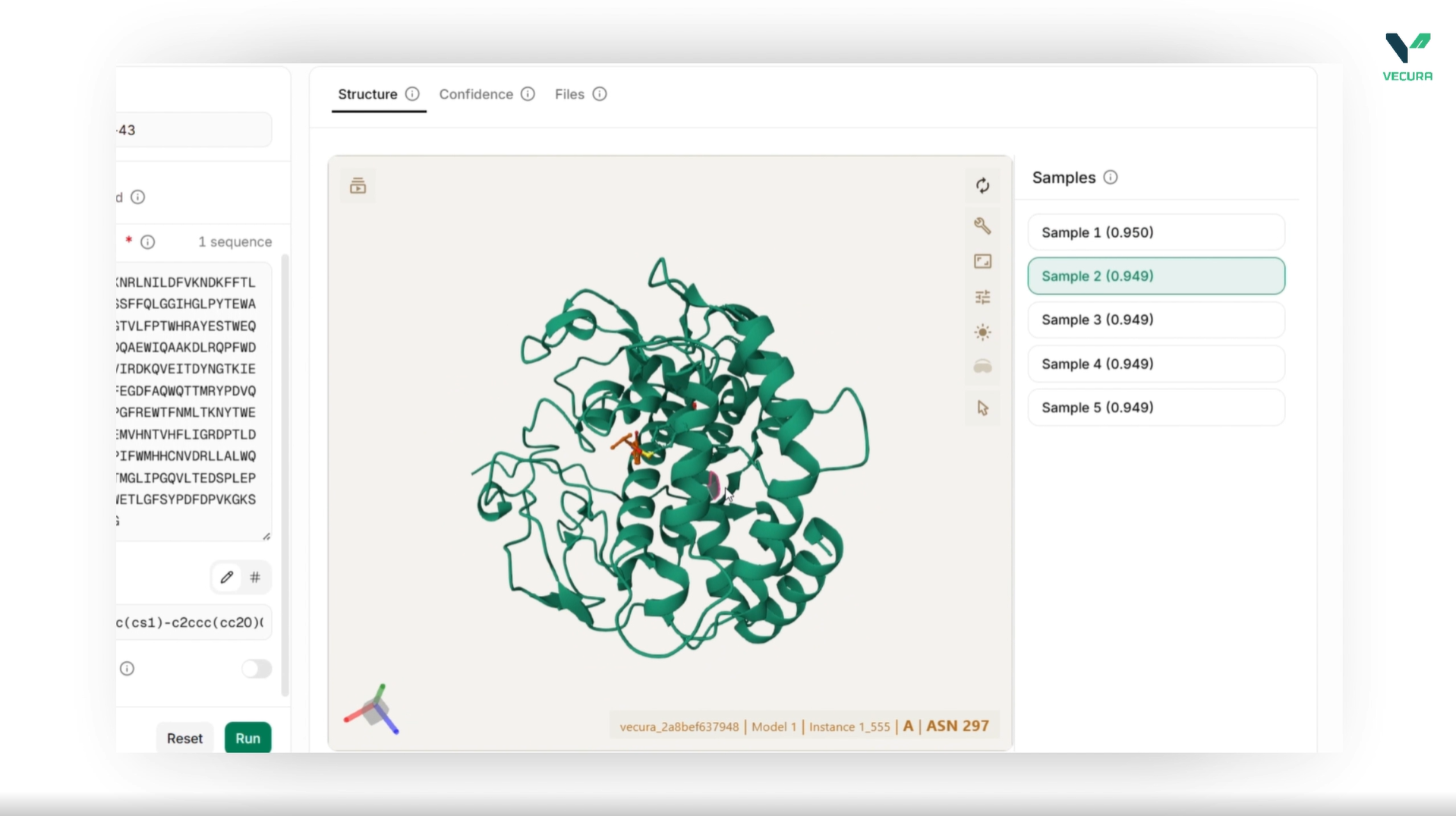
What is OpenDDE?
OpenDDE is a 656-million-parameter all-atom biomolecular foundation model that performs co-folding—predicting the joint 3D structure of complexes made up of any combination of protein chains, DNA, RNA, small-molecule ligands, and ions in a single unified forward pass. Built with a Pairformer trunk architecture and an all-atom diffusion structure module, it directly generates atomic coordinates rather than relying on discretized structure representations.
It helps users predict how biomolecules assemble into functional complexes, which is critical for understanding biological mechanisms and designing therapeutics. It is especially useful for drug discovery workflows where the shape of a protein bound to its ligand, antibody partner, or nucleic acid is the object of interest.
What can users do with OpenDDE on Vecura?
With OpenDDE on Vecura, users can:
-
Predict protein-small molecule docking poses and binding modes with interface confidence metrics
-
Generate multi-chain protein complex structures, including antibody-antigen pairs
-
Co-fold protein-nucleic acid complexes (protein-DNA or protein-RNA assemblies)
-
Predict structures of any biomolecular complex combining proteins, DNA, RNA, ligands, and ions in a single prediction
What the output means
The output provides predicted 3D complex structures in mmCIF format along with comprehensive confidence metrics including mean pLDDT (per-atom confidence), pTM (overall fold accuracy), ipTM (interface accuracy), gPDE (global predicted distance error), and composite ranking scores. The ipTM metric is particularly important for assessing whether two entities are correctly positioned relative to each other.
This output should be used to support scientific decision making. It does not replace experimental validation.
Why this matters
Most real biological questions aren't about isolated proteins—they're about complexes. Understanding how a protein binds to its ligand, its antibody partner, or a nucleic acid is fundamental to drug discovery, antibody engineering, and structural biology. Traditional approaches often require pipelines of specialized tools, each optimized for a specific interaction type. OpenDDE addresses this by providing a single unified model that handles the full spectrum of biomolecular interactions, from protein-ligand docking to multi-component assemblies.
For drug discovery, this means researchers can more efficiently explore how candidate molecules interact with their targets, predict binding modes, and assess interface quality—all critical steps in designing effective therapeutics. The open-source nature of OpenDDE also enables reproducible research and community-driven improvements to the foundation model, accelerating the development of AI-driven structural biology tools.
-
Developed by: Aureka (AI TechBio company)
-
Source: GitHub repository, Documentation, Model weights on HuggingFace
-
Reference: Official project website
Try OpenDDE on Vecura.
Open the model workspace and start evaluating it with your own inputs.