CheMeleon Foundation Model Now Available on Vecura for Molecular Property Prediction
This update enables cheminformatics researchers and drug discovery scientists to generate molecular fingerprints and fine-tune property predictors through a guided workflow inside Vecura, without setting up complex GPU infrastructure or managing ChemProp installations.
What is CheMeleon?
CheMeleon is an O(10M)-parameter directed message-passing neural network (D-MPNN) foundation model for small-molecule property prediction, pre-trained to regress classical 2D Mordred molecular descriptors from molecular graphs across roughly 1–10 million PubChem molecules. Unlike prior molecular foundation models trained on noisy assay data or biased quantum-mechanical simulations, CheMeleon sidesteps both by learning from deterministic, noise-free cheminformatics features — capturing general-purpose chemical structure in a compact ~8.7M-parameter checkpoint. It is consumed either as a frozen 2048-dimensional molecular fingerprint generator for downstream models and similarity searches, or as the message-passing initialization for a fine-tuned ChemProp property predictor trained on a user's own labelled dataset.
It helps users turn any SMILES string into a rich molecular embedding or transform a small labelled dataset into a task-specific property predictor — for solubility, potency, toxicity, or any other numeric or categorical endpoint. It is especially useful for small-dataset scenarios (hundreds to a few thousand labelled rows) where high-quality experimental labels are scarce and expensive, and where CheMeleon has demonstrated a 75% win rate across 58 Polaris/MoleculeACE property-prediction benchmarks and a 97% win rate on activity-cliff benchmarks that stress sensitivity to small structural changes.
What can users do with CheMeleon on Vecura?
With CheMeleon on Vecura, users can:
-
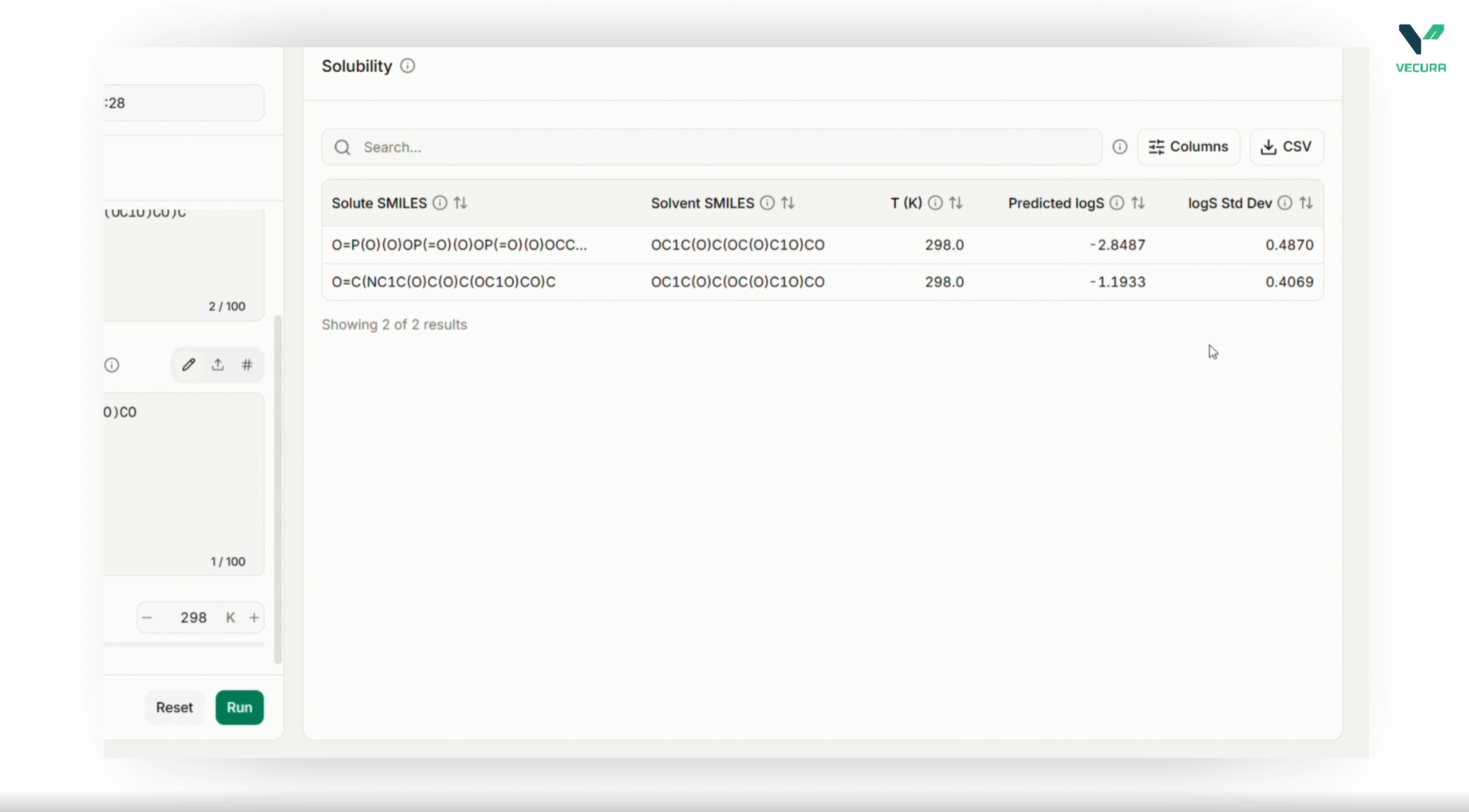
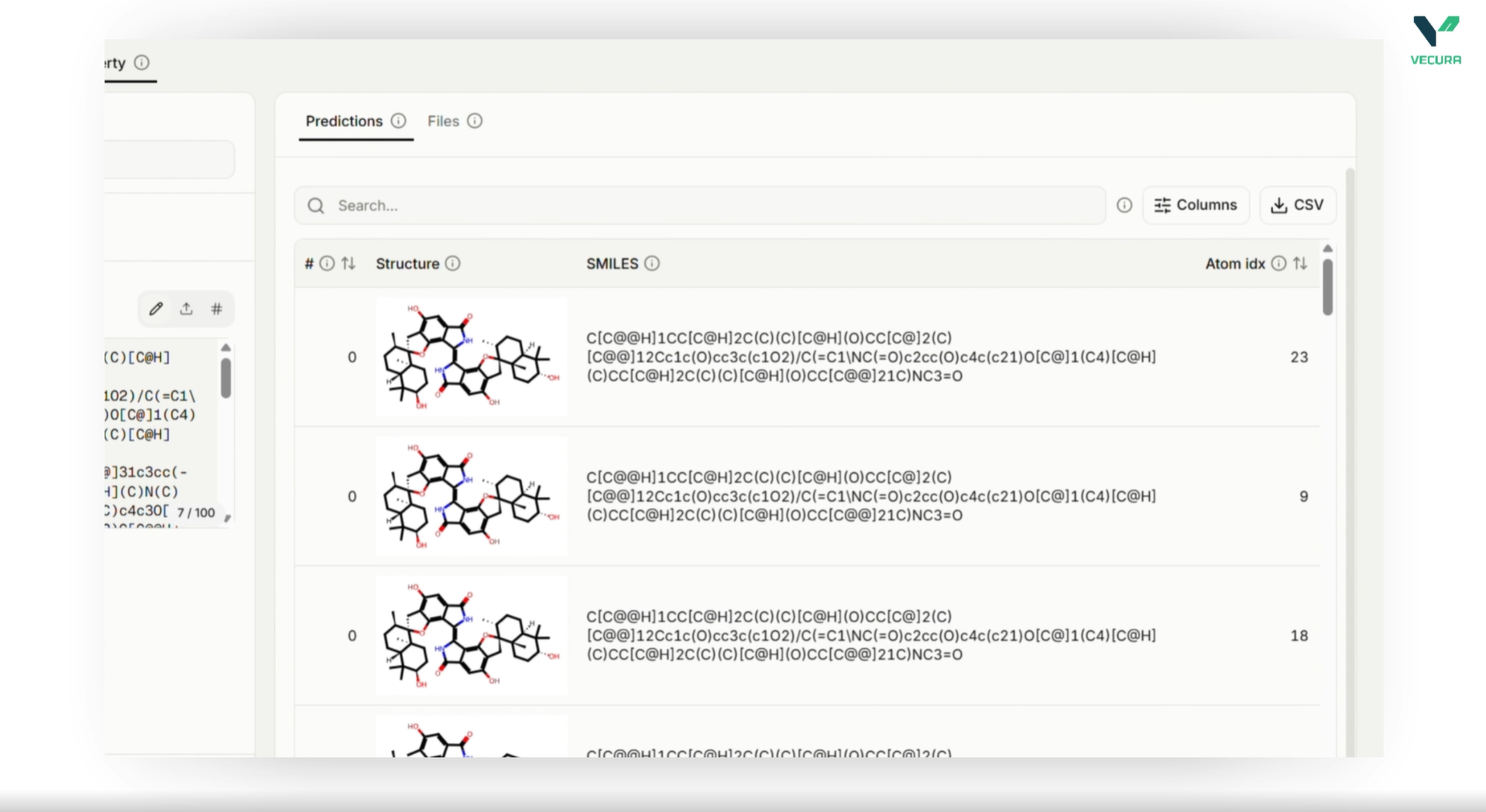
Generate frozen molecular fingerprints — embed any list of SMILES strings into 2048-dimensional vectors in a single batched forward pass, ready for similarity search, clustering, chemical-space visualization, or feeding into downstream ML models.
-
Fine-tune a task-specific property predictor — upload a small labelled CSV dataset, configure task type (regression, classification, multiclass, etc.), and train a ChemProp model initialized from the CheMeleon foundation weights in roughly one GPU-hour, then score query molecules with the resulting model.
-
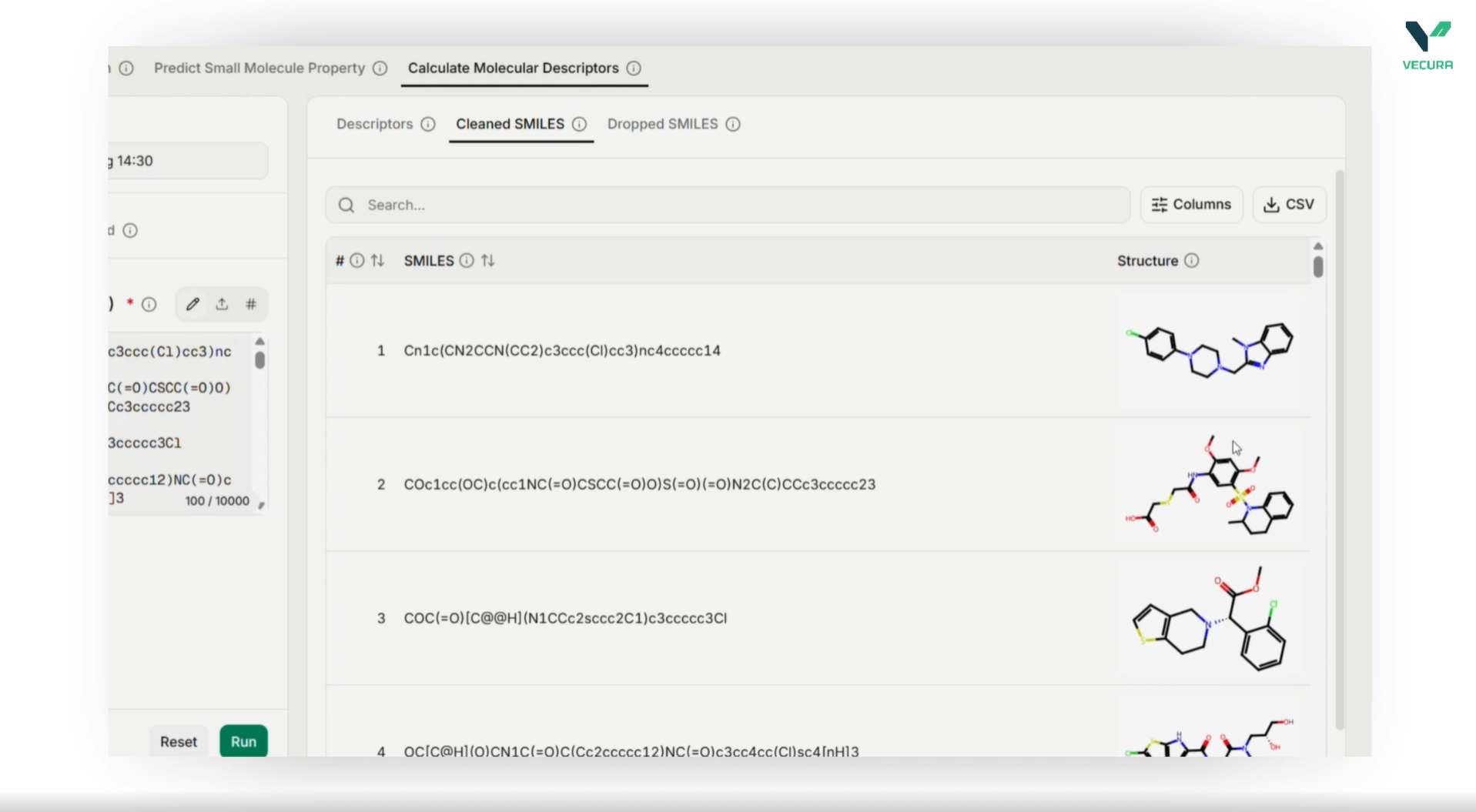
Compute classical Mordred molecular descriptors — calculate the full set of 1613 deterministic 2D cheminformatics descriptors (bond counts, topological indices, charge distributions) for use in QSAR modeling, feature-based similarity comparisons, or as an interpretable baseline against learned embeddings.
-
Evaluate model generalisation with built-in metrics — leverage scaffold-balanced splitting, ensemble averaging, multiple replicates, and uncertainty estimation methods (MVE, evidential, dropout, quantile regression) to assess how well the fine-tuned model will perform on unseen chemical scaffolds before acting on predictions.
What the output means
The output provides either a 2048-dimensional fingerprint matrix (one vector per molecule), a fine-tuned property prediction file with per-molecule scores and optional uncertainty estimates alongside held-out test metrics, or a 1613-column descriptor matrix of classical cheminformatics features — depending on the selected workflow.
This output should be used to support scientific decision making. It does not replace experimental validation.
Why this matters
Molecular property prediction sits at the heart of drug discovery, materials science, and toxicology screening, yet the field has long been bottlenecked by a fundamental tension: high-quality experimental labels are scarce and expensive, while the data-rich alternatives — large-scale assay databases and quantum-mechanical simulation sets — introduce noise and systematic bias that degrade downstream performance on real-world, small-scale tasks. CheMeleon addresses this by pre-training on a signal that is cheap, abundant, and essentially noise-free: deterministic 2D Mordred descriptors computed directly from molecular graphs. The result is a foundation model whose learned representations transfer unusually well to the exact regime where practitioners need it most — small, carefully curated datasets where every label counts.
For cheminformatics researchers and drug discovery teams, CheMeleon on Vecura removes the friction of setting up ChemProp, managing GPU infrastructure, and sourcing pre-trained weights. The MIT-licensed model and code, combined with Vecura's guided workflow, mean that a researcher can go from a raw CSV of a few hundred labelled molecules to a validated, scaffold-split property predictor with reported test metrics — all without leaving the platform. This is particularly impactful for teams working on niche targets or early-stage programs where labelled data is limited but the cost of mis-prioritizing compounds is high.
-
Developed by: Jackson Burns and contributors (MIT License)
-
Source: GitHub Repository — github.com/JacksonBurns/chemeleon
-
Reference: "Deep Learning Foundation Models from Classical Molecular Descriptors" (arXiv:2506.15792)
Try CheMeleon on Vecura.
Open the model workspace and start evaluating it with your own inputs.