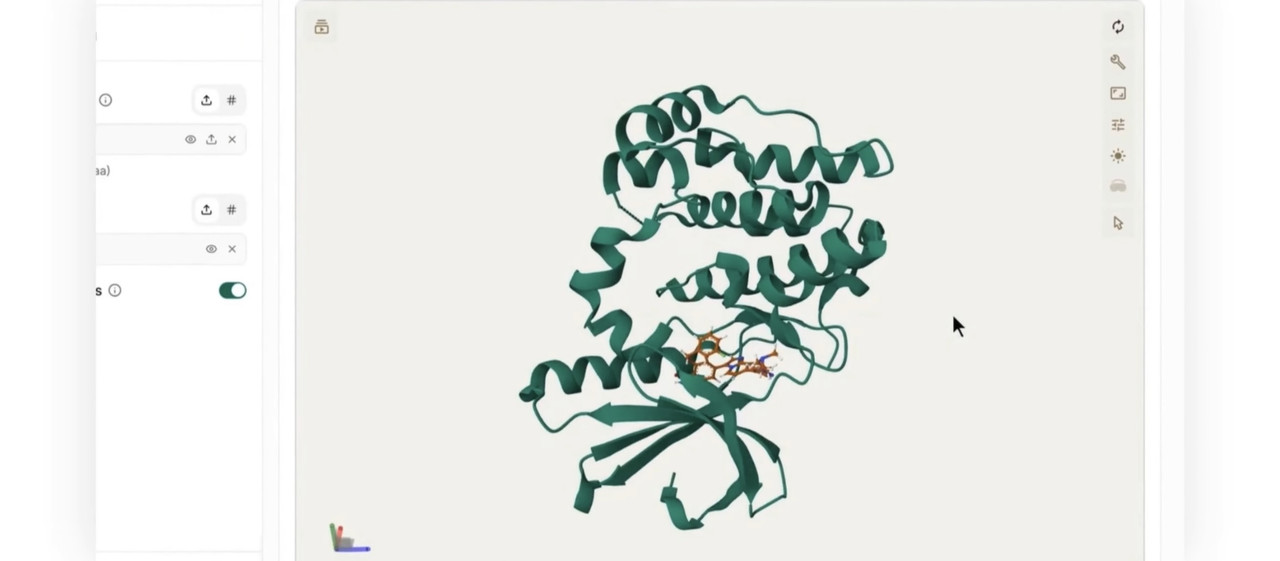
BoltzMol Now Available on Vecura: AI-Powered Small-Molecule Design and Screening
This update enables drug discovery researchers and computational biologists to generate novel small-molecule candidates and screen compound libraries against protein targets through a guided workflow inside Vecura, without setting up complex GPU infrastructure or managing API integrations.
What is BoltzMol?
BoltzMol is a cloud-based small-molecule design and screening platform developed by Boltz, an AI research lab specializing in biomolecular modeling. It leverages advanced generative AI models to create novel drug candidates optimized for specific protein targets and predict binding affinities for existing compound libraries. The platform runs entirely on Boltz's remote infrastructure, eliminating the need for local GPU resources or complex model deployments.
It helps users accelerate hit discovery by generating chemically novel, synthesizable compounds with predicted binding metrics and ADME properties, or by rapidly prioritizing existing molecule libraries based on binding confidence scores. It is especially useful for early-stage drug discovery projects where researchers need to explore chemical space efficiently and identify promising candidates for experimental validation.
What can users do with BoltzMol on Vecura?
With BoltzMol on Vecura, users can:
-
Generate de novo small-molecule candidates optimized for binding to a specific protein target, with optional constraints like pocket residues or reference ligands
-
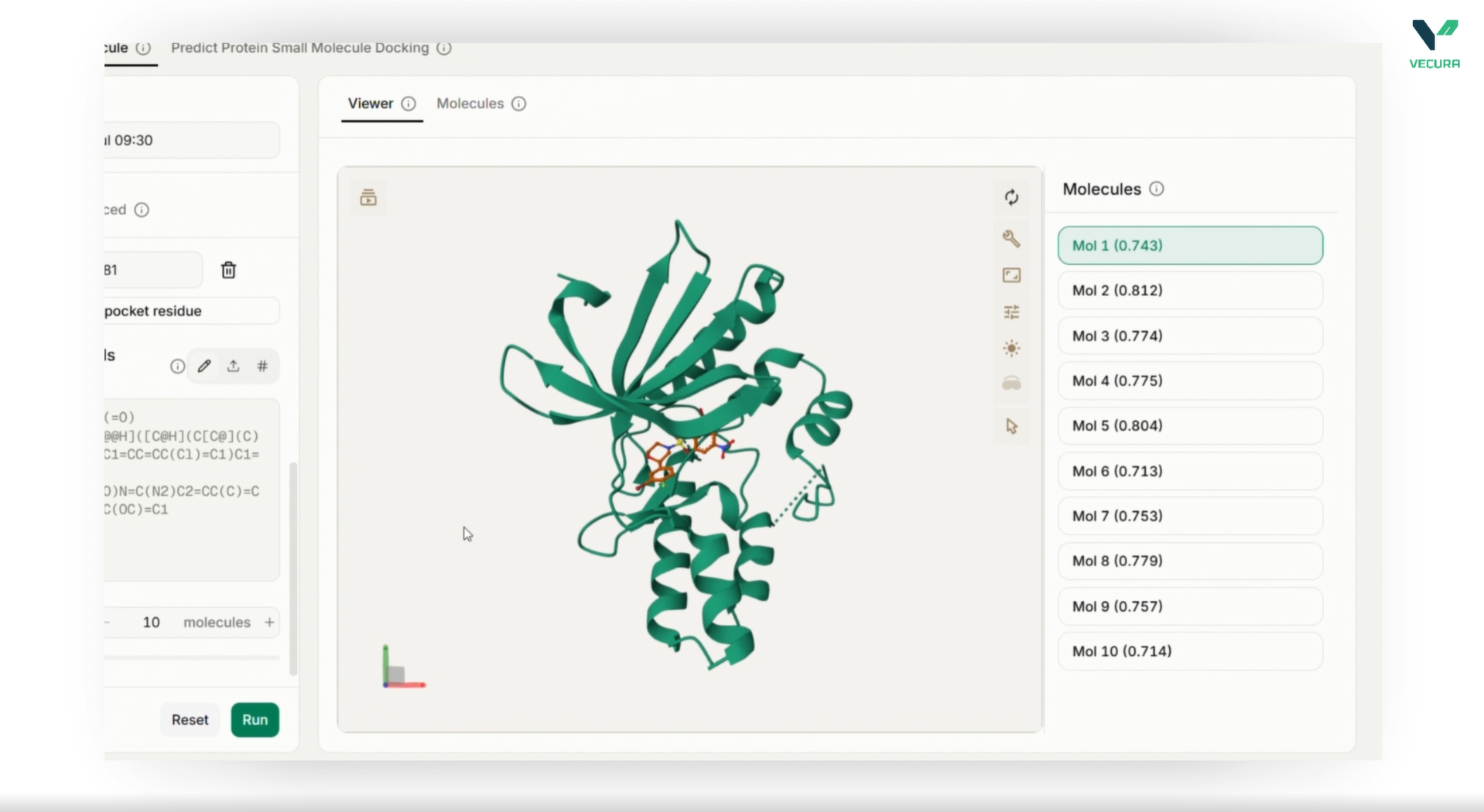
Screen existing SMILES libraries (from virtual collections, commercial catalogs, or prior generative runs) and rank molecules by predicted binding confidence
-
Access comprehensive per-molecule metrics including binding confidence, structure confidence (iPTM, pTM, complex pLDDT), and ADME predictions (solubility risk, permeability, lipophilicity)
-
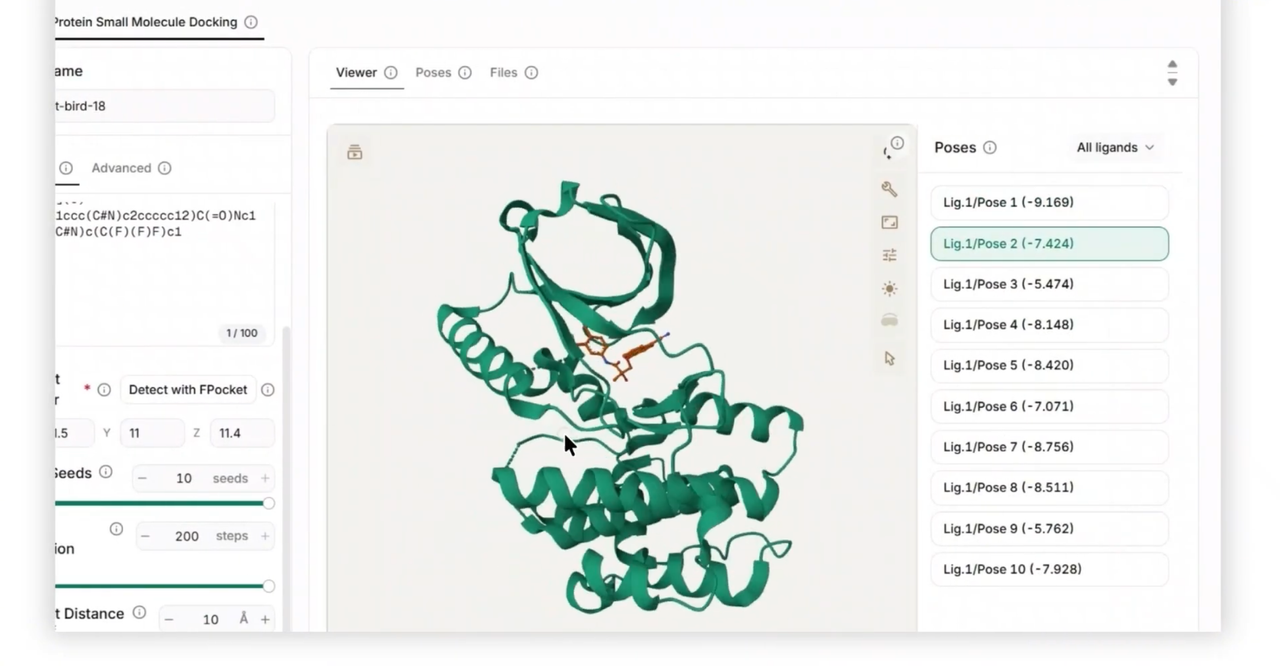
Download predicted protein-ligand complex structures in CIF format for downstream analysis, visualization, or integration with docking pipelines
What the output means
The output provides ranked lists of small molecules with detailed binding predictions, ADME property assessments, and 3D structural models of protein-ligand complexes. Each generated or screened molecule includes quantitative metrics for binding confidence and drug-likeness, along with presigned URLs to download the predicted complex structure for visual inspection.
This output should be used to support scientific decision making. It does not replace experimental validation. The computational predictions help prioritize which molecules to synthesize or purchase for wet-lab testing, but binding affinity and ADME properties must be confirmed through biochemical assays and pharmacokinetic studies.
Why this matters
Small-molecule drug discovery traditionally requires extensive computational infrastructure, specialized expertise in molecular docking, and significant time investment to explore chemical space. AI-powered generative models like BoltzMol democratize access to advanced computational drug design by providing state-of-the-art predictions through simple API calls, enabling research teams to rapidly iterate on compound design without deep technical overhead.
The integration of generative design with ADMET prediction in a single workflow addresses a critical bottleneck in hit-to-lead optimization. By simultaneously optimizing for binding affinity and drug-like properties, researchers can identify candidates with higher probability of success in downstream development, reducing costly late-stage failures and accelerating the path from target identification to experimental validation.
-
Developed by: Boltz (AI research lab, in collaboration with MIT researchers)
-
Source: Boltz hosted API documentation and model specifications
-
Reference: https://boltz.bio
Try BoltzMol on Vecura.
Open the model workspace and start evaluating it with your own inputs.