Boltz-2.1 Now Available on Vecura: Structure and Binding Affinity Prediction
This update enables researchers and drug discovery teams to predict 3D biomolecular structures and binding affinities through a guided workflow inside Vecura, without setting up complex GPU infrastructure or managing model weights.
What is Boltz-2.1?
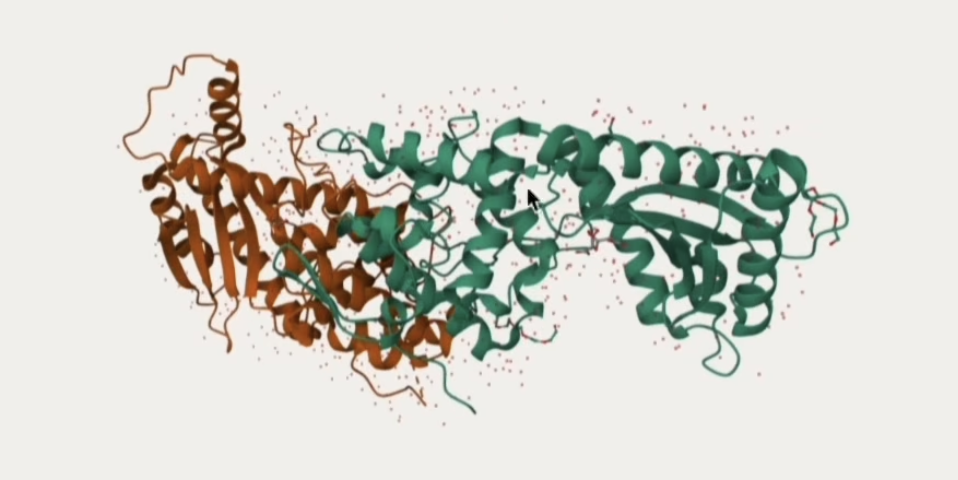
Boltz-2.1 is a commercial biomolecular structure prediction service that jointly models the 3D assembly and binding affinity of protein, nucleic acid, and small-molecule complexes. It represents a significant advance over previous structure-only predictors by combining co-folding with binding affinity estimation in a single unified job, approaching the accuracy of free-energy perturbation methods while being orders of magnitude more computationally efficient.
It helps users understand how molecules interact in three-dimensional space and estimate binding strength without running expensive experimental assays. It is especially useful for early-stage drug discovery, where researchers need to rapidly evaluate how candidate ligands engage protein targets, model protein–protein interfaces, or visualize protein–nucleic acid assemblies.
What can users do with Boltz-2.1 on Vecura?
With Boltz-2.1 on Vecura, users can:
-
Predict the 3D co-complex structure of heterogeneous molecular assemblies containing proteins, RNA, DNA, and small molecules in a single job
-
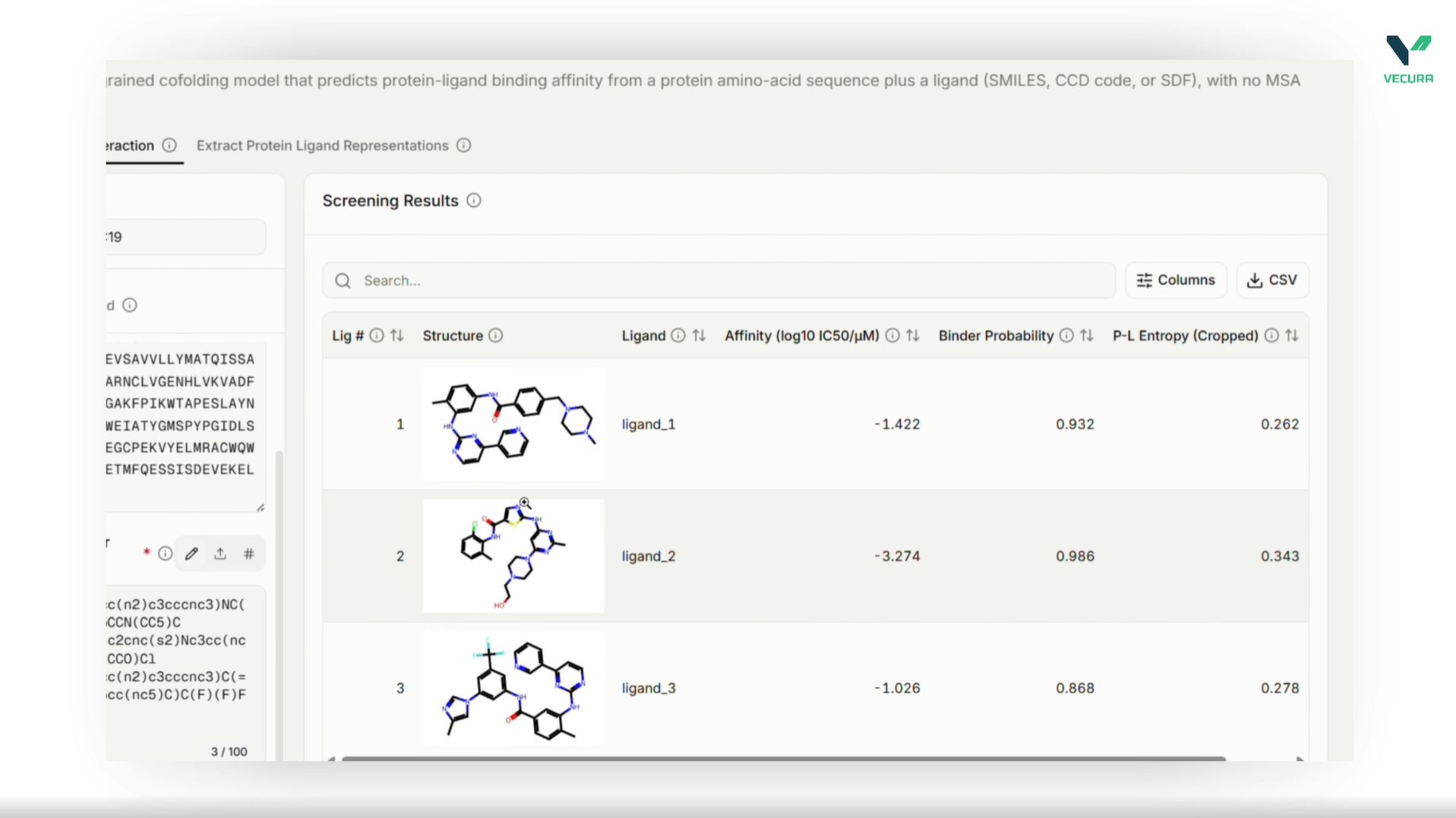
Obtain binding confidence and optimization scores for ligand–protein interactions without a separate docking step
-
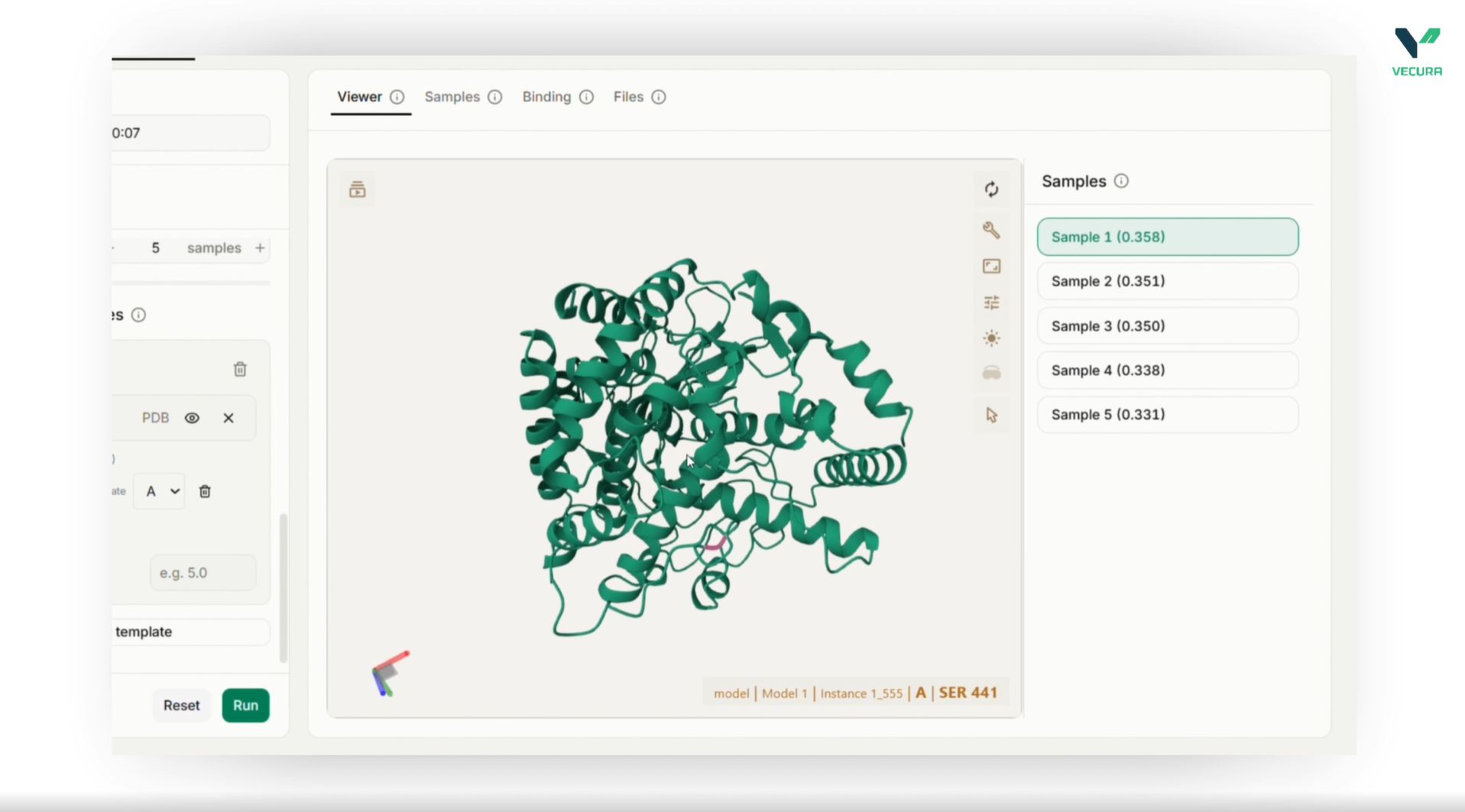
Generate multiple independent structure samples to explore conformational diversity and select the highest-confidence pose
-
Retrieve per-residue confidence metrics (pLDDT, ipTM, PDE) to assess prediction quality and guide downstream analysis
What the output means
The output provides a predicted 3D structure in mmCIF format, confidence metrics including overall structure confidence, interface predicted TM-scores, and per-residue pLDDT values. When binding is specified, it also returns binding confidence and optimization scores reflecting the model's assessment of the ligand–protein interaction quality. A results archive with all sampled structures is available when multiple samples are requested.
This output should be used to support scientific decision making. It does not replace experimental validation.
Why this matters
Structural biology has been transformed by AI-powered prediction tools, but most have focused exclusively on geometry without addressing binding affinity—a critical factor in drug design. Boltz-2.1 bridges this gap by providing both structural and thermodynamic insights in one workflow, enabling researchers to move faster from sequence to functional understanding.
By integrating Boltz-2.1 into Vecura, scientists gain access to state-of-the-art biomolecular modeling without the burden of managing GPU infrastructure, model weights, or complex inference pipelines. This democratizes access to advanced structure–affinity prediction and accelerates iterative design cycles in therapeutic development.
-
Developed by: Boltz (https://boltz.bio)
-
Source: Boltz-2 technical report and hosted API documentation
-
Reference: https://api.boltz.bio/compute/v1
Try Boltz-2.1 on Vecura.
Open the model workspace and start evaluating it with your own inputs.