Vecura Biotech Insiders Spotlight #14: Twice, the Best Binder Was the Wrong Molecule
For Vecura Biotech Insiders Spotlight #14, Ryan Ming shares both tracks, the gates that caught the two top-ranked candidates, and a second disagreement between what a prediction algorithm says about this target and what twenty years of experiments say.
Designing BCL2 silencing guides, and what a binding energy ranking cannot see
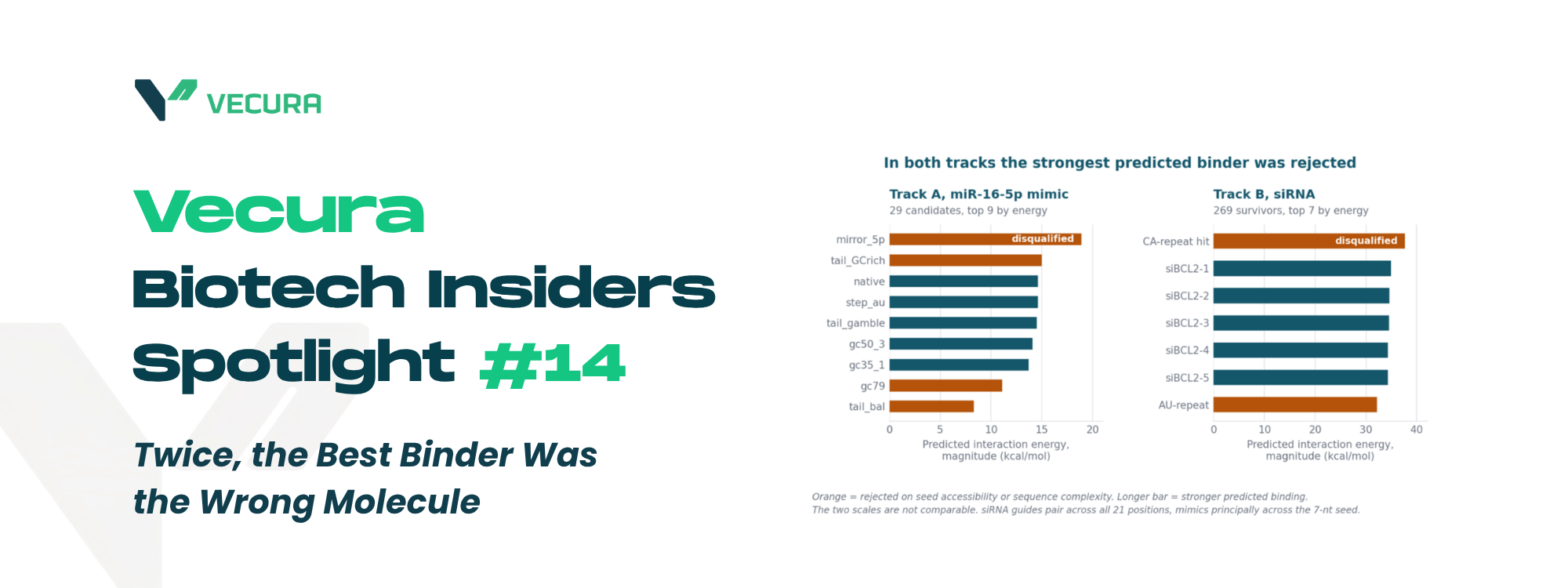
Two design tracks were run against the same target, and in each one the candidate that ranked first on predicted interaction energy was disqualified before the shortlist. In the miRNA mimic track the top-ranked molecule of 29 could not bind the target at all. In the siRNA track the top-ranked molecule of 269 survivors would have bound thousands of transcripts indiscriminately. Neither failure is visible in the energy value, and ranking on that value alone would have advanced both.

Figure 1. Candidates ordered by predicted interaction energy in each track. The strongest predicted binder is rejected in both.
The target
BCL2 is an anti-apoptotic protein and a long-standing oncology target. Its 3′UTR is unusually long, 5,279 of the transcript's 6,881 nucleotides, and AU-rich at 59.5 percent A plus U, which matters later for how often a given seed turns up by chance. The 7-mer complement of the miR-16-5p seed occurs exactly once in it, at offset 2528, and Ryan Ming used a 47-nucleotide window centered on that site for every cofold, folding in ViennaRNA 2.7.0 and computing interaction energy as the cofold minimum free energy minus the guide self-energy minus the constant window self-energy.
Two routes ran in parallel. Track A takes the natural miR-16-5p sequence as a scaffold and varies everything outside the fixed seed. Track B abandons the inherited seed and tiles new 21-mers against the 3′UTR, aiming for full complementarity and slicer-mediated cleavage.
First failure, a molecule that binds itself
mirror_5p ranked first of 29 at −18.90 kcal/mol, 4.3 kcal/mol better than the native miR-16-5p sequence. On an energy ranking it is a decisive winner rather than a marginal one.
| Parameter | Value |
| Interaction energy | −18.90 kcal/mol, rank 1 of 29 |
| Seed positions paired in its own self-fold | 5 of 7 |
| Seed positions paired to BCL2 in the cofold | 0 of 7 |
| Seed positions paired to itself in the cofold | 5 of 7 |
| Verdict | Disqualified |
Table 1. The top-ranked mimic candidate, and the accessibility analysis that removed it.
Its tail contains an internal repeat of the seed, so in the cofold the seed pairs to the guide's own 3′ half rather than to the target window. The apparent binding advantage was the molecule binding itself. The energy was computed correctly, and what it cannot express is where the pairing went. Reading partner indices off the dot-bracket string and asking whether each paired seed position has its partner in the target half is a cheap check, and it is the only thing standing between this candidate and a synthesis order.
Second failure, a molecule that binds everything
The siRNA track produced the same error from the opposite direction. After rule filtering cut 5,259 tiled windows to 269 survivors, the top candidate by interaction energy scored −37.70 kcal/mol, roughly 23 kcal/mol stronger than the native mimic. Its sequence was UGUUGUGUGUGUGUGUGUCUG, a CA-repeat tract carrying a 14-nucleotide tandem repeat and scoring 0.375 on a linguistic complexity measure where the retained candidates sit between 0.83 and 0.94. A second candidate with the same problem was rejected alongside it.
The energy was real. Repetitive base pairing is thermodynamically excellent and biologically useless, because the same tract occurs across a large fraction of the transcriptome. A complexity audit counting distinct k-mers against the maximum possible for k of 2, 3 and 4 separates these candidates from the rest without any reference to energy at all.
Every gate that mattered was a veto
Both failures share a structure. The energy function answered the question it was asked, which is how strongly two sequences pair, and in both cases the question that decided the outcome was a different one: where does the pairing actually go, and how many other places does that sequence occur?
Every filter that changed the shortlist was binary. Seed accessibility, sequence complexity, seed site uniqueness within the 3′UTR and thermodynamic asymmetry at the duplex ends each returned a pass or a fail and nothing else. Composite scoring is the natural instinct when a pipeline produces several numbers per candidate, and a weighted sum of energy, accessibility and complexity would have let mirror_5p's four kilocalorie advantage buy its way past an accessibility score of zero. The veto architecture costs nothing except the discipline of deciding in advance which criteria are not negotiable.
Prediction and experiment disagree about the target
What else would a miR-16-5p mimic hit? Two sources answer that and they do not agree. The prediction algorithm returns 1,416 predicted targets, of which 593 clear the conventional high-confidence cutoff, and BCL2 is not among them: it ranks 609th with a score of 79, one point below the cutoff. The experimental record says the opposite. In the curated database of validated interactions, BCL2 is one of only 21 entries at the strongest confidence tier, supported by reporter assay, Western blot, qPCR, microarray, NGS and CLASH across 20 independent papers, the highest paper count of any target in the 8,049-gene set, where the next highest carries 14.
| Gene | Prediction rank | Prediction score | Evidence tier | Reporter assay | Papers |
| PAPPA | 1 | 100 | B | No | 0 |
| FASN | 2 | 100 | B | No | 2 |
| UNC80 | 3 | 100 | absent | n/a | n/a |
| FGF2 | 4 | 100 | A | Yes | 5 |
| TNRC6B | 5 | 100 | B | No | 4 |
| VEGFA | 122 | 95 | A | Yes | 14 |
| BCL2 | 609 | 79 | A | Yes | 20 |
| CDK6 | 1258 | 55 | B | Yes | 2 |
Table 2. Selected genes present in both sources. The three top-ranked predictions carry no functional validation, and one is absent from the experimental record entirely.
Across the twelve watchlist genes present in both sources, the rank correlation between prediction score and paper count is −0.354. Read that narrowly: twelve genes is a small sample, selected for biological relevance rather than drawn at random, and paper count measures research attention as much as biological importance. It shows the two sources are decoupled on this watchlist rather than that the prediction algorithm is inaccurate. Neither source is wrong either, since the prediction is a statement about sequence features and the record is a statement about measured repression. For a design decision the measured one governs.
What the validated list actually contains
The database returns 8,049 human gene associations for this miRNA, which sounds like an enormous validated set and is not. Only 67 of those genes carry any low-throughput functional evidence, meaning a reporter assay or a Western blot, and the rest rest on high-throughput capture methods that show only that the miRNA and the transcript were found together in an Argonaute complex. Co-occupancy is not repression. The usable set is roughly the 21 top-tier genes plus a handful of second-tier entries carrying both reporter and Western support. Never cite 8,049 as a count of functionally validated targets, and apply the same caution to any database of this kind.
One caveat runs the other way, against Ryan Ming's own conclusion. BCL2 is among the most studied apoptosis genes in biology, so its twenty papers reflect research attention as well as biological reality. The tier assignment rests on evidence types rather than paper count, which insulates it somewhat, but calling BCL2 the most replicated target in the set is sensitive to that bias.
Three genes in the top-tier set matter for anyone building a mimic. KRAS and RAF1 are validated with both reporter assay and Western blot support, and TP53 with reporter assay support. For a molecule meant to induce apoptosis, suppressing TP53 runs directly against the therapeutic objective, and that is a measured interaction in the primary literature rather than a prediction artifact that might disappear under scrutiny. It does not rule the mimic out. Where broad anti-proliferative activity is the goal, restoring miR-16 function in a 13q14-deleted hematological setting for example, the wide validated profile spanning BCL2, VEGFA, the cyclins and several cell-cycle kinases is mechanistically supportive. The multi-target profile is a feature or a defect depending entirely on the objective, and you have to fix the objective before you choose the molecule.
A premise that did not survive testing
Track B rested on an explicit hypothesis: dropping the inherited seed and choosing a new one freely should cut the off-target seed-match burden. Ryan Ming estimated expected seed-site counts across roughly one hundred million nucleotides of human 3′UTR sequence, using the BCL2 3′UTR's own base composition as background.
| Candidate | Seed | Estimated 3′UTR seed sites | Ratio to the miR-16 seed |
| miR-16-5p native | AGCAGCA | ~4,564 | 1.00, reference |
| siBCL2-3 | UGUUGGC | ~3,727 | 0.82 |
| siBCL2-2 | UAGAUCC | ~6,898 | 1.51 |
| siBCL2-1 | UCCCUUU | ~7,485 | 1.64 |
| siBCL2-5 | UAAAUGC | ~9,609 | 2.11 |
| siBCL2-4 | CAAAUAC | ~11,212 | 2.46 |
Table 3. Estimated off-target seed-site load. Four of the five freely chosen seeds are worse than the inherited one.
Only one of the five retained candidates beats the inherited seed, by a factor of 1.22, and the other four are between 1.5 and 2.5 times worse. The premise does not hold, for a structural reason rather than an incidental one. Seed-match frequency is governed by the mononucleotide composition of an AU-rich 3′UTR, and once a guide is constrained to a workable GC content band the achievable variation in expected seed-match count is small relative to the overall level. There is not much room to design the problem away.
Why the siRNA wins, and what the comparison hides
The recommendation did not change when the premise failed, but the justification did. The case is mechanistic: full 21 of 21 complementarity drives Argonaute-2 slicer cleavage of the target, which is stoichiometric and irreversible, where a seed-only interaction produces translational repression. The on-target potency window widens substantially against a seed-mediated off-target background of roughly unchanged size. So the siRNA wins on on-target potency, not on having fewer off-targets, and that distinction determines which experiment you run next. A design that wins on potency needs a transcriptome-wide off-target readout, and one that genuinely won on selectivity would not.
A comparison problem runs underneath the whole head-to-head and favors the siRNA for reasons that have nothing to do with the molecules. The mimic's off-target profile is partly measured, across twenty-one top-tier validated genes with functional evidence from multiple independent laboratories, including the three that create the therapeutic problem above. The siRNA's is entirely unmeasured, since every site count in Table 3 is a composition-matched estimate and no experimental target validation exists for any of the five candidates. Set side by side, the mimic shows a list of liabilities and the siRNA shows a blank, and that blank is an absence of measurement rather than an absence of liabilities.
A related trap sits in the energy column of the same table. The siRNA candidates score around −34.5 kcal/mol and the mimics around −14.5, a gap of roughly 20 kcal/mol that looks decisive and means nothing, because an siRNA guide pairs across all 21 positions while a mimic pairs principally across the 7-nucleotide seed. The gap counts base pairs rather than quality of engagement, and interaction energies are comparable only within a track.
Where it lands, and what would move it
For BCL2-selective silencing, two siRNA candidates go forward, one chosen for balance across all metrics and one for the best target-site accessibility combined with the lowest estimated off-target load. For miR-16 function restoration, where breadth is the point, the mimic track goes forward with the native sequence as the reference arm.
The single computation that would most change this assessment has not been run. Every off-target number above is a composition-matched estimate rather than a measured count, because no human 3′UTR sequence set was available in the working environment, and a genuine genome-wide seed scan would replace all of them. It would affect the siRNA track far more than the mimic track, whose profile is at least partly anchored in experiment. Other gaps are worth naming plainly: no chemical modification pattern has been designed, and an unmodified RNA is not a therapeutic candidate; the tiling covered the 3′UTR only, leaving the coding sequence, a well-established and often more potent target space, unexplored; accessibility came from local 60-nucleotide folding windows rather than full-length structure or in-cell probing; and the folding model is secondary structure at default conditions, with no Argonaute protein context and no competition from RNA-binding proteins.
The validation sequence that would settle the open questions is conventional. A dual-luciferase 3′UTR reporter assay, then endogenous BCL2 measurement by qPCR and Western blot in a relevant cell line, then RNA sequencing to measure rather than estimate the off-target transcriptome, with KRAS, RAF1 and TP53 pre-specified as mandatory readouts for any mimic arm.
A binding energy tells you how strongly two sequences pair. It does not tell you whether the pairing is with your target, whether your target is the only place that sequence occurs, or whether the gene you are aiming at is the one the literature says this molecule actually regulates. Those are three different questions needing three different checks, and none of them is a number you can rank on.
Try Vecura now.
Bring your own inputs and start exploring what Vecura can do.