Vecura Biotech Insiders Spotlight #13: Five Generations, and the Potency Never Moved
For Vecura Biotech Insiders Spotlight #13, Chang Yong Zu shares all five generations, the controls as well as the leads, and what the contact data showed that the docking scores did not.
A p53 Y220C stabilizer campaign, read against its own error bars
Five generations of structure-based optimization against the p53 Y220C crevice produced roughly 150 compounds, seven docking runs, eight ADMET passes, a focused re-dock for interaction fingerprinting, and three retrosynthesis runs against the final lead. The potency did not improve.
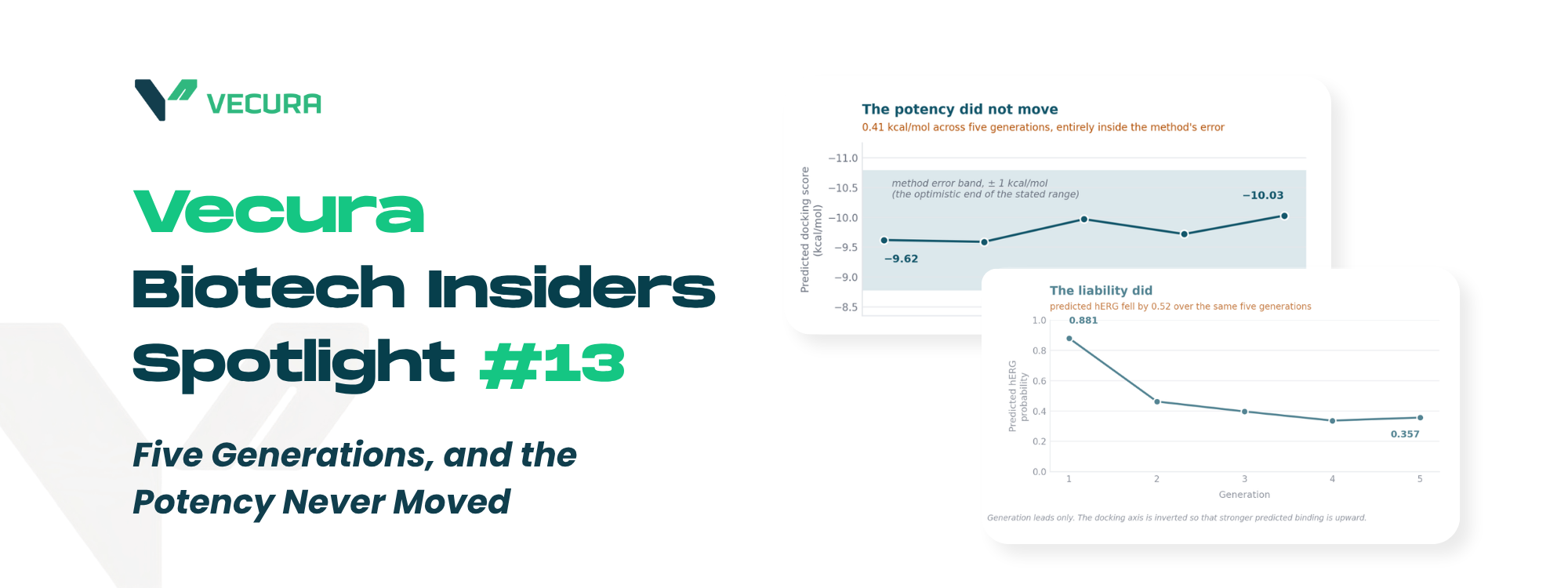
Predicted docking scores ran from −9.62 kcal/mol at the Generation 1 lead to −10.03 kcal/mol at the Generation 5 lead, a spread of 0.41 kcal/mol from a scoring function whose error against measured affinities is conventionally cited at 1 to 2 kcal/mol. If you read five generations of structure activity relationship into that spread, you are reading noise.
The liability profile did move, and far enough to survive the same skepticism. Predicted hERG probability fell from 0.881 to 0.357, calculated logP from 4.12 to 1.39, and the flag count from three to zero.

Figure 1. The two trajectories across the same five generations. The shaded band is the method's own error at the optimistic end of its stated range, and the entire potency trajectory sits inside it.
The crevice, and the compound already in the clinic
The Y220C mutation removes the buried hydroxyl of Tyr220 and opens a surface-accessible hydrophobic crevice in the DNA-binding domain of p53. The mutant protein is destabilized, and a small molecule that occupies the crevice can restore thermodynamic stability. Every docking run used PDB 6GGC, chain A, protein only, and extracted the co-crystal ligand to define the binding box rather than using it as a template pose.
The mechanism has clinical precedent. Rezatapopt, from PMV Pharmaceuticals, is in the registrational phase 2 portion of the PYNNACLE trial and reported a 46 percent objective response rate in the platinum-resistant ovarian cohort at the May 2026 data cutoff, with a median duration of response of 10.0 months. PMV plans an NDA submission in the first quarter of 2027.
Chang Yong Zu docked rezatapopt alongside the Generation 0 screen as a positive control. It scored −8.46 kcal/mol, and all ten top hits beat it by 1.54 to 2.38 kcal/mol. Treat that as calibration rather than as a result: docking functions run optimistic on compounds that reality has not yet penalized them for, and rezatapopt's affinity has actually been measured. The control tells you roughly where the scoring function sits on this target, and nothing more.
The one experiment that earned its place
Generation 2 ran truncation controls alongside the polar head replacements. Two compounds lost the benzyl and aryl head entirely, leaving the scaffold behind.
| Compound | Docking score (kcal/mol) | Change vs. head-bearing |
| L16-OMe-acetyl (head intact) | −9.74 | reference |
| G2-Me-OMe (methyl-capped) | −6.96 | +2.78 |
| G2-desBn-OMe (des-benzyl) | −6.78 | +2.96 |
Table 1. The truncation controls. Removing the head costs close to 3 kcal/mol, roughly seven times the entire five-generation potency spread.
That result carries more information than any ranking in the campaign, because it is not a ranking. Docking scores can rise with molecular bulk for reasons that have nothing to do with the site, so the truncation pair asks a different question: is the head doing work? It is, and everything downstream depends on that holding. It is also the first thing most write-ups drop, since it produces no candidate and improves nothing. Report your rankings without your controls and you have not shown that the rankings mean anything.
What actually moved
Generation 1 ran a full combinatorial matrix on the starting scaffold, 27 compounds across two substitution points, and returned a problem rather than a solution. All eleven shortlisted compounds carried three to five predicted liability flags, with predicted hERG probability from 0.8808 to 0.9690 across the shortlist. Nothing came back clean.
The pattern is recognizable on sight. Calculated logP between 3.50 and 4.43, with a basic nitrogen sitting near a hydrophobic aromatic system, is the lipophilic base signature that the hERG channel binds. That is a structural diagnosis rather than a statistical one, which means it comes with a structural remedy.
Generation 2 applied it, replacing the lipophilic aryl head with sulfonamide, amide, phenol and pyridyl alternatives. Predicted hERG on the chosen lead dropped from 0.881 to 0.463 and calculated logP from 4.12 to 1.88, clearing the problem in one generation without enumerating a larger matrix. It also traded one liability for another: the polar heads raised predicted DILI probability and degraded predicted permeability, pushing topological polar surface area above 100 Ų. Generation 3 found the sulfonamide head series carrying roughly double the mean predicted DILI of the alternatives, and Generation 4 swapped that head for a benzamide, bringing predicted DILI from 0.724 to 0.510 at a cost of 0.07 kcal/mol in docking score.
| Parameter | Generation 1 lead | Generation 5 lead | Direction |
| Predicted hERG | 0.8808 | 0.357 | improved |
| Predicted AMES | 0.5764 | 0.319 | improved |
| Calculated logP | 4.12 | 1.39 | improved |
| Flag count | 3 | 0 | improved |
| Predicted DILI | 0.3753 | 0.429 | slightly worse |
| Docking score (kcal/mol) | −9.62 | −10.03 | within method error |
Table 2. The liability trajectory across five generations. It is substantial without being uniform, and DILI is the parameter that did not cooperate.
Look at the DILI row. Predicted DILI at the Generation 5 lead comes out slightly worse than at the Generation 1 lead, after peaking at 0.724 in Generation 3. Across hERG, AMES, logP and flag count the trajectory is close to monotonically favorable, and describing the whole ADMET picture that way would still be wrong. The campaign traded one liability for another and partially recovered, which is more accurate and more useful than a clean downward arrow.
Two things the score could not tell you
One Generation 0 compound returned a Jaccard similarity of 1.00 against the fourteen-residue reference contact set, meaning it touched every core residue, while its pose confidence score from the convolutional network came back at 0.318. Those two numbers disagree completely: the contact measure says the compound occupies the site perfectly, and the pose quality network says the pose is not believable. When a scoring signal and a pose signal diverge that far, suspect a pose artifact. Chang Yong Zu deprioritized the compound despite its fingerprint, and had only one of the two numbers been computed it would have gone forward as a top hit.
The second case is easier to spot. Two Generation 1 compounds returned predicted half-lives of −6.37 and −6.86 hours, and a negative half-life has no pharmacokinetic interpretation. These are not small errors but a model reporting from outside its applicability domain, and the report carries the values as the tool produced them. An impossible prediction is more useful than a merely wrong one because it announces itself, so worry instead about the cases where the same extrapolation lands on a plausible number.
Two further checks are worth recording. A structural quality control gate before Generation 3 ADMET removed nine of 34 compounds, five of them hydrolytically labile hemiaminals and three of them enumeration artifacts carrying bonds nobody intended. The first interaction fingerprint pass returned a Jaccard of zero for every ligand, which traced to a reference set stored as residue names rather than residue identifiers, so every comparison failed to match. Both were caught before they reached a conclusion, and neither would have been visible from the ranked output.
The finding that only contacts could reveal
From Generation 3 onward the campaign tracked five pharmacophore elements and reported coverage as a fraction, without ever constraining them. That distinction ends up deciding the outcome.
| Element | Gen 0 (10 hits) | Gen 3 lead | Gen 4 profiled | Gen 5 profiled |
| CYS220 | all | yes | all | all |
| VAL147 | all | yes | all | all |
| CYS229 | 9 of 10 | yes | none | none |
| ASP228 | partial | no | lead only | lead and epimer |
| PHE109 | 6 of 10 | no | none | none |
Table 3. Pharmacophore engagement across generations. Two elements present at the start of the campaign are absent from everything profiled after Generation 3.
CYS229 was engaged by nine of the ten Generation 0 hits and by the Generation 3 lead, the highest-confidence compound the campaign produced, and it is absent from every profiled compound in Generations 4 and 5. PHE109, which marks the deepest sub-pocket, was engaged by six of the ten Generation 0 hits and has been absent since Generation 3. No compound after Generation 3 exceeds three of five coverage, and the three you get in Generations 4 and 5 are not the same three, because CYS229 went out and ASP228 came in.
The mechanism behind that is not mysterious. Chang Yong Zu optimized hard against liabilities, measuring them and acting on them every generation, while pharmacophore coverage got reported and never acted on. A metric you report but do not constrain steers nothing. Two compounds can land within 0.2 kcal/mol of each other while occupying the crevice differently, and a docking score will not tell them apart.
Whether the Generation 5 binding mode is genuinely shallower than the Generation 3 mode, or the two are equivalent and the fingerprint difference is an artifact of a rigid receptor, more docking will not settle. That needs free energy perturbation or an assay.
The same compound, docked twice
G3-SO2-Me, the Generation 3 lead, scored −9.97 kcal/mol in its own generation and −9.95 kcal/mol when it was carried into Generation 4 as a control. The compound, the receptor and the method were identical, and the two numbers sit 0.02 kcal/mol apart.
On its own that is unremarkable and well inside what you would expect from pose sampling. Set against the 0.41 kcal/mol separating the first and last leads of a five-generation campaign, it becomes the clearest statement available of what the campaign can claim: run-to-run variance on an identical molecule is roughly five percent of the entire optimization trajectory. Carrying controls forward between generations costs almost nothing and generates that number automatically, which makes it the cheapest calibration a virtual campaign has access to and the one most often skipped.
Stereochemistry, and knowing when to stop
Generation 5 produced the campaign's most interesting pair, two epimers of a quaternary benzylic carbinol, identical in constitution and opposite in configuration.
| Compound | Configuration | Docking (kcal/mol) | Hydrogen bond | Contacts vs. partner | Flags |
| G5-Ac-gemMe_b | S | −10.03 | ASP228 | reference | 0 |
| G5-Ac-gemMe_a | R | −9.56 | VAL147 | 3 fewer | 0 |
Table 4. The epimer pair. Both predicted flag-free, which makes configuration the only variable between them.
The S epimer is favored by 0.47 kcal/mol, and the fingerprint gives you a coherent reason why. It retains three contacts the R epimer loses and directs its hydrogen bond to ASP228, a charged residue, rather than to the backbone of VAL147. A charged acceptor should make the interaction stronger, so the structural story and the score agree.
And 0.47 kcal/mol still sits inside the noise. Two independent lines of evidence pointing the same way beats one, but neither of them is a measurement, and the campaign's own re-dock variance came in at 0.02 kcal/mol while the method error against experiment runs one to two orders larger. So the defensible conclusion is not that the S epimer is better, only that it is the better hypothesis. Make the racemate, separate it by chiral chromatography and assay both, because one separation step converts a prediction into a fact.
Retrosynthesis, where the tools stopped being useful
Three retrosynthesis runs went against the lead, and they disagreed in an instructive way.
The first proposed only peripheral disconnections, never attempted the tetracyclic core, and ignored stereocenters entirely, which on a target whose defining feature is a quaternary stereocenter is a significant omission. Use it to plan substituents, not to plan a route.
A full-target search returned three solved routes, the best at three steps with all three precursors commercially available. That is the actionable output of the campaign and it deserves a synthetic chemist's scrutiny, with the caveat that route scores of this kind reflect template confidence and precursor availability rather than any assessment of selectivity, protecting group strategy or stereocontrol. The same tool, pointed at the N-benzyl-protected bottleneck intermediate, explored 14,826 nodes across 658 iterations, generated fourteen routes and solved none of them. Step confidences ran from 0.0027 to 0.1979 and every step in every route came back classified as unrecognized, so the ring-forming chemistry on this scaffold has no applicable precedent in the template set.
A separate tree search on the full target produced three defects worth reporting rather than hiding. Six of fourteen routes required fluorinated starting materials to produce a target that contains no fluorine, which makes them chemically invalid. The ring-breaking policy, the component built specifically for ring formation, contributed zero steps to any route. And one of the two best routes was blocked only because vinylmagnesium bromide is missing from the stock database, which is a catalog gap rather than a chemistry gap. The ring-forming step in those routes looks consistent with a Bartoli indole synthesis, though that identification is a human reading of the template pattern and the literature search returned no on-point precedent, so treat it as a hypothesis to check against primary literature.
What the platform did, and what it did not
Seven docking runs returned and one stalled, alongside eight ADMET passes, three generative runs of which one failed, and three retrosynthesis runs. Every number in the report traces to a job identifier, which is why the stalled docking run and the failed generative run sit in the ledger instead of disappearing from the record.
That provenance is what made the rest possible. The pharmacophore erosion is visible only because you can compare contacts recorded in Generation 0 directly against contacts recorded in Generation 5. The re-dock variance on G3-SO2-Me exists only because the same compound went forward as a control and both numbers were kept. The negative half-lives are instructive only because nobody had the chance to tidy them away between the tool and the report. The value of running five generations through one system is not any single generation's output but having five generations of internally consistent data to look across.
The platform did not decide anything. It did not notice pharmacophore coverage eroding, because nothing told it to constrain a metric it had been told to report, and it did not flag that 0.41 kcal/mol across five generations is not a potency trajectory. Both readings came from Chang Yong Zu looking at the aggregate afterward.
Where this leaves the compound
Two decisions sit in front of this campaign and neither is answerable by more docking. Resolve the stereochemistry by making both epimers rather than by trusting 0.47 kcal/mol. Then decide whether to commit to synthesis on the current leads or to run a further generation with pharmacophore coverage imposed as a hard filter rather than a reported number, targeting recovery of CYS229 and PHE109 at four of five coverage.
That second run has an informative failure mode, which is the best argument for making it. If a constrained generation cannot find a compound that recovers those contacts while keeping a clean predicted liability profile, you have evidence that the two requirements are structurally incompatible in this chemotype, and the current leads can go forward knowing why.
Nothing here has been synthesized. No binding measurement, thermal shift assay, selectivity panel or cellular readout exists for any compound in the campaign, and the first experiment that would make any of it real is a differential scanning fluorimetry assay of the top candidates against recombinant p53 Y220C. What the campaign leaves you with is a liability reduction large enough to be real, a potency trajectory that is not, and a binding mode that drifted without anyone noticing until the contacts were examined.
Scope
All values in this post are computational predictions. Docking scores are gnina predicted binding energies, not measured affinities. ADMET values are model-predicted probabilities. No compound described here has been synthesized or assayed.
Try Vecura now.
Bring your own inputs and start exploring what Vecura can do.