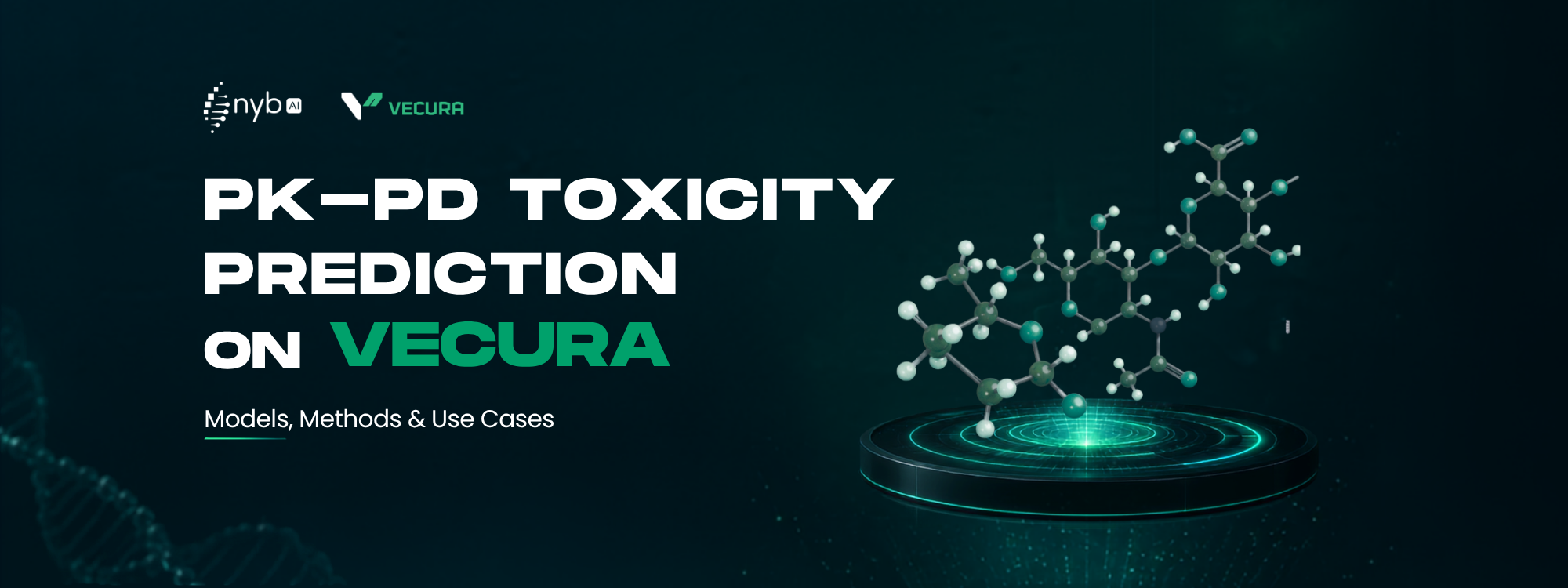
Pharmacokinetic-Pharmacodynamic Toxicity Prediction on Vecura: Models, Methods & Use Cases
Introduction
Every year, roughly 30% of clinical drug candidates fail not because they lack efficacy, but because their pharmacokinetic (PK) or safety profiles prove unacceptable once tested in humans[ 1]. Pharmacokinetics: how the body absorbs, distributes, metabolizes, and excretes a compound (ADME), and pharmacodynamics: what the compound does to the body at the molecular level, together define the therapeutic window of any drug candidate. Predicting these properties early, before costly synthesis and animal studies, is one of the highest-leverage interventions in modern drug discovery.
Vecura provides a comprehensive suite of AI-driven PK/PD and safety prediction tools spanning the full ADMET spectrum: from absorption and permeability modelling, through metabolic liability and clearance estimation, to cardiotoxicity screening, drug–drug interaction prediction, and polypharmacy side-effect analysis. This article maps every relevant model on the platform to its use case, explains the underlying methodology, and provides guidance on when and why to deploy each one.
Background
Why PK/PD Prediction Matters
The attrition funnel in drug discovery is notoriously steep. Of the ~10,000 compounds that enter preclinical screening, only one typically reaches the market, at a cumulative cost exceeding $2 billion and a timeline of 10–15 years[ 2]. ADMET failures account for approximately 30–40% of all clinical-stage attrition[ 1], making early computational triage essential. A compound with excellent target affinity but poor oral bioavailability, rapid hepatic clearance, or hERG-mediated cardiotoxicity will never reach patients — and identifying these liabilities in silico before synthesis saves both time and resources.
The integration of machine learning and deep learning into ADMET prediction has been transformative. Hybrid AI models combining conventional ML with deep learning architectures have demonstrated improved accuracy over traditional approaches, reducing drug development timelines and improving success rates[ 3]. Graph neural networks, message-passing neural networks, and transformer-based architectures now routinely outperform hand-engineered fingerprint-based models on benchmark datasets[ 4].
What PK/PD Prediction Encompasses
Pharmacokinetic prediction covers five principal domains:
• Absorption — intestinal permeability (Caco-2, PAMPA), oral bioavailability, and P-glycoprotein (P-gp) substrate/inhibitor status.
• Distribution — plasma protein binding (PPBR), volume of distribution (VDss), and blood–brain barrier (BBB) penetration.
• Metabolism — cytochrome P450 (CYP) inhibition and substrate activity across major isoforms (CYP1A2, 2C9, 2C19, 2D6, 3A4), and metabolic stability.
• Excretion — hepatic and renal clearance, half-life, and total clearance pathways.
• Toxicity — hERG channel inhibition (cardiotoxicity), acute toxicity (LD50), hepatotoxicity (DILI), mutagenicity (Ames), and broader safety liabilities.
Pharmacodynamic prediction complements this by estimating binding affinity, drug–target interaction strength, and downstream functional consequences — including drug–drug interactions (DDIs) and polypharmacy side effects that emerge only when multiple agents are co-administered[ 5].
PK/PD Models on Vecura
The following table organizes all PK/PD and safety-relevant models available on Vecura by use case. Each section groups models that address a related prediction task, with recommended models and the rationale for their selection.
| Use Case | Models | Why |
| ADMET Property Profiling (Absorption, Distribution, Metabolism, Excretion, Toxicity) | ||
| Comprehensive ADMET profiling of compound libraries | Admetica | Predicts 22 key drug behaviors — like how well a compound gets absorbed, how it's broken down, and whether it's toxic — all from its chemical structure. You can upload thousands of compounds at once in a spreadsheet and get results without needing expensive hardware. |
| ADMET profiling with DrugBank percentile benchmarking | ADMET-AI | Covers 50+ drug properties and gives each one a percentile score compared to real approved drugs. Instead of just a raw number, you get context like "this compound crosses into the brain better than 90% of drugs already on the market." Makes it easy to see where your compound stands. |
| Multi-task ADMET, DTI, DDI, and PPI in a single framework | DeepPurpose | An all-in-one toolkit that handles multiple drug-discovery questions in a single system: will this compound bind to a target? What are its properties? Will two drugs interact? Great when you don't want to juggle separate tools for each question. |
| Toxicity & Safety Prediction | ||
| Rapid toxicity and synthetic accessibility screening | eToxPred | Quickly estimates two things: is this compound likely to be toxic, and how hard is it to actually make in the lab? Lightweight and fast — perfect for weeding out risky or impractical compounds early, before spending time and money on them. |
| PPI-targeting compound drug-likeness screening | QEPPI | Standard "drug-likeness" filters are built for typical small-molecule drugs. But drugs that block protein–protein interactions (a harder, newer class of targets) have very different chemistry. This tool is purpose-built to score whether a compound looks like it could work in that space. |
| Drug–Drug Interaction (DDI) Prediction | ||
| Typed DDI prediction with human-readable sentences (86 types) | DeepDDI | Given two drugs, predicts what kind of interaction they'll have — across 86 different types — and explains it in plain English, like "Drug A may increase the liver toxicity of Drug B." Much more useful than a simple yes/no answer. |
| Expanded DDI prediction with uncertainty estimation (113 types) | DeepDDI2 | The upgraded version of DeepDDI: now covers 113 interaction types (up from 86) and adds a confidence score so you know how sure the model is about each prediction. More categories, more transparency. |
| Polypharmacy side-effect prediction via graph neural networks | Decagon | Instead of just saying two drugs interact, this predicts which specific side effects the combination will cause — nausea, dizziness, heart rhythm issues, etc. It learns from a massive network of known drug–target and drug–drug relationships to make those predictions. |
| DDI scoring via deep learning (interaction probability) | DeepPurpose (DDI module) | A simpler DDI scorer that estimates the probability that two drugs will interact. Best used when DDI checking is just one step inside a larger DeepPurpose pipeline that's already handling other tasks. |
| Drug Combination Synergy Prediction | | |
| Anti-cancer drug synergy prediction (Loewe score) | DeepSynergy | Predicts whether two cancer drugs will work better together than expected (synergy). Trained on tens of thousands of real drug combinations tested across dozens of cancer cell lines, so it has a strong experimental foundation. |
| Drug synergy prediction with symmetry enforcement | MatchMakerApp | A more accurate successor to DeepSynergy — roughly 20% better at correlation and 40% less error. It also enforces a common-sense rule: the prediction shouldn't change just because you swap the order of the two drugs. Covers 81 cancer cell lines. |
| Experimental dose-response synergy analysis | SynergyFinder | This one doesn't predict but analyzes real lab results. If you've already run a combination experiment and have dose–response data, this tool calculates synergy scores using four established methods and tells you whether the combo truly works better together. The standard for interpreting actual experiments. |
| Ionization State & Physicochemical Preprocessing | ||
| Protonation / ionization state enumeration | Dimorphite-DL | A small but critical prep step: figures out which form a molecule takes at a given pH (e.g., in the stomach vs. the bloodstream). Getting this wrong can throw off every downstream prediction — docking, solubility, absorption — so it's important to get it right before anything else. Fast and simple. |
Notes
-
Complementarity of ADMET tools. Admetica and ADMET-AI cover overlapping but non-identical endpoint sets. Admetica excels at batch throughput (CSV input, 22 endpoints, CPU-only), while ADMET-AI provides DrugBank percentile context that turns raw predictions into actionable lead-optimization guidance. For comprehensive profiling, running both in parallel is recommended.
-
DDI models are pairwise only. DeepDDI, DeepDDI2, and Decagon all score one drug pair at a time. Polypharmacy regimens involving three or more co-administered drugs require pairwise enumeration. Decagon's graph-based approach captures network-level context but is limited to its closed drug vocabulary.
-
Synergy models have closed vocabularies. DeepSynergy is restricted to 38 drugs and 39 cell lines from the Merck oncology screen; MatchMakerApp covers a broader set via DrugComb but still requires drugs present in its lookup table. For novel compounds, SynergyFinder remains the appropriate tool — but only after experimental dose-response data has been generated.
References
[1] OpenADMET Consortium. Mapping the avoid-ome: a systematic open-science approach to predictive ADMET. Nature Communications, 2026. DOI: 10.1038/s41467-026-73410-8
[2] Rethinking Nature's Pharmacy: AI Era and Natural Product Drug Discovery. Pharmaceuticals, 19(2):301, 2026. DOI: 10.3390/ph19020301
[3] A review on integrated machine learning and deep learning driven artificial intelligence models for pharmacokinetics and toxicokinetics predictions, and their application. Drug Metabolism and Disposition, 2026. DOI: 10.1016/j.dmd.2026.100240
[4] Bridging traditional and contemporary approaches in computational medicinal chemistry: opportunities for innovation in drug discovery. RSC Medicinal Chemistry, 2025. DOI: 10.1039/d5md00700c
[5] From Pharmacovigilance Signals to Mechanistic Phenotypes: Integrating ADMET, PK/PD, and Network Context to Interpret Antiviral Safety in Pregnancy. Pharmaceuticals, 19(3):450, 2026. DOI: 10.3390/ph19030450