Binding site prediction and pocket generation on Vecura
Locating druggable cavities on an existing protein and engineering a new pocket from scratch are complementary problems that sit at the entry point of any structure-based campaign. Vecura covers both through two operations: Protein binding site prediction and Protein binding pocket generation.
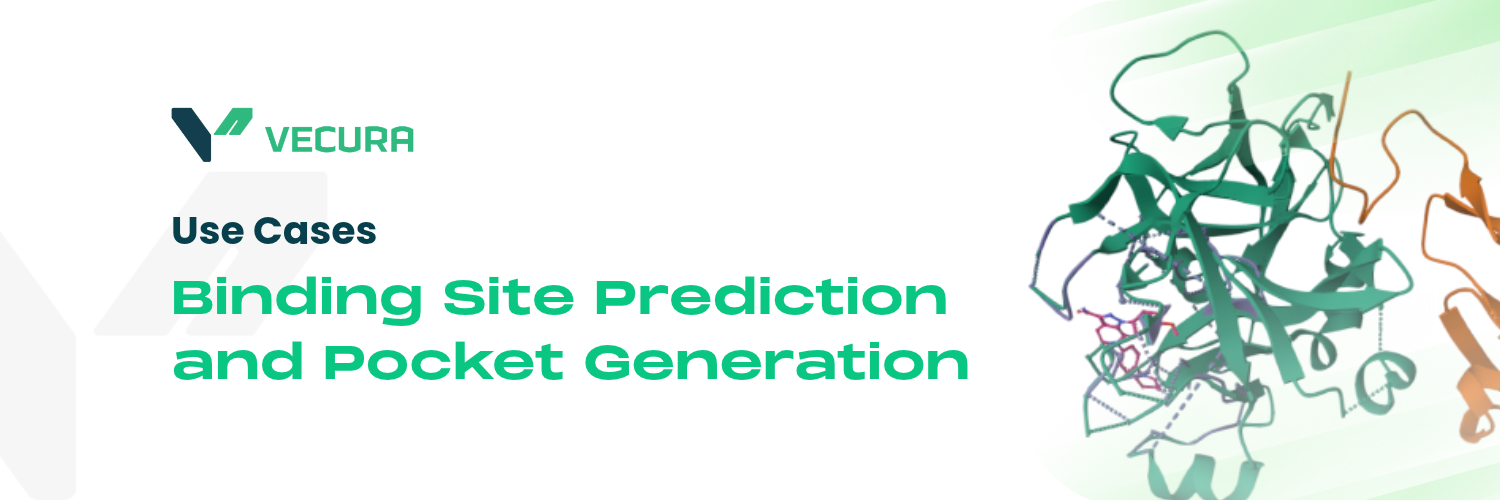
Binding site prediction reads the surface geometry or learned representations of a structure you already have and returns ranked candidate cavities or binding-competent residues — no atoms are changed. Pocket generation goes further: given a protein scaffold and a target ligand or catalytic motif, it designs new backbone geometry and residue identities so the protein will accommodate the molecule.
Choosing an operation
| What you have | What you want | Use | Typical runtime |
| Protein structure (PDB / CIF / PQR) | Ranked list of candidate druggable cavities | Protein binding site prediction | Seconds to a few minutes |
| Protein scaffold PDB + ligand (SDF or SMILES) | Designed pocket sequence and structure | Protein binding pocket generation | Several minutes per batch |
Prediction versus generation. Prediction characterises cavities that already exist in your structure; it is non-destructive and fast. Generation creates new backbone and residue identities around a target ligand or catalytic motif, producing novel pocket designs that require downstream sequence validation and experimental confirmation before use. Choose prediction when you need to locate or prioritise existing cavities; choose generation when the native pocket is absent, occluded, or geometrically unsuited to your compound.
Protein binding site prediction
 使用案例回放Protein Binding Site Prediction查看此使用案例
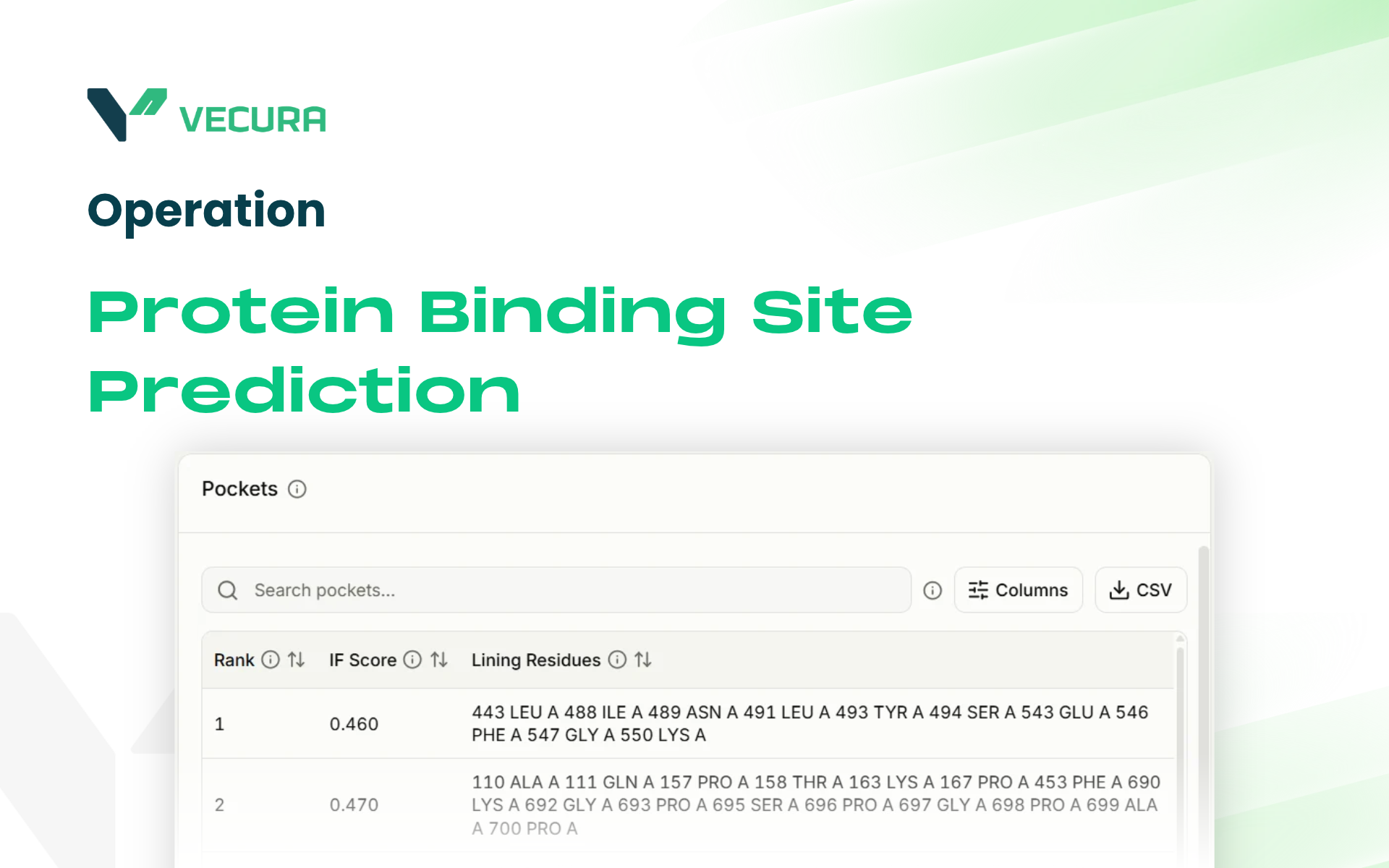
Identifies druggable cavities or binding-competent surface residues on an existing protein structure and returns each candidate pocket as a ranked result with geometric descriptors or per-residue probability scores.
Use this operation as the first step of a structure-based campaign to locate where to dock. It is equally appropriate for druggability assessment, comparison of cavities across conformational states, and automated pocket selection for downstream docking setup. Because the operation only reads the input structure and does not alter any atoms, it is faster and lower-risk than generation. For creating a new pocket, use Protein binding pocket generation instead.
输入
Protein structure file (PDB, CIF, or PQR depending on the model chosen); optional chain selector
输出
Ranked pocket list; per-residue or per-vertex binding probability scores; downloadable pocket geometry files (PDB or PQR)
Which model
| Model | Approach | Reach for it when |
| fpocket | Voronoi tessellation, clusters alpha spheres into candidate cavities and extracts pocket descriptors | You want fast, geometry-only pocket detection with tunable alpha-sphere radius and clustering parameters; no training-data dependency |
| SiteFerret | Hierarchical probe clustering via NanoShaper + Isolation Forest anomaly scoring for druggability | You want pockets pre-filtered by a druggability score, need PQR-native input, or want fine-grained control over probe radii and cluster tightness |
| MaSIF | Geometric deep learning on the protein molecular surface; outputs per-vertex interaction propensity | The site you are looking for is a protein–protein interface rather than a small-molecule cavity, MaSIF-site scores where another protein is likely to bind, which is a different question from where a ligand fits |
| AF2BIND | Linear head trained on AlphaFold2 pairwise representations; scores per-residue p(bind) using 20 bait amino acids without requiring a ligand | You want residue-level binding probability informed by AF2 internal representations; five bundled checkpoints allow ensemble scoring |
Protein binding pocket generation
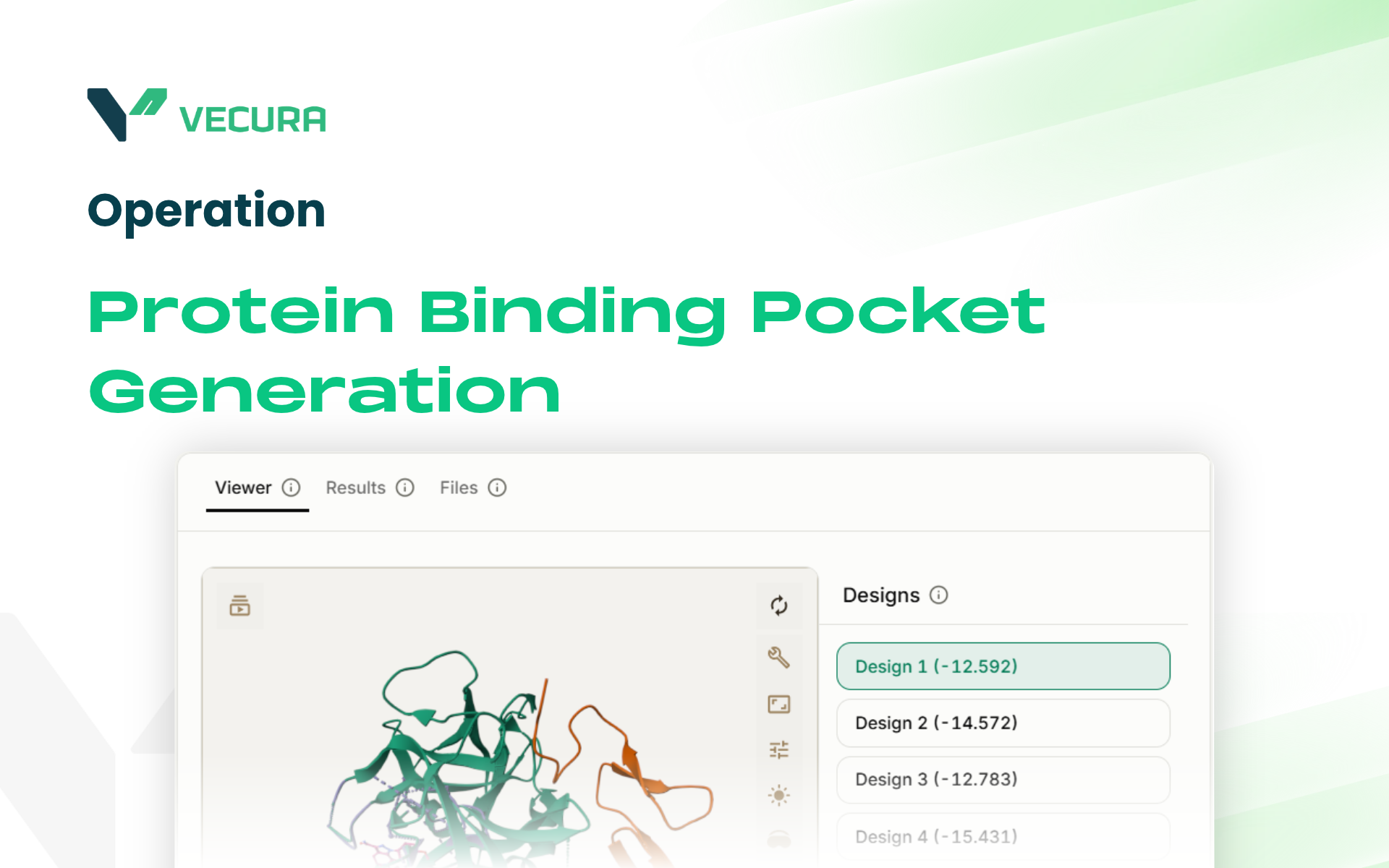 使用案例回放Protein Binding Pocket Generation查看此使用案例
Designs a new protein binding pocket, full-atom structure and residue sequence, conditioned on a target ligand or a set of catalytic residue–atom motifs.
Use this operation when no suitable native pocket exists, or when you want to engineer a pocket with specific geometry around a given molecule. The output is a designed protein structure, not a characterisation of an existing one; it differs fundamentally from prediction. All outputs should be passed through sequence design validation and confirmed experimentally before synthesis.
输入
Protein scaffold PDB + ligand SDF file or SMILES string; number of designs (1–8)
输出
Designed pocket backbone and sequence; up to 8 (PocketGen)
Which model
PocketGen is a generative deep-learning model that takes a protein scaffold PDB and a ligand SDF or SMILES and outputs up to 8 full-atom pocket designs with optimised sequences. It converts a SMILES to a 3D conformer automatically and places it at the protein centroid when no pre-positioned SDF is provided. Reach for PocketGen when you have a defined ligand and a known scaffold and want multiple ready-to-evaluate pocket sequences in one run.
Next step
After Protein binding site prediction returns ranked cavities, the natural follow-on is docking: pass the identified pocket coordinates into a docking model (such as AutoDock-Vina, gnina, or DiffDock on Vecura) to score ligand poses. After Protein binding pocket generation, pair the designed pocket with a sequence design tool such as ProteinMPNN or LigandMPNN to refine residue identities and assess per-position confidence before moving to synthesis or experimental validation.