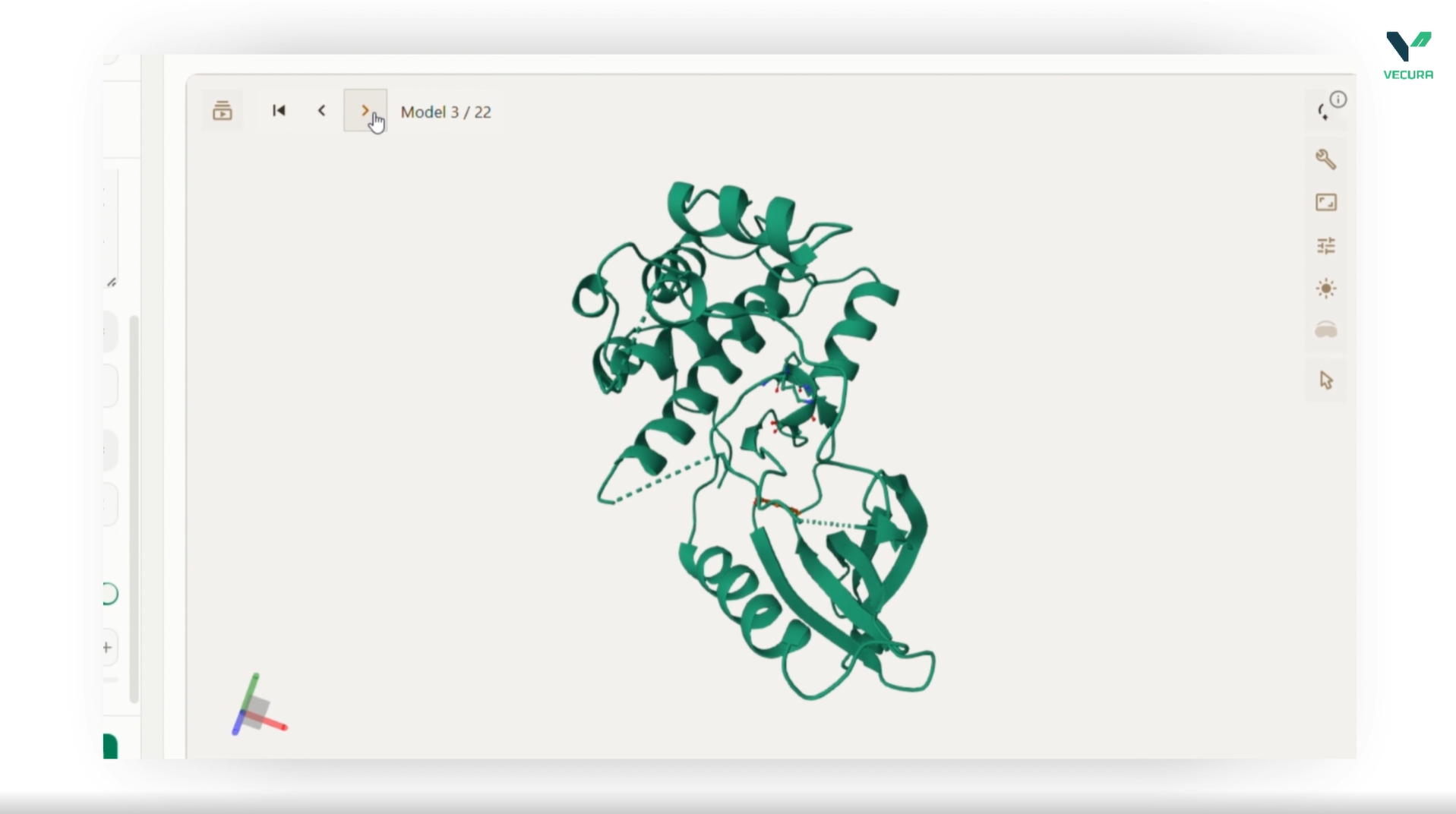
RFD4-Proteina Is Now Available on Vecura
This update enables protein designers, structural biologists, and computational researchers to co-design all-atom protein structures and sequences through a guided workflow inside Vecura, without setting up complex technical infrastructure.
What is RFD4-Proteina?
RFD4-Proteina is a flow-matching foundation model for all-atom biomolecular design, co-developed by the Baker Lab at the Institute for Protein Design (University of Washington) and NVIDIA GenAIR. It jointly generates protein sequences and all-atom structures in a single trajectory of 60 steps over a latent space, conditioned on the molecular context a user wants to preserve — such as a binding target, an enzyme motif, a ligand, or selected structural features.
It helps users design new proteins and protein complexes at all-atom resolution, from de novo monomers to protein binders, antibodies, enzyme active sites, small-molecule binders, motif scaffolds, and refined designs — all through a single unified model with rich conditioning. It is especially useful for researchers working on therapeutic protein design, enzyme engineering, and biomolecular complex development who need to rapidly generate and iterate on candidate designs without managing GPU infrastructure or complex deployment pipelines.
What can users do with RFD4-Proteina on Vecura?
With RFD4-Proteina on Vecura, users can:
- Generate de novo protein monomers from scratch at predefined lengths (100, 150, or 250 residues) or custom lengths using expandable annotated templates
- Design conditioned biomolecular binders across six design types: protein binders against a target structure, VHH antibodies and nanobodies, enzyme active site scaffolds, small-molecule binding pockets, motif scaffolding around fixed structural elements, and refinement of existing designs through partial diffusion
- Perform inverse folding to generate new amino acid sequences for an existing protein backbone, enabling rapid sequence optimization for known structures
- Apply rich conditioning controls including motif preservation, hotspot residues, burial levels, hydrogen bond patterns, pi interactions, CATH fold class, and chain centroids — all through an intuitive interface without writing code
What the output means
The output provides all-atom protein structures in mmCIF format, one file per design, along with the co-designed amino acid sequences (one-letter codes) for each designed chain. Each structure file includes per-atom provenance annotations that record which atoms came from the user's conditioning input and which the model generated. A summary table reports the design ID, chain composition, residue count, and designed length for each output.
It is important to note that designs returned by RFD4-Proteina on Vecura are generated without inline scoring — no confidence values, no pLDDT scores, no designability metrics, and no ranking are provided. Each design is a hypothesis that should be treated as a starting point. This output should be used to support scientific decision making. It does not replace experimental validation. Researchers are encouraged to apply their own computational validation (such as refolding predictions and clustering) and ultimately wet-lab experiments to confirm the functionality and stability of generated designs.
Why this matters
Protein design has traditionally required a multi-step pipeline: first generating a backbone structure, then running a separate inverse folding model to assign sequences, and finally scoring the results with structure prediction tools. RFD4-Proteina collapses this pipeline into a single generative pass, co-designing sequence and structure simultaneously so that changes in one seamlessly inform changes in the other. Across computational benchmarks, the model achieves five- to tenfold higher design success rates while generating protein candidates five to ten times faster than previous approaches. Its residue-level latent representation and engineered diffusion schedule reduce sampling from approximately 400 steps to just 60, delivering 3.8× faster generation and 84% less peak memory compared to its predecessor RFD3 at 200 residues.
The model's versatility is equally significant. A single checkpoint serves many design tasks — from de novo monomer generation to antibody CDR loop design, enzyme active site scaffolding, and small-molecule pocket engineering — through conditioning alone, without switching models. This unified approach, combined with its open-source BSD-3-Clause license, makes state-of-the-art biomolecular design accessible to academic labs and biotech teams worldwide. Early lab bench tests have validated that the model's protein outputs function as anticipated in experimental settings, demonstrating success across biomolecular tasks of varying sizes, complexities, and functions.
- Developed by: Baker Lab at the Institute for Protein Design (University of Washington) and NVIDIA GenAIR
- Source: Paper (preprint, 2026) · GitHub · Hugging Face Model Card · Documentation
- Reference: Corley, Didi, Kazman, Brent et al. (2026). "Biomolecular design through latent reasoning with RFD4-Proteina." Preprint. Institute for Protein Design, University of Washington.
在 Vecura 上试用 RFD4-Proteina
打开模型工作区,用您自己的输入开始评估