RDKit_mETKDG: Improved 3D Conformer Generation for Macrocycles Now Available on Vecura
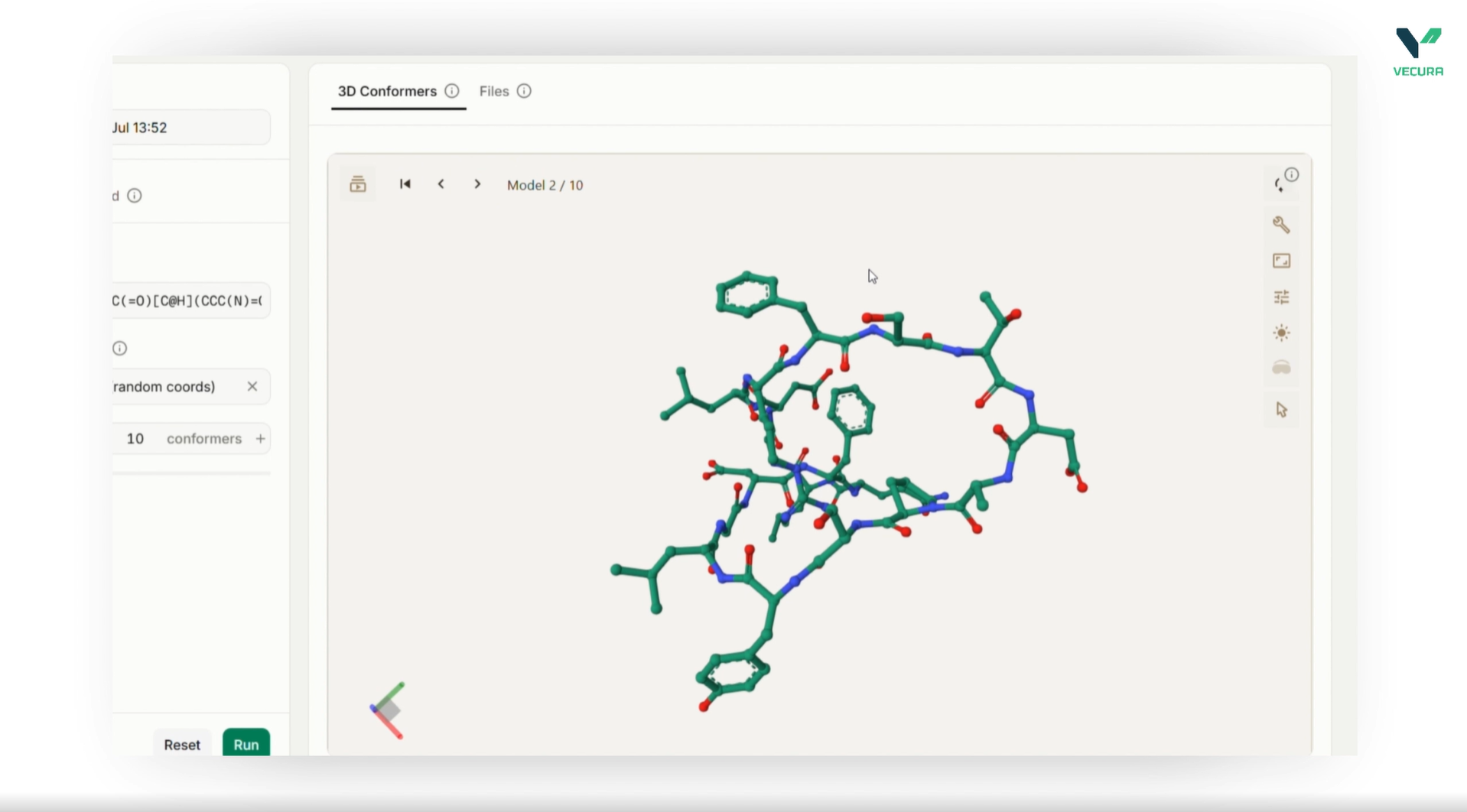
This update enables computational chemists and drug discovery researchers to generate physically realistic 3D conformer ensembles for macrocyclic molecules and cyclic peptides through a guided workflow inside Vecura, without setting up complex technical infrastructure.
What is RDKit_mETKDG?
RDKit_mETKDG is a targeted modification of RDKit's Experimental Torsion Knowledge Distance Geometry (ETKDG) algorithm, developed by the Rinikerlab research group to overcome the systematic failures that standard ETKDG encounters when embedding macrocyclic molecules. While the original ETKDG was built and validated on drug-like small molecules, it frequently produces collapsed or unrealistic 3D geometries for large rings and cyclic peptides because its torsion library and 1-4 distance bounds were not parameterised for those ring sizes. RDKit_mETKDG ships updated torsion SMARTS potentials, revised 1-4 distance constraints, optional random-coordinate seeding, an ellipse-derived distance-bounds-matrix prior, and custom pairwise Coulombic interactions (CPCI) for amide groups present in cyclic peptides.
It helps users generate physically plausible 3D conformer ensembles for macrocyclic compounds that standard tools cannot handle reliably. It is especially useful for cyclic peptides and large-ring drug candidates where conventional conformer generators produce distorted or collapsed geometries that undermine downstream computational analyses.
What can users do with RDKit_mETKDG on Vecura?
With RDKit_mETKDG on Vecura, users can:
-
Generate 3D conformer ensembles using four progressively elaborated sampling modes — from basic mETKDG to eccentricity-ellipse bounds combined with amide Coulombic interactions (CPCI)
-
Tune sampling parameters such as the number of conformers, ellipse eccentricity, bond scale factor, and CPCI scale factor to optimise results for specific macrocyclic scaffolds
-
Evaluate generated conformer ensembles against known reference crystal or NMR structures by computing per-conformer heavy-atom RMSD and ring-specific RMSD metrics
-
Export multi-conformer SDF files for direct use in downstream applications such as molecular docking, molecular dynamics setup, and pharmacophore modelling
What the output means
The output provides a multi-record SDF file containing all embedded 3D conformers, along with comprehensive RMSD metrics when a reference structure is supplied. Per-conformer heavy-atom RMSD measures the overall geometric agreement with the known 3D structure after best-fit alignment, while ring-RMSD isolates the quality of the macrocyclic ring pucker from sidechain variation. The lowest RMSD and lowest ring-RMSD values across the ensemble indicate the best-case sampling quality — that is, how close at least one generated conformer comes to reproducing the experimentally observed geometry.
This output should be used to support scientific decision making. It does not replace experimental validation.
Why this matters
Macrocyclic molecules and cyclic peptides represent a rapidly growing class of therapeutic agents that occupy a unique chemical space between small molecules and biologics. Their large, flexible ring structures can target protein-protein interactions and other traditionally "undruggable" interfaces, making them increasingly attractive in modern drug discovery. However, generating accurate 3D conformations for these molecules has been a persistent computational bottleneck. Standard conformer generation algorithms like ETKDG were parameterised on small, drug-like molecules and systematically fail on large rings, producing collapsed geometries with unrealistic bond angles and torsions. This limitation cascades through the entire drug discovery pipeline — from molecular docking to molecular dynamics simulations — because the quality of downstream results depends critically on the quality of the input 3D structures.
RDKit_mETKDG addresses this gap by extending the ETKDG framework with macrocycle-specific parameterisation. The introduction of an ellipse-derived bounds matrix provides a physically motivated prior that encourages the algorithm to explore extended ring conformations rather than collapsed ones, while the custom pairwise Coulombic interactions for amide groups capture the electrostatic constraints that govern cyclic peptide backbone geometry. By making this tool available on Vecura, researchers can now generate high-quality macrocyclic conformer ensembles without the need to compile custom RDKit builds, manage complex dependency chains, or write custom scripting pipelines — accelerating the path from molecular design to computational evaluation.
-
Developed by: Rinikerlab (Riniker Research Group)
-
Source: GitHub Repository / cpeptools
-
Reference: Riniker & Landrum (2015) — Better Informed Torsion Knowledge Distance Geometry, J. Chem. Inf. Model.
在 Vecura 上试用 RDKit_mETKDG
打开模型工作区,用您自己的输入开始评估