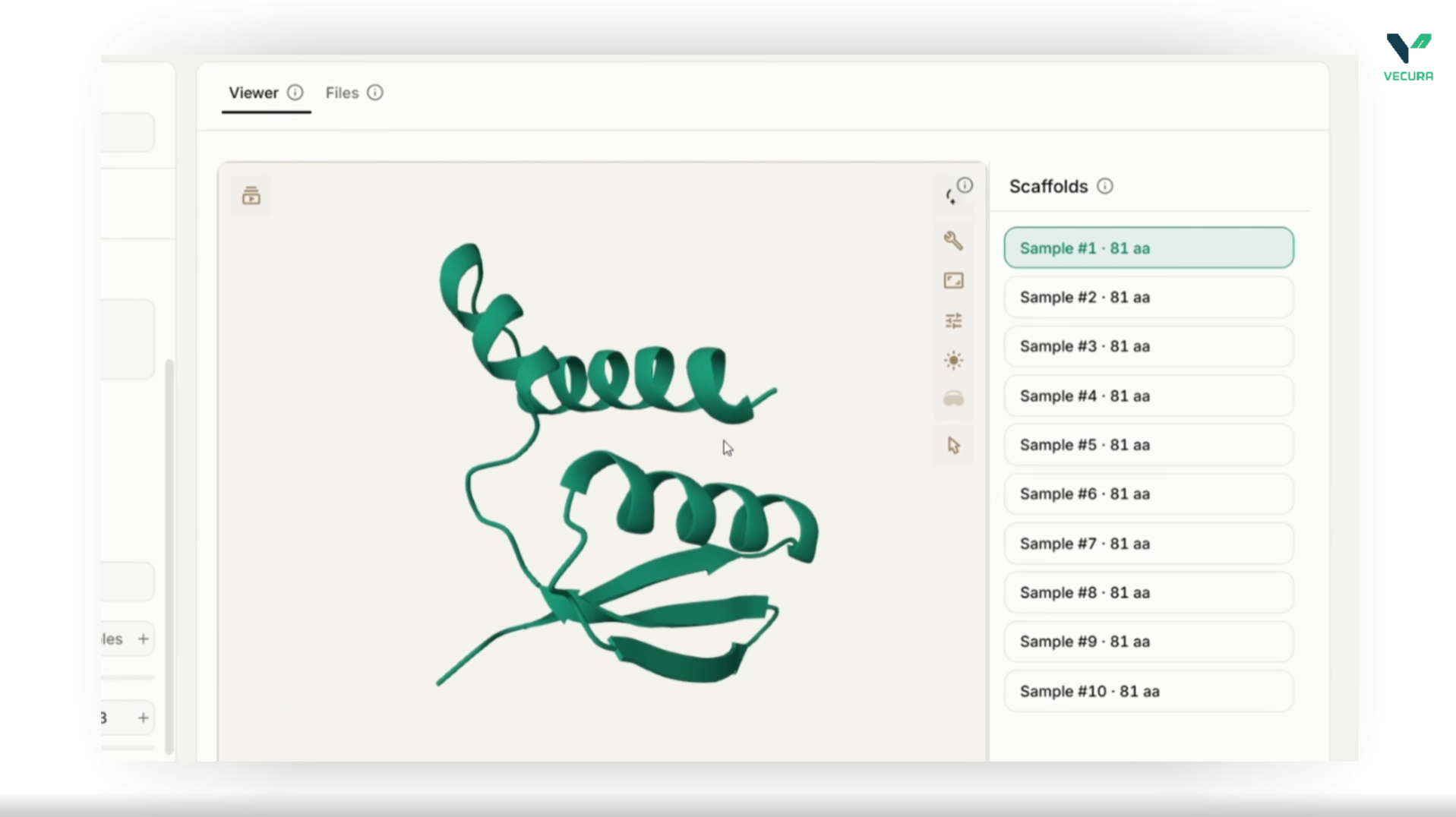
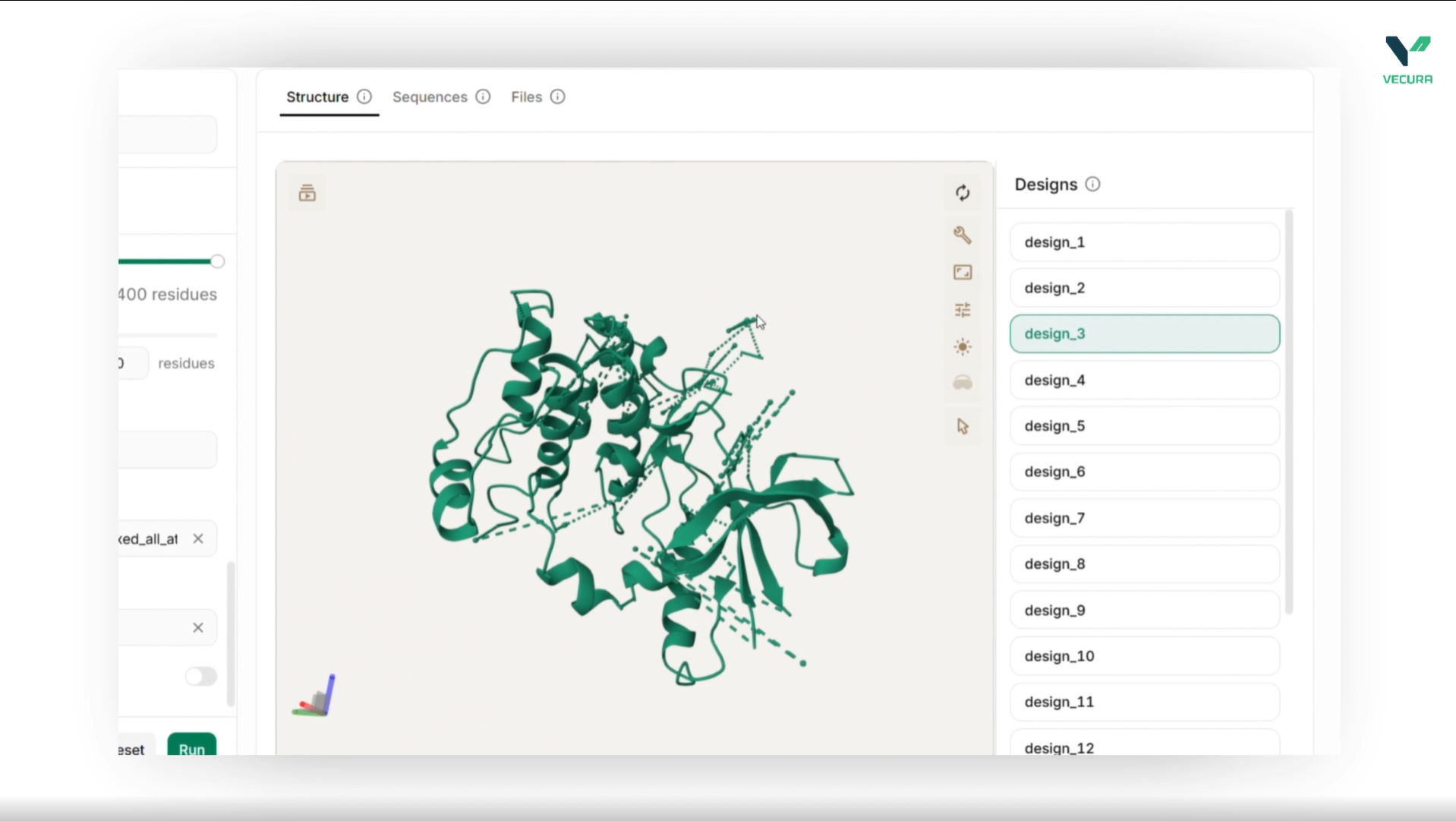
ProtComposer Now Available on Vecura: Compositional Protein Structure Generation with 3D Spatial Control
This update enables protein designers and structural biologists to generate de novo protein backbones with co-designed sequences conditioned on user-defined 3D ellipsoidal layouts through a guided workflow inside Vecura, without setting up complex technical infrastructure.
What is ProtComposer?
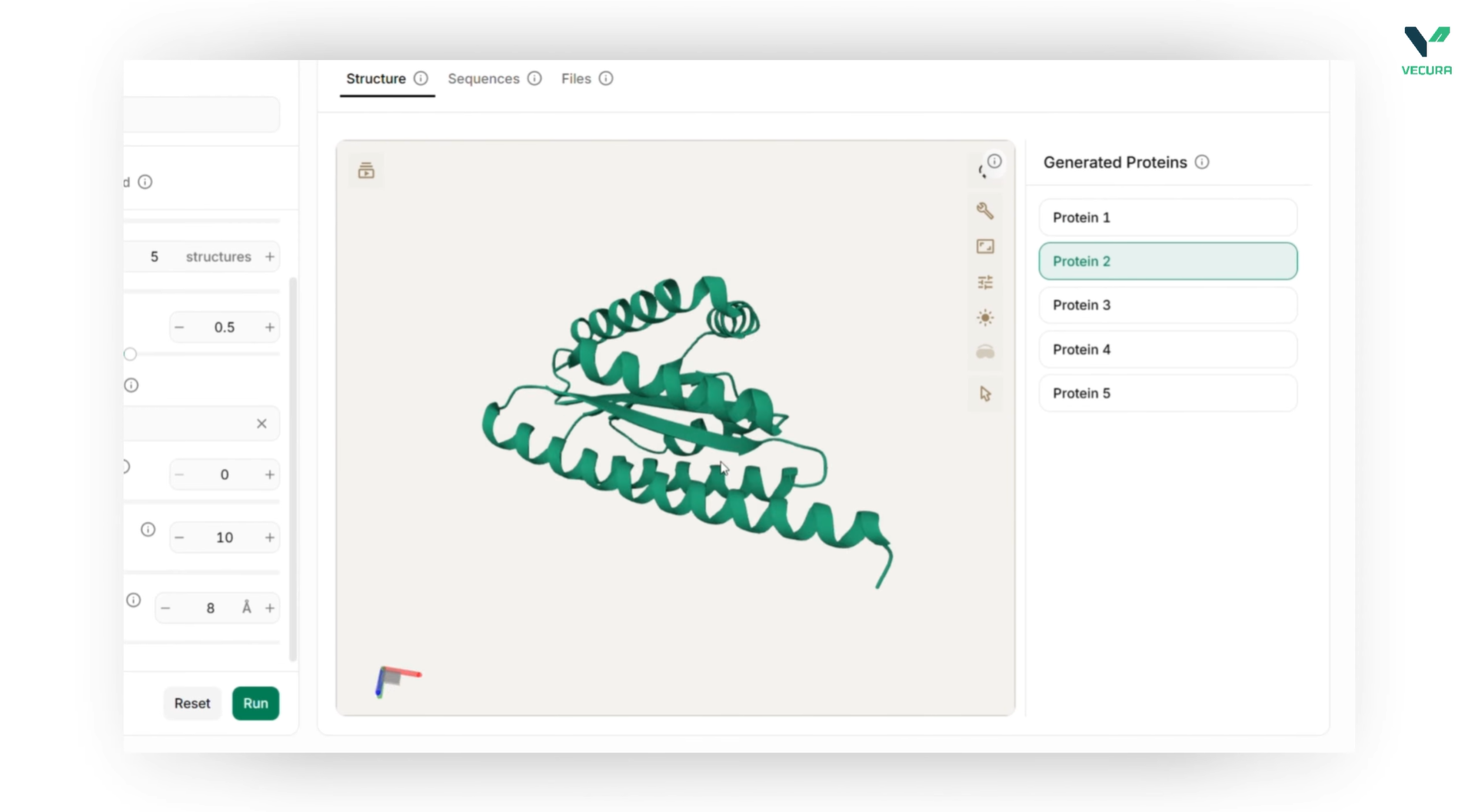
ProtComposer is a generative model for compositional protein structure design that creates novel protein backbones and amino acid sequences based on 3D ellipsoidal shape constraints. Built on the MultiFlow framework, it uses flow-matching to simultaneously generate atomic coordinates and sequence identities through a continuous-time normalizing flow. The model accepts a set of 3D ellipsoids ("blobs") that specify spatial regions, secondary structure types (helix or beta-sheet), and expected residue counts, then produces complete protein structures that adhere to these prescribed layouts.
It helps users generate custom protein architectures with precise control over topology, secondary structure distribution, and spatial extent. It is especially useful for designing proteins with specific geometric requirements—such as helical bundles, mixed alpha-beta domains, or multi-subdomain assemblies—where traditional unconditional generators cannot guarantee the desired spatial organization.
What can users do with ProtComposer on Vecura?
With ProtComposer on Vecura, users can:
-
Generate novel protein backbones with co-designed sequences that follow prescribed 3D ellipsoidal layouts
-
Control the helix-to-sheet ratio and overall compositional complexity by adjusting the number of blobs and secondary structure fractions
-
Choose between experimentally-validated PDB-trained models or AlphaFold Database-trained models for different fold characteristics
-
Apply self-conditioning guidance to increase adherence to spatial constraints while maintaining structural diversity
-
Specify blob anisotropy, compactness, and scale parameters to fine-tune the spatial extent and shape of generated proteins
What the output means
The output provides generated protein structures in PDB format with atom37 coordinates, co-designed amino acid sequences in single-letter codes, and ellipsoid configuration data showing the spatial constraints used for generation. The PDB structures represent designed backbone topologies that can be directly visualized in molecular viewers or validated using downstream tools like ESMFold for designability scoring and ProteinMPNN for sequence redesign.
This output should be used to support scientific decision making. It does not replace experimental validation.
Why this matters
Protein design has long faced a fundamental limitation: while generative models can produce realistic protein structures, they typically cannot specify the spatial layout or secondary structure composition before generation. Researchers have been forced to generate structures unconditionally and then filter for desired properties—a process that is inefficient and often fails to produce architectures with specific geometric requirements. ProtComposer addresses this by introducing compositional control through 3D ellipsoids, enabling rational design of proteins with prescribed topology from the outset. This capability is critical for applications in enzyme design, therapeutic protein engineering, and synthetic biology, where the spatial arrangement of functional domains directly determines biological activity.
The model's ability to jointly design backbone and sequence in a single flow, combined with its state-of-the-art designability scores and user-controllable spatial constraints, represents a significant advance in computational protein design. By training on both experimental PDB structures and the AlphaFold Database, ProtComposer can generate both canonical folds and novel AlphaFold-like topologies, expanding the accessible protein design space for research and biotechnology applications.
-
Developed by: NVIDIA Research (NVlabs)
-
Source: ICLR 2025 Oral paper, GitHub repository, and model card
-
Reference: https://github.com/NVlabs/protcomposer
在 Vecura 上试用 ProtComposer
打开模型工作区,用您自己的输入开始评估