Prompteina: Text-Conditioned Protein Design Is Now Available on Vecura
This update enables researchers and protein engineers to design all-atom protein structures and target-conditioned binders from plain-language descriptions through a guided workflow inside Vecura, without setting up complex technical infrastructure.
What is Prompteina?
Prompteina is the first text-conditioned, all-atom protein structure generation model that turns natural-language descriptions into complete 3D protein structures with co-designed amino acid sequences. Built on NVIDIA's Proteina-Complexa latent flow-matching architecture and trained on a 1.8-million paired text–structure dataset, it functions much like a text-to-image generator — except the output is a physically grounded protein backbone and side-chain geometry.
It helps users describe a desired protein in plain prose — specifying fold, secondary structure, tertiary motifs, global shape, surface properties, or even a functional family — and receive a ready-to-inspect all-atom structure. It is especially useful for researchers exploring de novo monomer design and target-conditioned binder design without needing to translate biological intent into model-specific numerical conditioning inputs.
What can users do with Prompteina on Vecura?
With Prompteina on Vecura, users can:
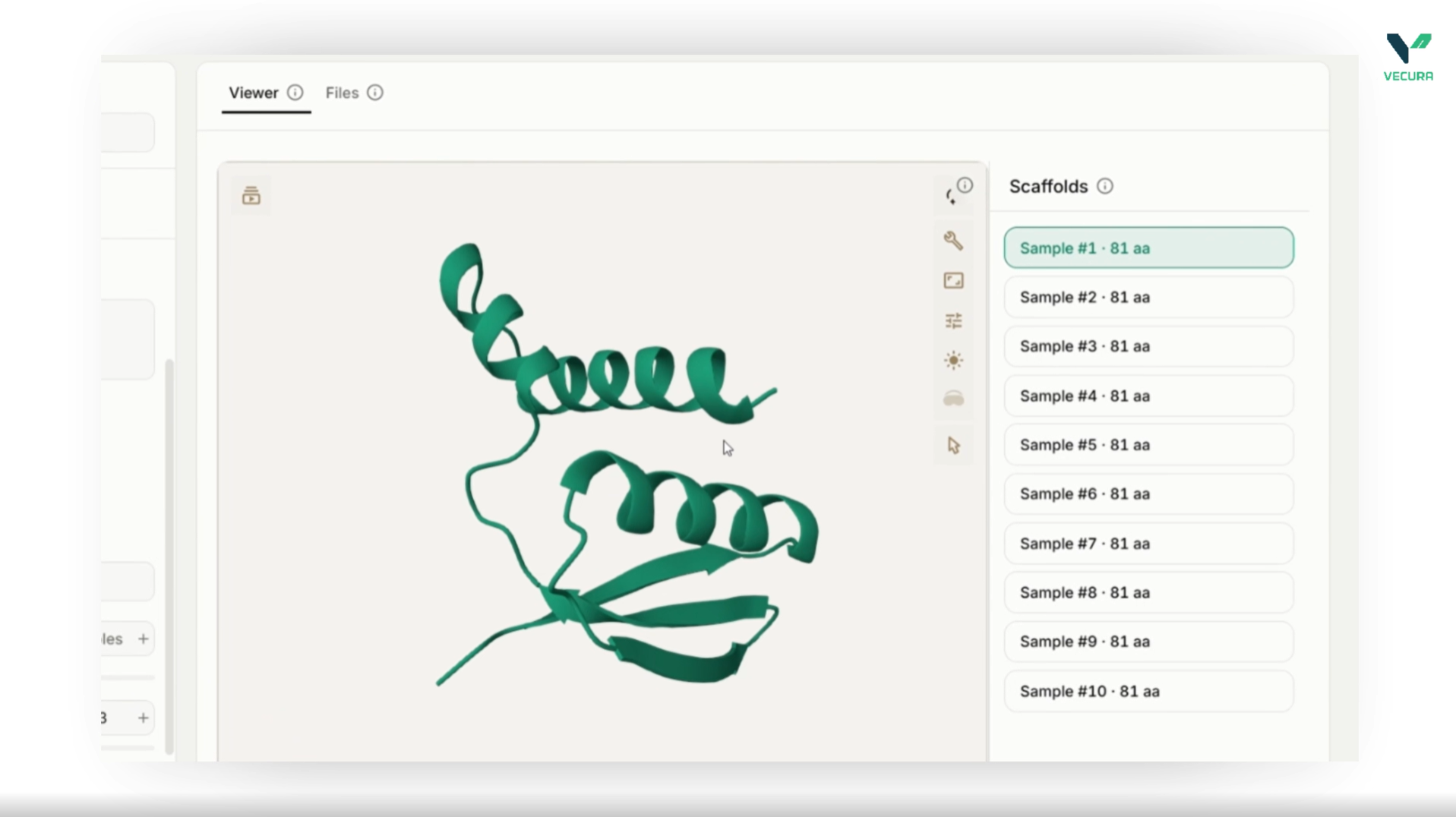
- Generate de novo monomer structures by describing the desired fold, topology, secondary-structure counts, disulfide bonds, salt bridges, compactness, symmetry, or functional family (e.g., lysozyme, GFP) in a natural-language prompt.
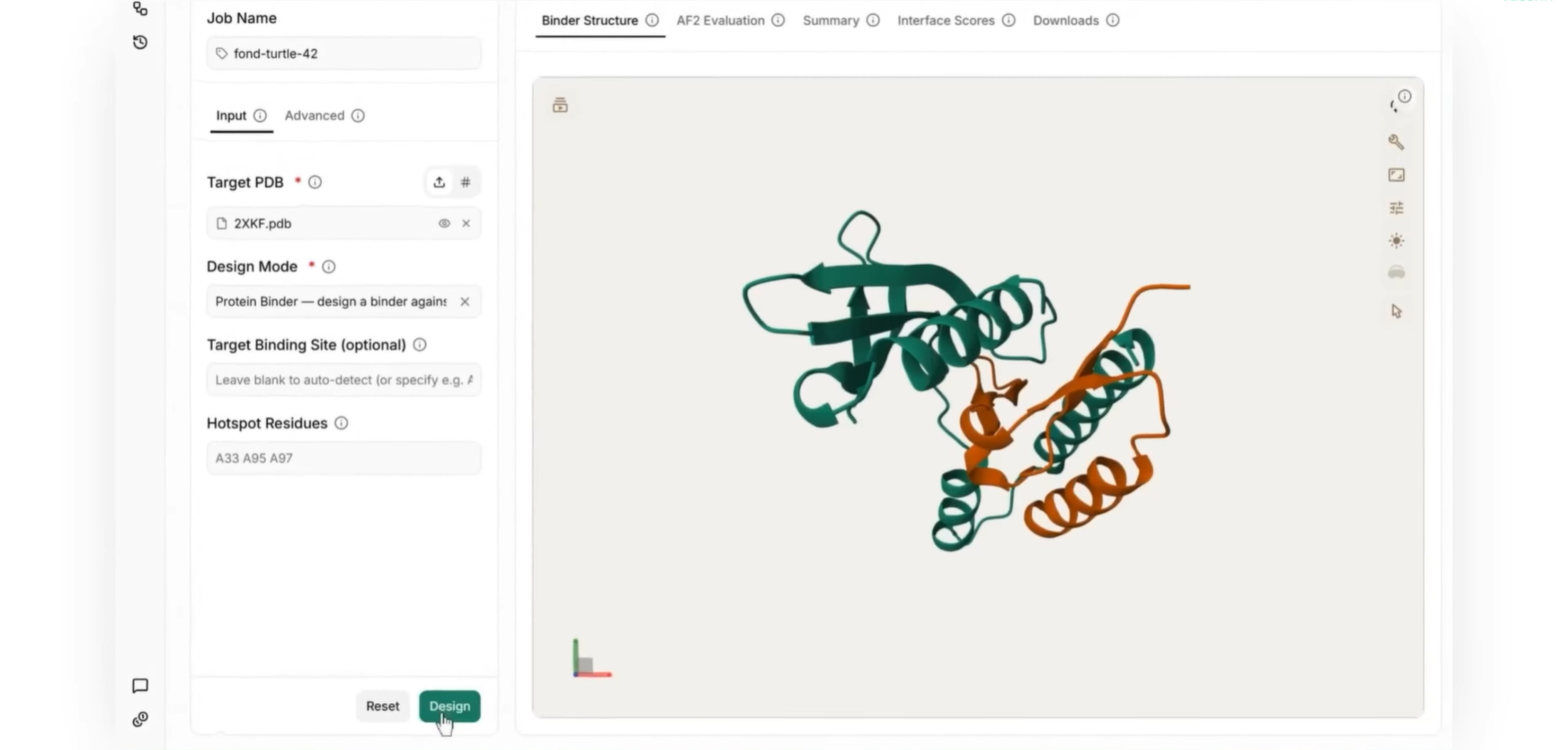
- Design target-conditioned protein binders against 21 vendored targets (including PDL1, GM2A, and other benchmark antigens), with optional epitope hotspot specification to steer the binding interface.
- Score and rank generated binders using an integrated ipSAE_min pipeline that refolds each complex from sequence alone with ESMFold2, optionally applies ProteinMPNN redesign (free or fixed-interface), and reports interface confidence metrics.
- Control generation parameters such as classifier-free guidance weight, flow-matching steps, residue length ranges, and random seeds — all through a guided interface, without writing code or managing GPU infrastructure.
What the output means
The output provides all-atom PDB structures (one per design), co-designed amino acid sequences, a per-design summary table, and — when scoring is enabled — interface confidence scores including ipSAE_min, pLDDT for both binder and complex, and PAE-based quality gates. For binder runs, the score summary also reports the best ipSAE_min, top-8 mean, and overall mean across the batch.
This output should be used to support scientific decision making. It does not replace experimental validation. ipSAE_min is a proxy for predicted interface confidence, not a direct measurement of binding affinity, and sequence-only refolding (without MSA) may yield lower confidence for unusual folds. In the authors' prospective wet-lab campaign against GM2A, 9 out of 90 designs were experimentally confirmed as binders, underscoring that computational scores are a starting point, not a guarantee.
Why this matters
De novo protein design has traditionally required researchers to translate their biological goals — desired fold, binding site, shape, or function — into model-specific numerical or graphical conditioning inputs, a step that demands deep expertise in both structural biology and machine learning. Prompteina removes that translation barrier by accepting natural-language descriptions as the sole conditioning signal, making protein design accessible to a broader range of researchers. The model outperforms baselines on 15 of 18 structural properties and generates proteins that more closely match their intended descriptions, demonstrating that language-conditioned generation is a viable and powerful paradigm for structural biology.
The integration of generation and scoring into a single pipeline is particularly significant for binder design. By combining flow-matching-based structure generation with ESMFold2 refolding and ipSAE_min scoring — and optionally ProteinMPNN sequence redesign — Prompteina provides an end-to-end workflow that compresses what was previously a multi-tool, multi-step process into a single guided run. For targets like GM2A, where earlier campaigns of 30 designs produced no hits, this streamlined approach yielded experimentally validated binders, highlighting the practical impact of unified, language-driven protein design.
- Developed by: Justin Lee et al. (University of Toronto research group), building on NVIDIA Proteina-Complexa
- Source: Paper (arXiv:2610.13917) / GitHub / Project page / Model checkpoints (HuggingFace)
- Reference: Lee, J. et al. "Designing Protein Structures from Natural Language." arXiv:2610.13917 (2025). Code: Apache-2.0. Model weights: NVIDIA Open Model License.
在 Vecura 上试用 Prompteina
打开模型工作区,用您自己的输入开始评估