PLACER: Protein-Ligand Docking Ensembles Now Available on Vecura
This update enables structural biologists and computational chemists to generate protein-ligand docking ensembles and predict sidechain conformations through a guided workflow inside Vecura, without setting up complex technical infrastructure.
What is PLACER?
PLACER (Protein-Ligand Atomistic Conformational Ensemble Resolver) is an atom-level graph neural network developed by the Baker Lab at the University of Washington's Institute for Protein Design. It operates as a generative denoising model that produces stochastic ensembles of protein-ligand and protein-sidechain atomic coordinates by iteratively refining noisy inputs into physically reasonable conformations.
It helps users explore the full conformational landscape of protein-ligand interactions by sampling multiple plausible docked poses and sidechain arrangements rather than returning a single deterministic prediction. It is especially useful for studying conformational heterogeneity at binding sites, evaluating designed pockets in protein engineering projects, and generating diverse pose ensembles for downstream scoring and analysis.
What can users do with PLACER on Vecura?
With PLACER on Vecura, users can:
-
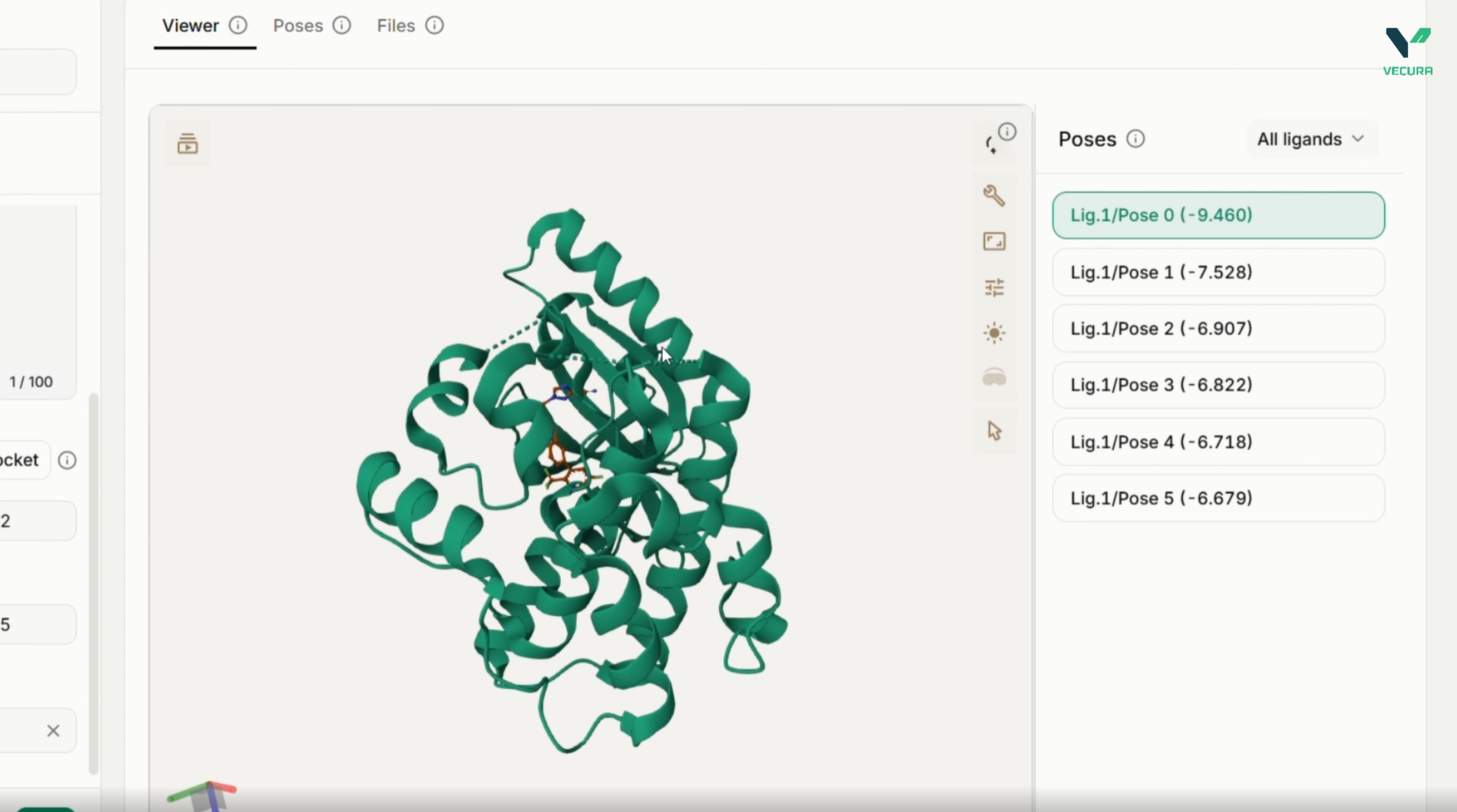
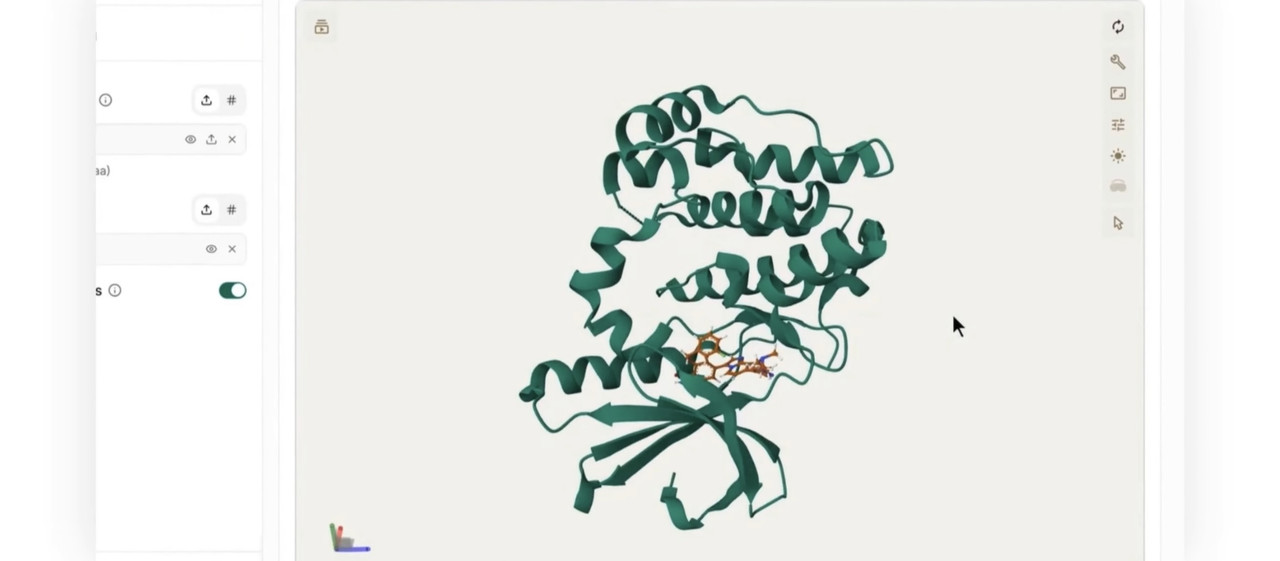
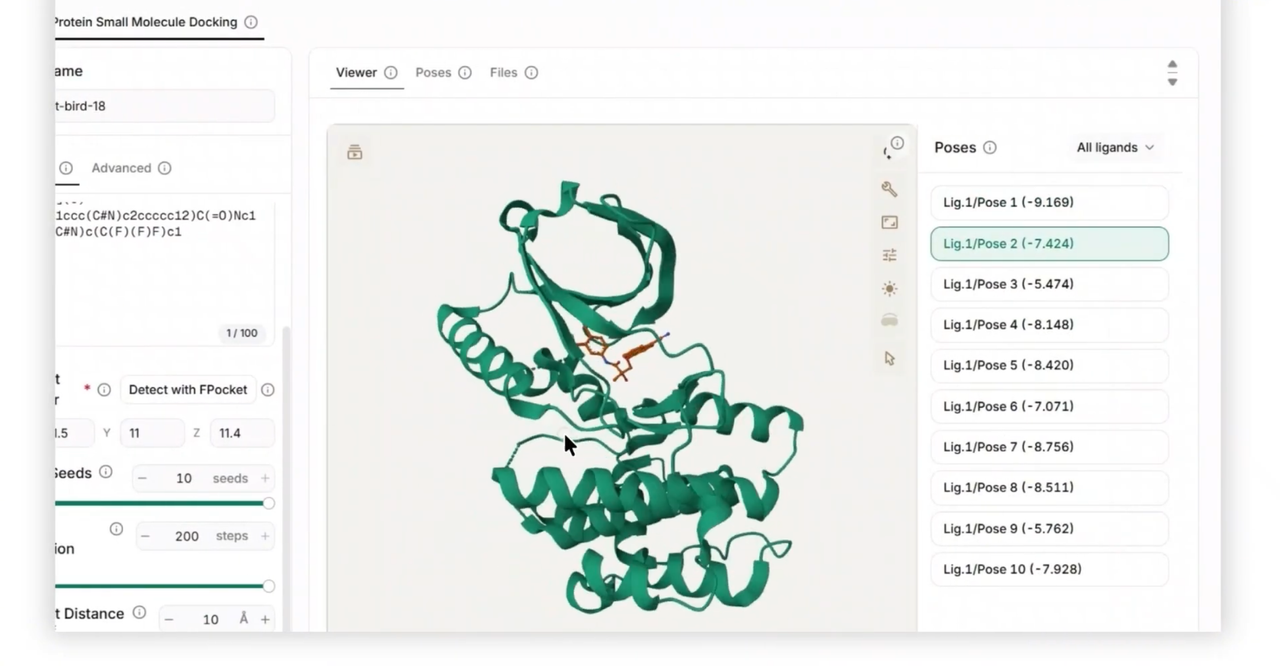
Run competitive protein-small molecule docking by providing a protein structure with a pre-placed ligand at an approximate binding site, then generating an ensemble of refined docked poses ranked by self-confidence metrics.
-
Predict sidechain and local backbone conformations in apo (ligand-free) mode by specifying a target residue as the crop center, producing an ensemble of plausible sidechain arrangements within the protein context.
-
Perform global docking exploration using corruption centers to sample ligand placements across the full protein surface, enabling discovery of unexpected binding sites.
-
Analyze ensemble diversity and confidence through built-in scoring metrics including predicted RMS deviation (prmsd), predicted per-atom LDDT (plddt), and aggregate statistics that indicate whether a well-defined binding mode has been identified.
What the output means
The output provides a multi-model PDB ensemble file containing all sampled conformations (ranked by the user-selected metric), a per-sample CSV scores table with metrics such as prmsd, plddt, RMSD, and Kabsch-superimposed ligand RMSD, and summary statistics including counts of trustworthy poses (prmsd < 2.0 Å) and acceptable poses (prmsd < 4.0 Å). The prmsd self-confidence score is embedded in the B-factor column of ligand atoms, enabling direct visualization of confidence in tools like PyMOL or Mol*.
This output should be used to support scientific decision making. It does not replace experimental validation.
Why this matters
Understanding how small molecules bind to proteins — and the full range of conformations they can adopt — is central to structure-based drug design, enzyme engineering, and chemical biology. Traditional docking tools typically return a single best-scoring pose, which can miss functionally relevant alternative binding modes or fail to capture the inherent flexibility of binding-site sidechains. PLACER addresses this by generating entire ensembles of plausible conformations, giving researchers a richer picture of the conformational landscape.
The stochastic denoising approach, trained jointly on the Cambridge Structural Database (CSD) and the Protein Data Bank (PDB), allows PLACER to capture physically realistic atomic interactions at a level of detail that goes beyond coarse-grained or rigid-body methods. By making this model accessible through Vecura's guided workflow, researchers can leverage state-of-the-art conformational ensemble generation without managing GPU infrastructure, installing dependencies, or writing custom inference scripts — lowering the barrier to advanced computational structural biology.
-
Developed by: Baker Lab, Institute for Protein Design, University of Washington
-
Source: bioRxiv preprint (2024.09.25.614868) / PNAS publication (2025)
-
Reference: Anishchenko, I. et al. "Modeling protein–small molecule conformational ensembles with PLACER." PNAS (2025). GitHub repository
在 Vecura 上试用 PLACER
打开模型工作区,用您自己的输入开始评估