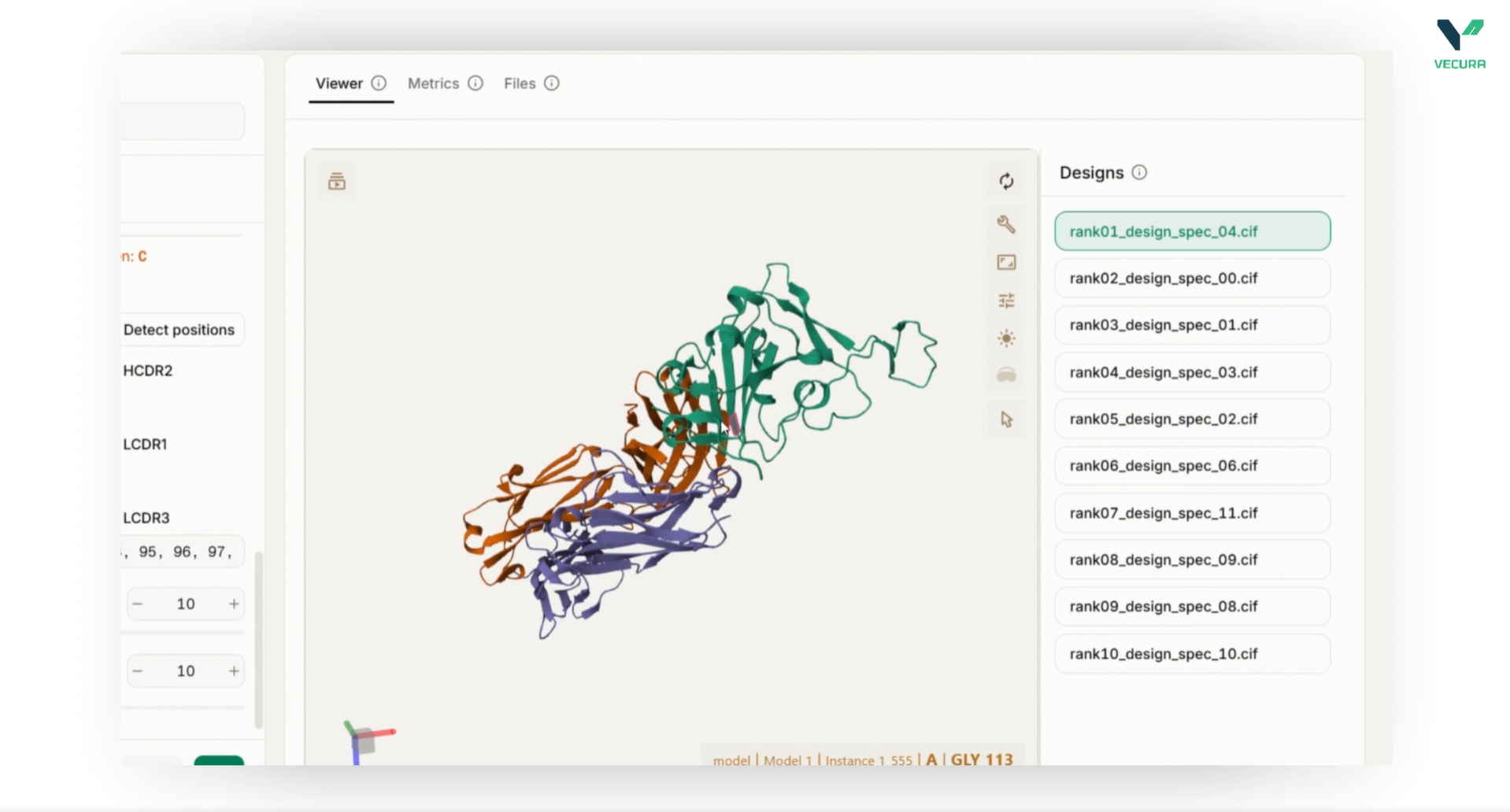
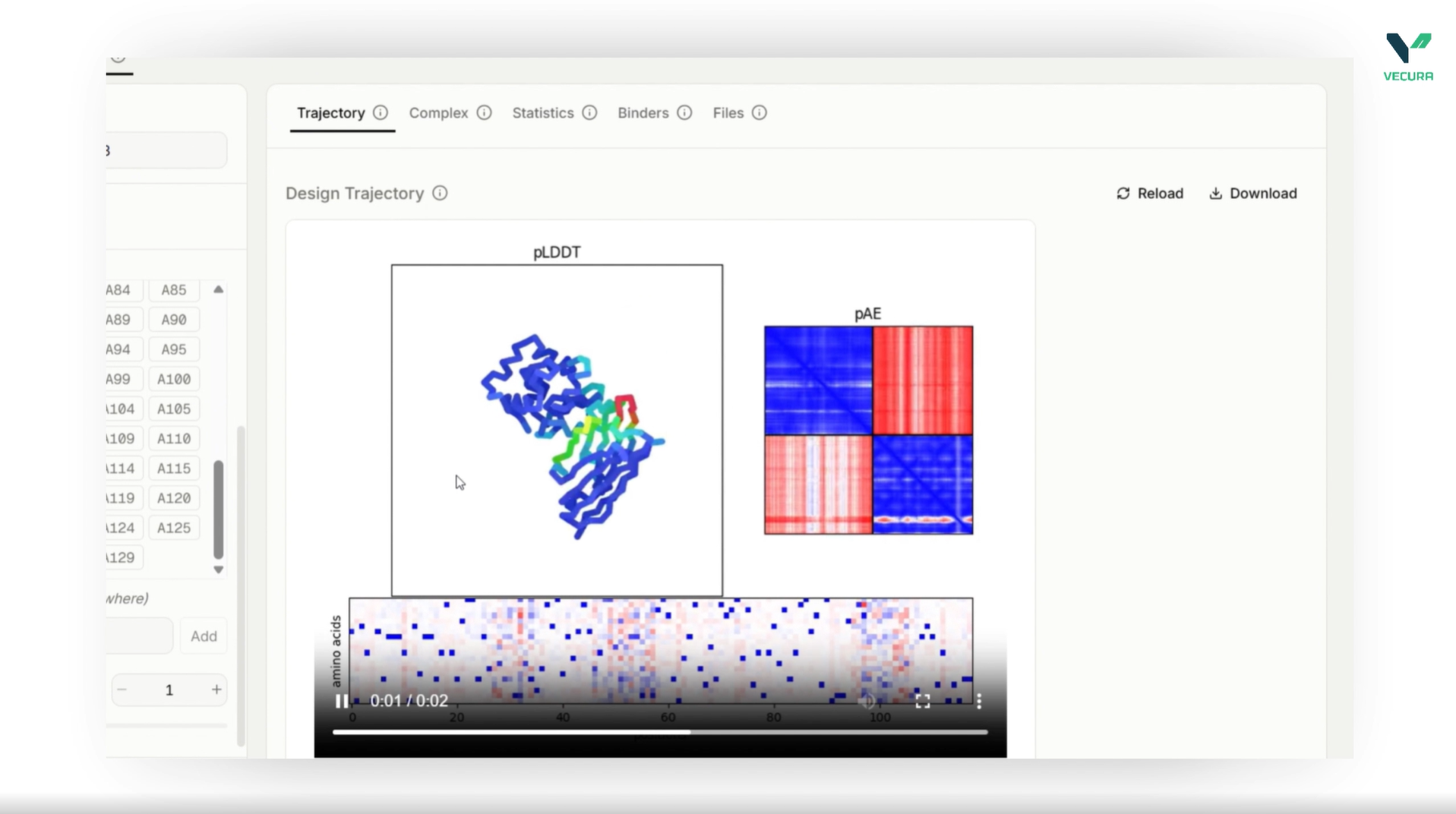
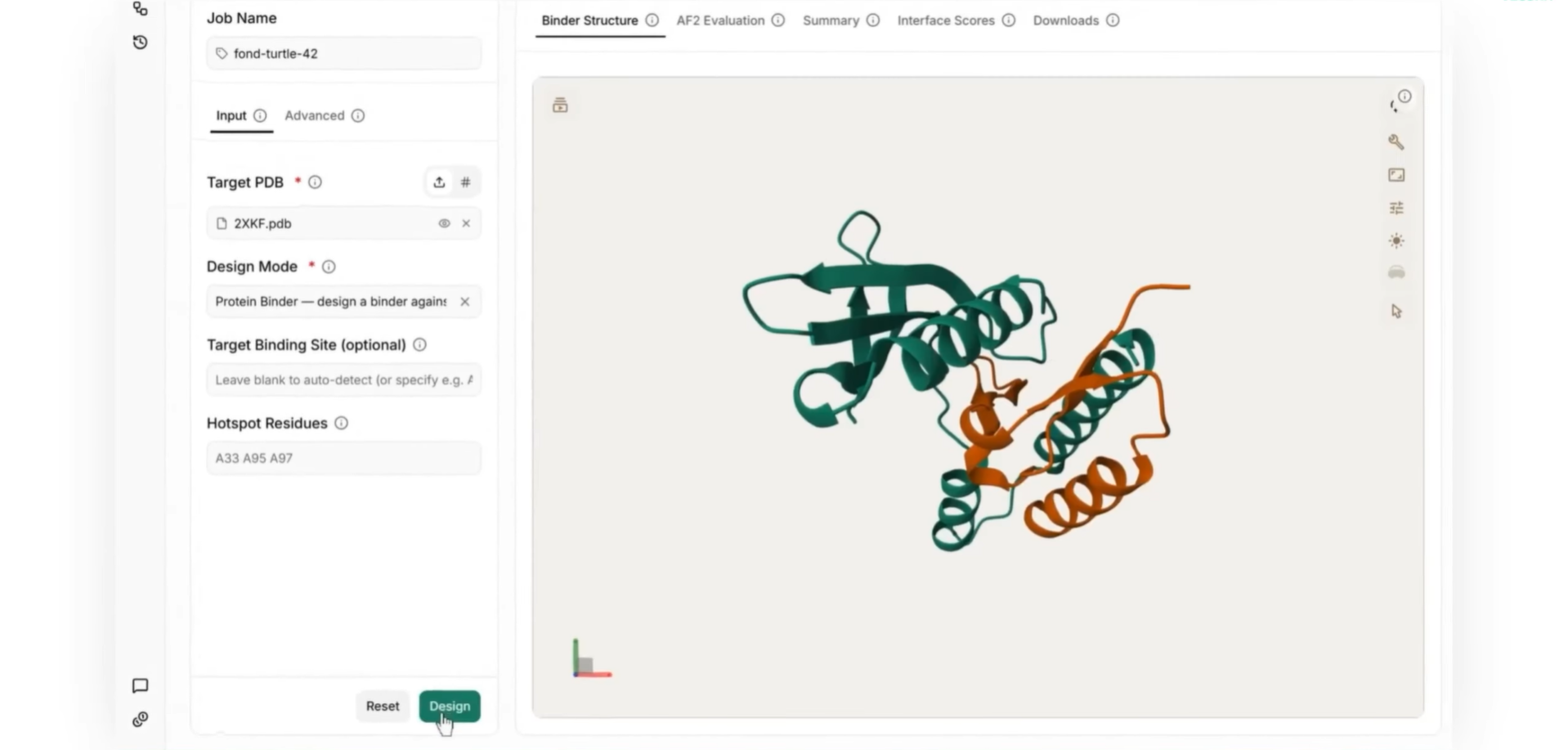
mosaic is Now Available on Vecura: Gradient-Based Multi-Objective Protein Binder Design
This update enables structural biologists and therapeutic developers to design de novo protein binders through a guided workflow inside Vecura, without setting up complex technical infrastructure.
What is mosaic?
mosaic is a JAX-based computational framework for de novo protein binder design developed by Escalante. It unifies differentiable structure prediction, inverse folding, and protein language model scoring into a single, cohesive optimization pipeline. By relaxing discrete amino acid sequences into a continuous probability distribution, mosaic is able to backpropagate gradients directly through advanced structural models to optimize binder sequences. It is especially useful for generating high-affinity candidate binders against therapeutic targets, such as viral proteins, cell-surface receptors, or other disease-relevant macromolecules.
What can users do with mosaic on Vecura?
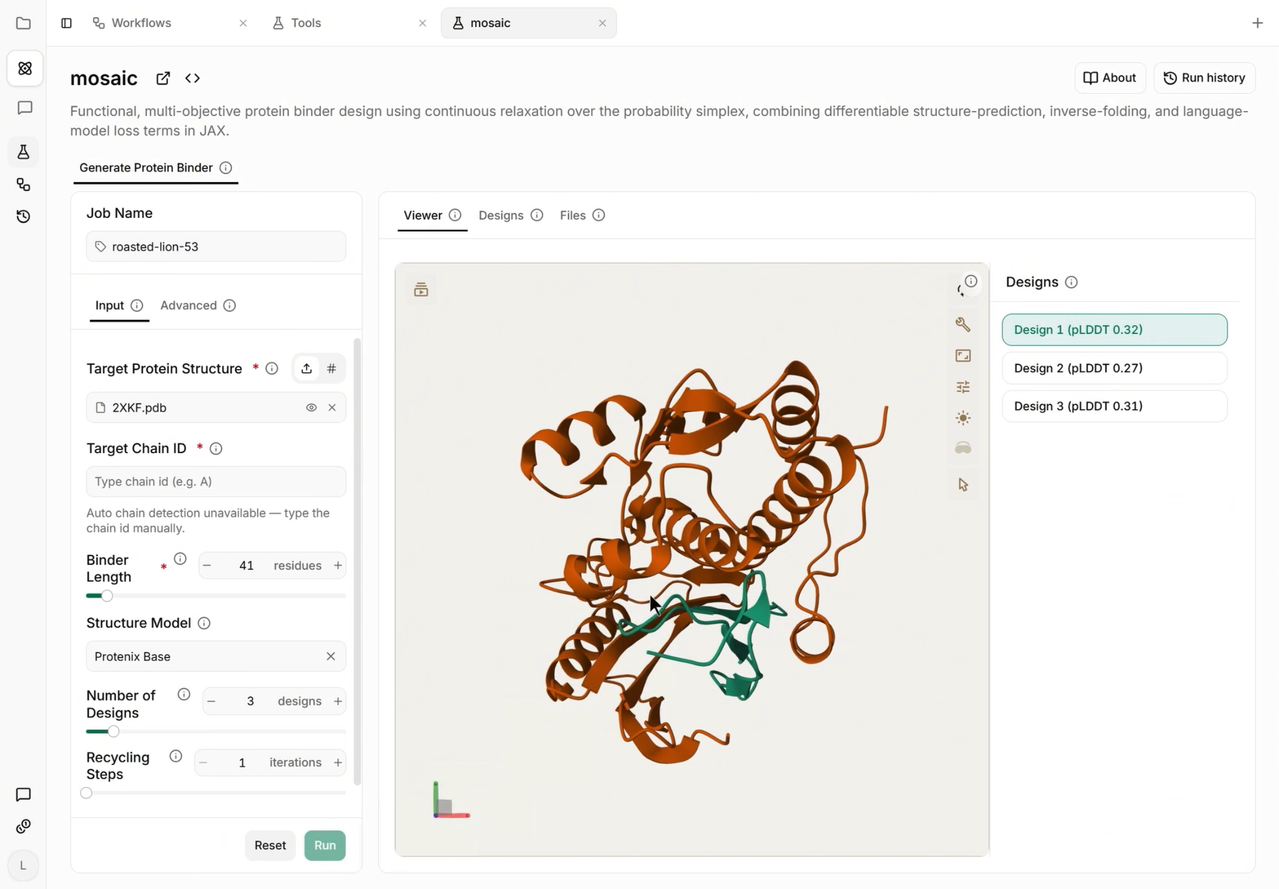
With mosaic on Vecura, users can:
-
Design de novo binders via gradient optimization: Generate targeted protein binders using continuous relaxation over a soft position-specific scoring matrix (PSSM), optimized directly via the
simplex_APGMalgorithm. -
Formulate multi-objective physical losses: Co-optimize for interface contact (
BinderTargetContact), internal binder folding (WithinBinderContact), and structural prediction confidence (PLDDTLoss) in a single run. -
Utilize cutting-edge, fully differentiable backbones: Power design trajectories using integrated structure-prediction backbones like Boltz-1 as fully differentiable JAX loss terms.
-
Generate comprehensive evaluation metrics: Automatically transition from continuous optimization to a discretized, high-fidelity 3D complex structure prediction complete with confidence scores (ipTM, pTM, PAE).
What the output means
The output provides a comprehensive set of computational predictions to guide wet-lab selection:
-
Designed Binder Sequences: The finalized single-letter amino acid sequences ready for experimental synthesis, along with their optimized PSSMs showing the positional residue probabilities.
-
Predicted Complex Structures (PDB): 3D coordinates representing the final binder-target complex, re-predicted using the structure backbone with high-recycling steps for structural and geometric inspection.
-
Binding Scores: Quantitative breakdowns of the trajectory performance including the composite total loss, target contact scores, binder compactness metrics, and average pLDDT confidence.
-
Interface Metrics: Specialized quality scores like
iptm(interface predicted TM-score) andpae_interface(predicted aligned error across the binding interface). Lower PAE and higher ipTM values suggest high-confidence interface stability.
This output should be used to support scientific decision making. It does not replace experimental validation. Candidate designs should undergo standard downstream filtering—such as Rosetta interface evaluation, molecular dynamics (MD) stability runs, or independent AlphaFold2 validation—prior to wet-lab synthesis.
Why this matters
De novo protein binder design is traditionally constrained by the discrete nature of sequence space, often requiring computationally intensive Monte Carlo sampling or vast experimental libraries to identify functional sequences. mosaic redefines this process by continuous relaxation over the probability simplex, converting sequence discovery into a continuous, gradient-guided trajectory. By leveraging fully differentiable JAX implementations of advanced structure prediction and language models, it allows physical and sequence-based constraints to directly guide amino acid selection.
Integrating mosaic into Vecura's cloud environment removes the substantial technical barriers associated with modern computational biology. Researchers can now initiate complex multi-objective optimization runs without needing to configure complex CUDA environments, manage JAX compilation (JIT) overhead, or manage local high-performance GPU resources. This speeds up the iteration cycle, enabling rapid, data-driven formulation of therapeutic candidates.
-
Developed by: Escalante
-
Source: escalante-bio/mosaic (GitHub)
-
Reference: A high-level programming language for generative protein design (Rives et al.) & Plug & Play Directed Evolution of Proteins with Gradient-based Discrete MCMC
在 Vecura 上试用 mosaic
打开模型工作区,用您自己的输入开始评估