Accelerating Protein Structure Prediction: MiniFold Arrives on Vecura
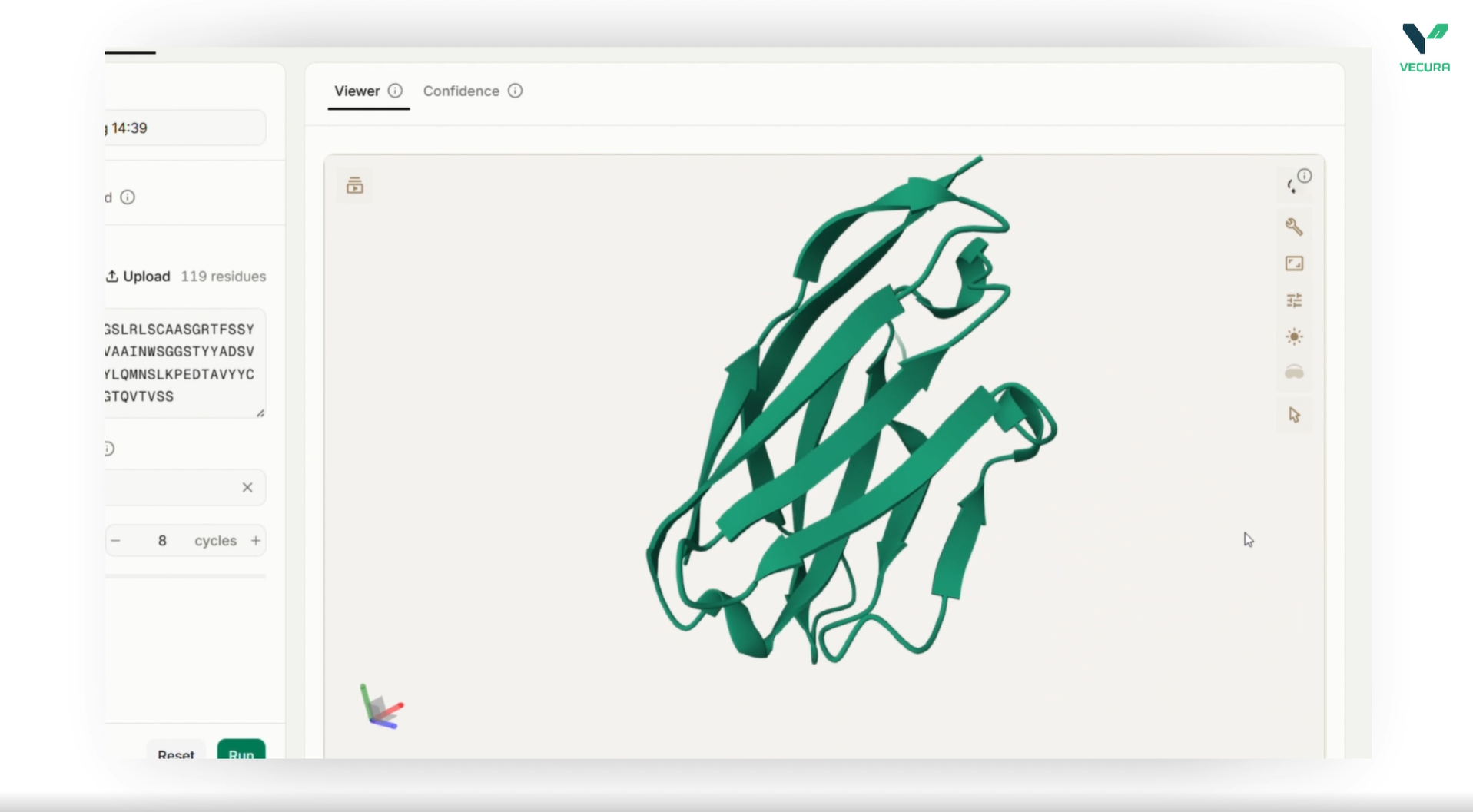
This update enables researchers and protein engineers to perform rapid, MSA-free single-chain protein structure prediction directly within the Vecura workflow, eliminating the need to manage complex GPU infrastructure or deep learning dependencies.

What is MiniFold?
MiniFold is a high-speed, single-chain protein structure prediction model built upon the powerful ESM-2 language model backbone. By utilizing a significantly slimmed-down folding trunk and custom-engineered Triton kernels, it achieves structural predictions with speed and memory efficiency improvements of up to 10-20x compared to ESMFold. It is designed to provide rapid, high-quality structural insights without the need for time-consuming multiple-sequence alignment (MSA) generation.
It helps users perform rapid protein folding predictions for single-chain sequences. It is especially useful for protein design iteration cycles, high-throughput structural screening, and resource-constrained environments where efficiency is paramount.
What can users do with MiniFold on Vecura?
With MiniFold on Vecura, users can:
-
Generate high-fidelity PDB structures from a single-chain amino acid sequence.
-
Choose between the 48L checkpoint for maximum accuracy or the 12L checkpoint for faster inference.
-
Optimize performance using custom Triton kernels and
torch.compilesettings tailored to their GPU infrastructure. -
Assess prediction reliability using per-residue and mean pLDDT confidence scores.
What the output means
The output provides a PDB file containing the predicted 3D atomic coordinates of the protein structure, with per-residue pLDDT confidence scores mapped to the B-factor column for easy visualization. It also includes the mean pLDDT score and a per-residue confidence vector.
This output should be used to support scientific decision making. It does not replace experimental validation.
Why this matters
The ability to predict protein structures from a single sequence, bypassing the computationally expensive and time-consuming process of MSA retrieval, is a game-changer for biotechnology and synthetic biology. By dramatically lowering the compute barrier for structure prediction, MiniFold enables researchers to perform iterative design and screening at a scale previously limited by hardware bottlenecks.
MiniFold democratizes access to predictive structural biology, allowing labs without massive compute clusters to generate reliable models of monomers quickly, accelerating the discovery pipeline from target identification to molecular design.
-
Developed by: Wohlwend et al. (MIT)
-
Source: MiniFold GitHub Repository
-
Reference: Wohlwend et al., TMLR 2025
在 Vecura 上试用 MiniFold
打开模型工作区,用您自己的输入开始评估