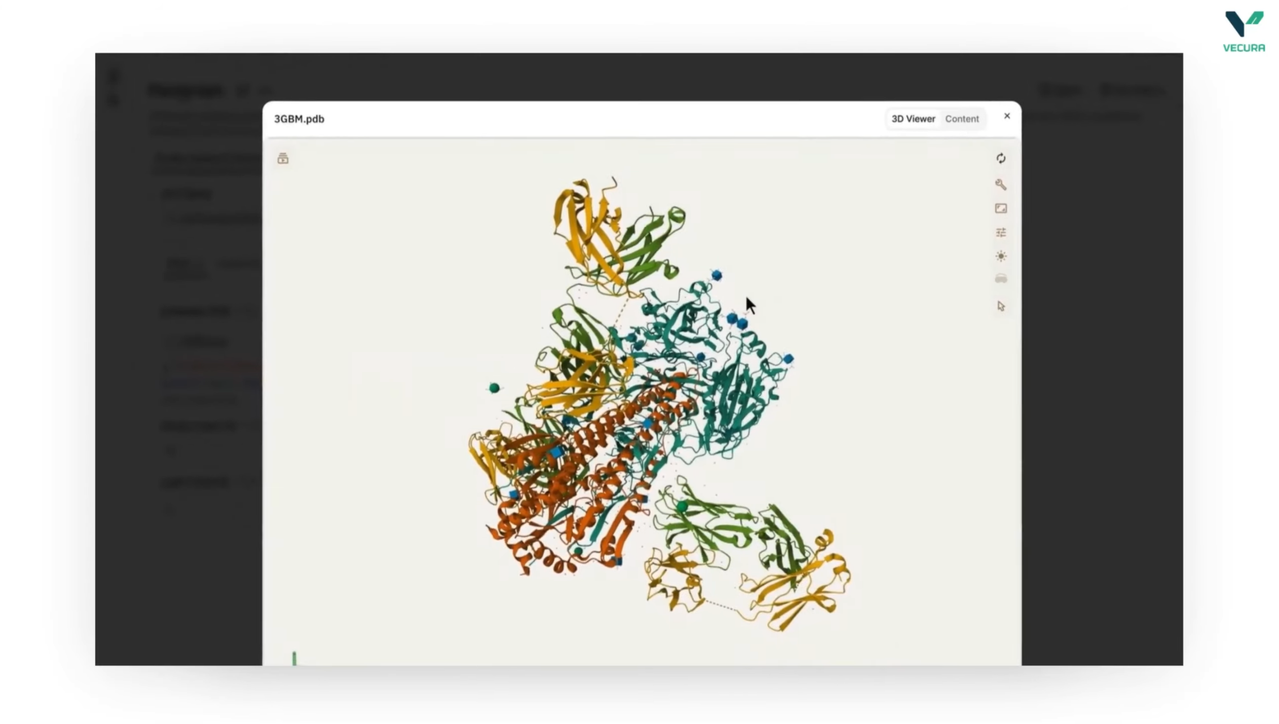
Predicting Antibody CDR3 Flexibility with ITsFlexible, Now on Vecura
This update enables antibody engineers and structural biologists to easily predict the conformational flexibility of CDR3 loops directly through a guided workflow on Vecura, eliminating the need for complex local infrastructure setup.
What is ITsFlexible?
ITsFlexible is an equivariant graph neural network (EGNN) binary classifier designed to predict the conformational flexibility of antibody and TCR CDR3 loops (and bounded CDR3-like loop motifs) from a single 3D structural model. By analyzing the structural context of the loop, the model determines whether it is likely to be rigid or adopt multiple conformations. It is especially useful for antibody engineers and researchers assessing binding affinity and cross-reactivity, where loop flexibility is a critical determinant of function.
What can users do with ITsFlexible on Vecura?
With ITsFlexible on Vecura, users can:
-
Predict whether a specific CDR3 loop in a PDB structure is flexible or rigid.
-
Utilize two specialized predictor variants: 'loop' (focusing on loop residues) and 'anchors' (focusing on surrounding Fv framework residues).
-
Obtain a continuous flexibility score ranging from 0 to 1, alongside a calibrated confidence-band label.
-
Seamlessly integrate structural flexibility assessment into antibody design workflows without managing complex local software environments.
What the output means
The output provides a flexibility score and a categorical confidence-band label. A higher score indicates a greater likelihood of conformational flexibility. Users should utilize the discrete confidence labels—ranging from high_confidence_rigid to high_confidence_flexible—for reliable interpretation, keeping in mind that scores from the 'loop' and 'anchors' variants are not directly comparable.
This output should be used to support scientific decision making. It does not replace experimental validation.
Why this matters
The flexibility of CDR3 loops is a fundamental property influencing antibody-antigen binding affinity and specificity. Crystal structures provide a static snapshot, which may fail to capture the full conformational ensemble present in solution. Assessing this flexibility accurately is a long-standing challenge in drug discovery and immunology.
By providing a scalable, equivariant deep learning approach, ITsFlexible enables researchers to account for conformational dynamics using readily available structural data, helping to prioritize candidates with favorable binding characteristics early in the development process.
-
Developed by: Oxford Protein Informatics Group (OXHPI)
-
Source: Official GitHub Repo
-
Reference: bioRxiv 2025 (10.1101/2025.03.19.644119)
在 Vecura 上试用 ITsFlexible
打开模型工作区,用您自己的输入开始评估