Accelerate Your Drug Discovery Pipeline with DynamicBind on Vecura
This update enables drug discovery researchers and structural biologists to perform advanced, induced-fit protein-ligand docking through a streamlined, guided workflow on Vecura, eliminating the need for complex local infrastructure.
What is DynamicBind?
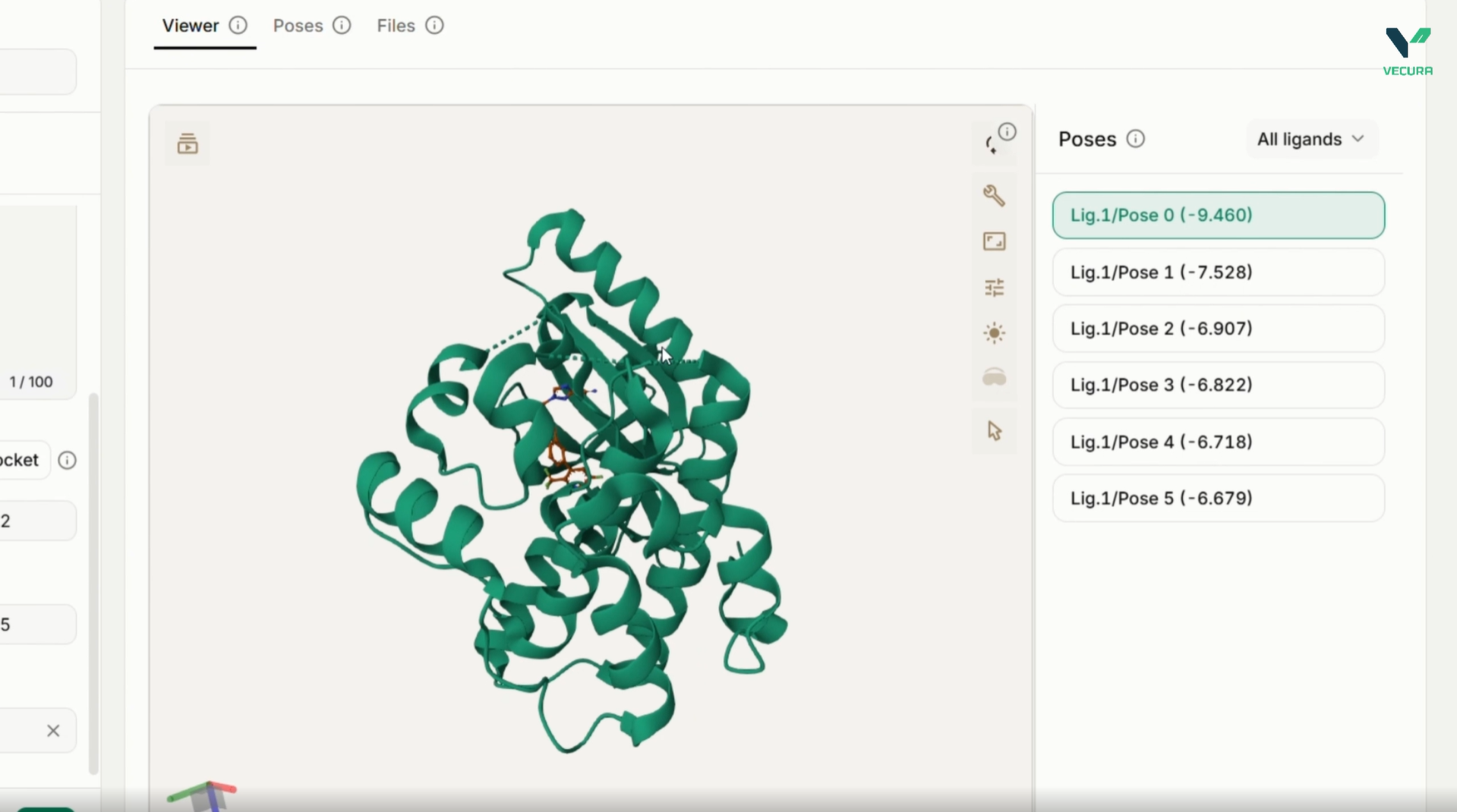
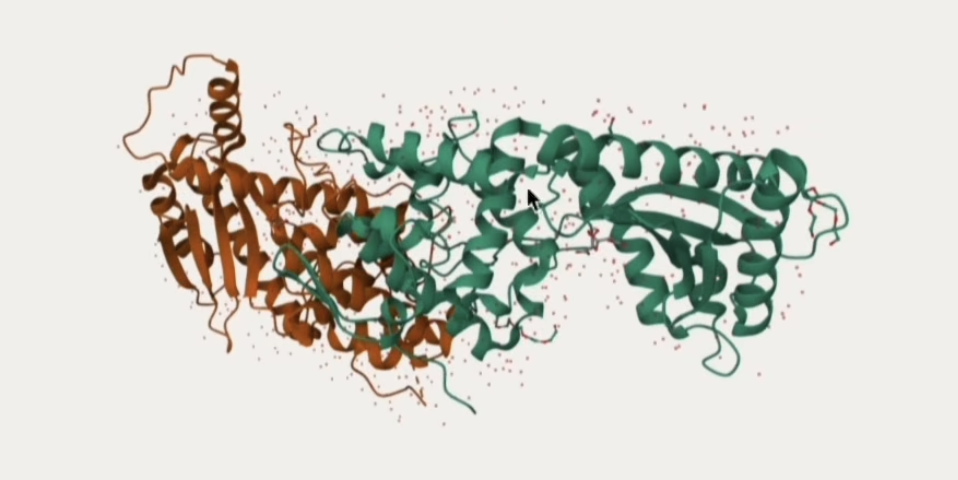
DynamicBind is a deep equivariant generative diffusion model designed to predict ligand-specific protein-ligand complex structures. Unlike traditional docking methods that often treat proteins as rigid entities, DynamicBind simulates induced-fit docking by transitioning unbound (apo or AlphaFold2-predicted) protein structures toward their ligand-bound (holo) conformations. This enables the model to simultaneously optimize both the protein's backbone/side-chain flexibility and the ligand's pose, while also predicting binding affinity for each generated pose.
What can users do with DynamicBind on Vecura?
With DynamicBind on Vecura, users can:
-
Generate high-accuracy, ligand-bound protein-ligand complex structures starting from apo or AlphaFold2-predicted protein models.
-
Perform efficient docking and binding affinity estimation without managing complex, local computational infrastructure.
-
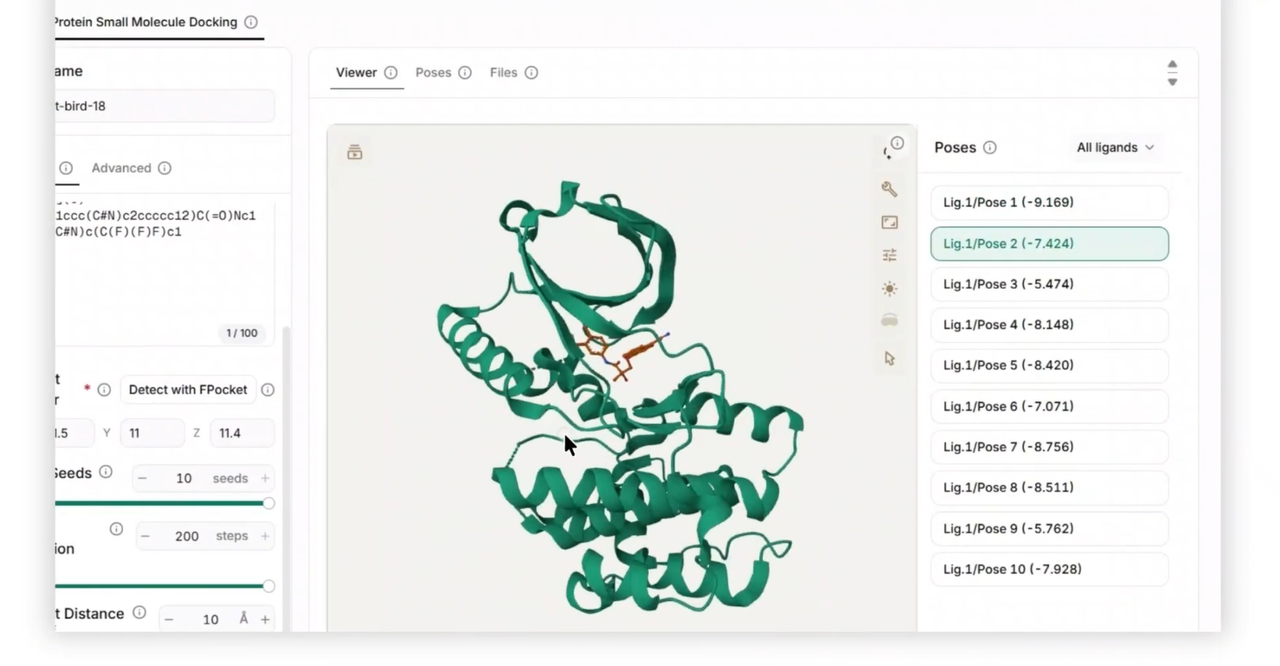
Execute High-Throughput Screening (HTS) mode to quickly rank large compound libraries based on predicted binding affinities.
-
Utilize configurable parameters, such as inference steps and structural relaxation, to balance between computational speed and the precision of the generated molecular models.
What the output means
The output includes ranked predicted protein-ligand complexes (poses), individual receptor PDB and ligand SDF files for structural analysis, and per-ligand binding affinity predictions.
These outputs provide a powerful basis for early-stage drug discovery and virtual screening workflows. It is important to note that the predicted affinity values are model-relative and intended for ranking; therefore, these results should be used to support and prioritize scientific decision-making, not as a replacement for downstream experimental validation.
Why this matters
The core challenge in structure-based drug discovery is the inherent flexibility of proteins. Traditional docking methods often fail when the apo (unbound) structure differs significantly from the holo (bound) state, leading to inaccurate poses and poor affinity rankings. DynamicBind addresses this "induced-fit" problem directly through its joint SE(3)-equivariant diffusion process.
By allowing the model to dynamically adjust the protein's conformation to accommodate the ligand, DynamicBind significantly improves the realism of the predicted docking interactions. This leap in predictive accuracy, validated on the PDBbind benchmark, provides researchers with a more robust tool for identifying potential drug candidates in silico.
-
Developed by: Wei Lu et al.
-
Source: Official GitHub Repository
-
Reference: Nature Communications (2024)
在 Vecura 上试用 DynamicBind
打开模型工作区,用您自己的输入开始评估