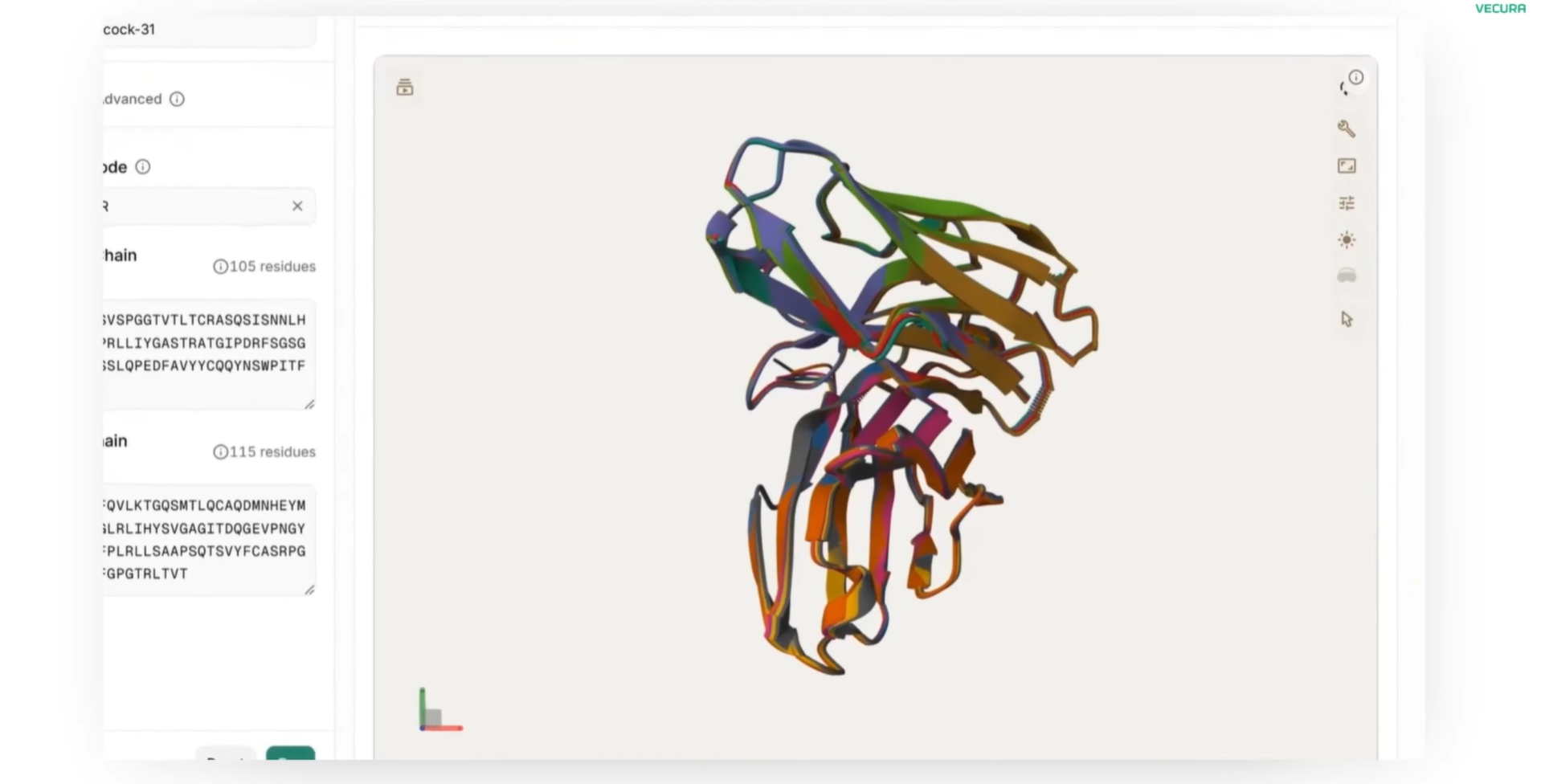
ANARCII Is Now Available on Vecura: Alignment-Free Antigen Receptor Numbering Powered by Language Models
This update enables antibody engineers, immunologists, and structural biologists to number and renumber antigen receptor variable-domain sequences and structures through a guided workflow inside Vecura, without setting up complex technical infrastructure or GPU environments.
What is ANARCII?
ANARCII (Antibody Numbering and Receptor ClassIfIcation II) is a sequence-to-sequence transformer language model developed by the Oxford Protein Informatics Group (OPIG) that assigns standardized residue numbering to antigen receptor variable domains without requiring any alignment step. Unlike traditional alignment-based tools such as ANARCI, ANARCII uses a fine-tuned protein language model to directly predict per-residue position labels, delivering substantially higher accuracy and throughput. It supports numbering of antibody, T cell receptor (TCR), VHH/VNAR (shark-derived), and single-chain variable fragment (scFv) sequences across five major numbering schemes: IMGT, Kabat, Chothia, Martin, and AHo.
It helps users assign consistent, scheme-compliant position labels to variable-domain residues, predict chain types, and renumber existing PDB/PDBx structure files in-situ. It is especially useful for large-scale antibody engineering pipelines, cross-study sequence comparison, CDR loop identification, and structural analysis workflows where consistent residue numbering is critical.
What can users do with ANARCII on Vecura?
With ANARCII on Vecura, users can:
- Number antigen receptor sequences — Submit FASTA files containing antibody, TCR, VHH/VNAR, or scFv variable-domain sequences and receive per-residue numbering in IMGT, Kabat, Chothia, Martin, or AHo schemes, along with predicted chain type and a model confidence score.
- Renumber PDB/mmCIF structures — Upload crystal or cryo-EM structure files and automatically detect and renumber variable-domain chains in the chosen scheme, with the output returned in the same PDB or mmCIF format ready for visualization or deposition.
- Auto-classify unknown receptor types — Use the built-in Classifii classifier by setting the sequence type to "unknown," allowing ANARCII to automatically distinguish antibody chains from TCR chains and route them appropriately.
- Process scFv constructs — Enable the scFv mode to automatically split single-chain variable fragment sequences into their constituent VH and VL domains before numbering each domain independently.
What the output means
The output provides per-sequence numbering results that include a list of position-label and amino-acid pairs (with insertion codes handled natively), the predicted chain type (e.g., H for heavy, K for kappa, L for lambda, A/B/D/G for TCR chains), a model confidence score indicating numbering quality, query start and end offsets to map numbered positions back to the original input sequence, and an error field when numbering fails (e.g., when a sequence scores below the per-type confidence threshold). For structure renumbering, the output is a complete renumbered PDB or mmCIF file with variable-domain chains relabeled in the chosen scheme while the rest of the structure remains unchanged.
This output should be used to support scientific decision making. It does not replace experimental validation.
Why this matters
Antigen receptor numbering is a foundational step in antibody and TCR research. It enables researchers to rapidly delineate antigen-binding regions, identify complementarity-determining regions (CDRs), and compare the vast diversity of antigen receptors within a consistent frame of reference. Traditional numbering tools rely on sequence alignment to reference sets, which can produce inconsistent results depending on the reference set used and may fail entirely for sequences from new species, rare germlines, or unconventional receptor types such as shark-derived VHH/VNAR domains. These limitations create bottlenecks in antibody engineering, therapeutic development, and immunological research.
ANARCII addresses this problem by eliminating the alignment step entirely. By leveraging a sequence-to-sequence language model architecture, it learns the implicit positional grammar of antigen receptor sequences directly from curated training data. This approach not only improves accuracy and generalizability across diverse receptor types and species but also enables GPU-accelerated inference at scale — making it practical to number thousands of sequences or renumber large structural datasets as part of modern drug discovery and biologics development workflows.
- Developed by: Oxford Protein Informatics Group (OPIG), University of Oxford
- Source: GitHub Repository — https://github.com/oxpig/ANARCII
- Reference: Dunbar et al., "ANARCII: A Generalised Language Model for Antigen Receptor Numbering," bioRxiv preprint (2025) — https://www.biorxiv.org/content/10.1101/2025.04.16.648720v1 | Published in Nature Communications Biology — https://www.nature.com/articles/s42003-026-10186-z
在 Vecura 上试用 ANARCII
打开模型工作区,用您自己的输入开始评估